Around the Elbe-Weser Watershed - Karstwanderweg Circular Route No. 16


- 5:15 h
- 19.07 km
- 327 m
- 327 m
- 261 m
- 423 m
- 162 m
- Start: in Nüxei at the B 243
- Destination: in Nüxei at the B 243
Eichsfeld Threshold, gypsum, dolomite, sinkhole lakes and the varied South Harz landscape

Good to know
Best to visit
- suitableDepends on weather
Directions
This route connects the separately signposted northern and southern branches of the Karstwanderweg. Along the way, you can refresh yourself in Steina or enjoy coffee and cake at the farmhouse café in Bartolfelde (Fri-Sun, 2-5 pm). The route is attractive in both directions. Here it is described starting from Nüxei counterclockwise.
The shallow karst sink at Nussteich, a polje, collects the water from the Fitzmühlen spring and holds it back during flooding up to the road; at the same time, the Steina flows into the sink. The waters disappear and part reemerges at the Salzaspring near Nordhausen. The path then passes the ford through the Steina’s bed, which lies dry eleven months a year.
On the other side of the ford is the memorial to the former Nüxei concentration camp subcamp, from where the Helmetalbahn was built in 1944/45. During the ascent to Römerstein, the spring meadow with various karst springs can be seen below to the right.
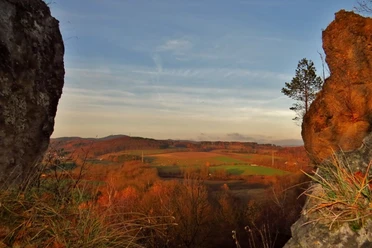
The Römerstein (caution when climbing!) is a 257 million year old "coral" reef made of dolomite rock. Slightly older is the Staufenbüttel located south of Steina, a volcano from the early Permian period, 290 million years old. Remains of a dolomite reef are also found there.
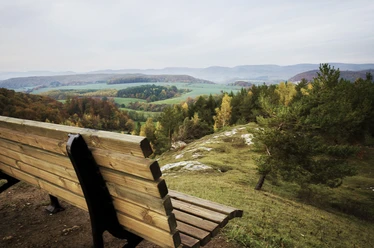
In Steina, a visit to the glass museum showcasing the historical forest glass production in the South Harz is worthwhile. After a possible stop, the path climbs steeply up to the Mühlberg with the watershed and wide panoramas over the South Harz landscape.
Another reef from the Zechstein period is the Eulenstein, located in the forest by the roadside. From here the route descends into the Winkel valley, where at the upper meadow end the valley stream disappears into the karst. A modest copper and iron mining operation used to take place here.
At the valley exit, the elevated bridge of the B243n surprises. The "moss animal reef" is an abandoned quarry near Bartolfelde. As a natural monument, it has been described in countless scientific works. It shows a snapshot of the Zechstein sea breaking from the northwest against a graywacke cliff of the old Harz mountains.
In Bartolfelde, you can stop at the farmhouse café on weekends; our tip: firefighter cake.
Then the route continues on the southern branch of the Karstwanderweg over sinkholes formed in the younger gypsum of the Zechstein by gypsum dissolution, such as the water-filled "Bottomless." Beautiful panoramas of the southern Harz also open up here. The path now crosses the route of the unfinished Helmetalbahn.
It continues over the spoil heap of the dolomite quarry at Wolfskuhle, from whose deposit stones were quarried 800 years ago for the Walkenried monastery. These are fine dolomitic deposits in a formerly tropical lagoon.
The path crosses the blind valley of the Steingraben, which disappears in a karst sink hidden slightly above in the bushes and reemerges at the Salzaspring near Nordhausen. Across meadows and horse pastures, it returns to the starting point in Nüxei.
Directions & Parking facilities
- Parking
At the B 243 near Nüxei
Nearby






Download GPX file