- 3:20 h
- 47.27 km
- 174 m
- 174 m
- 82 m
- 173 m
- 91 m
- Start: Castle Square Osterwieck (optional)
- Destination: Castle Square Osterwieck (optional)
The tour starts from the castle square in Osterwieck, initially following the Ilse river until shortly before Hornburg, where it reaches the ridge of the Kleiner Fallstein. This was once the former inner-German border, evidenced today by the former border tower Rhoden and the open-air border museum Rhoden.
Through the significant half-timbered town of Hornburg, with the eponymous Hornburg castle as its landmark, the route continues via Werlaburgdorf to the former imperial palace Werla, where there is now an open-air museum. Along the Oker valley, the route finally leads through Schladen, Wülperode, and Lüttgenrode back to Osterwieck. Characteristic of the tour are the concrete trail paths, which trace the former patrol roads of the border guards.

Pavements
- Trail (55%)Gravel (17%)Street (15%)Path (1%)Asphalt (12%)
Best to visit
- suitableDepends on weather
Directions
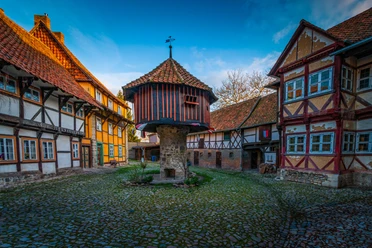
- We begin our tour at the castle square of the historic half-timbered town Osterwieck. First, we follow Schulzenstraße to the L87, the Goslarer Straße, which we leave after turning right onto Lakeufer path. There we follow the course of the Ilse, which we cross after about 2.5 kilometers. We cycle the rest of the star tour counterclockwise, initially leaving the village of Stötterlingen to our left. Before the Stumm mill, we turn left onto a country road and head towards the village Bühne, which we pass through once, then following Bahnhofsweg we first cross the Ilse again and then the main road between Hornburg and Hoppenstedt. We use the motor and pedal uphill to the Kleiner Fallstein. We follow the partly forested ridge path westward to Hornburg. This was once the former inner-German border, still evidenced today by the former border tower Rhoden and the open-air border museum Rhoden. We reach the small hop and half-timbered town of Hornburg, which is well worth an extensive visit. The castle of the same name is privately owned but is worthwhile as a high-altitude photo motif. We follow Braunschweiger Straße towards Seinstedt, turning left onto Erlenweg shortly before leaving the town. Via fields and meadows, we follow the course of the Mühlenilse, a tributary of the Ilse, which together with the Ilse flows into the Oker in Börßum. However, we do not continue to Börßum but follow Börßumer Straße towards Heiningen. We cross the Ilse, Oker, and a railway line before following the main road and turning into Werlaburgdorf. This place, once home to the imperial palace Werla, is now enriched by an open-air museum, which we should make a detour to visit. The imperial palace Werla is the largest archaeological park in northern Germany and is freely accessible at any time. After this historical excursion, we follow the course of the Oker river to Schladen, cross it by following Bahnhofsstraße, and take a country road to Isingerode. The village is quickly passed through, and after a few hundred meters, we leave Lower Saxony and reach Göddeckenrode as the first village in Saxony-Anhalt. A paved path along the Ecker ditch leads us southwards to Wülperode, which we cross via Dorfstraße, and after leaving the village, we quickly continue southwards on Alte Heerstraße. We cycle over country roads without significant elevation changes through Lüttgenrode and Stötterlingen back to Osterwieck.