© Fotoweberei & Schloß Wernigerode GmbH

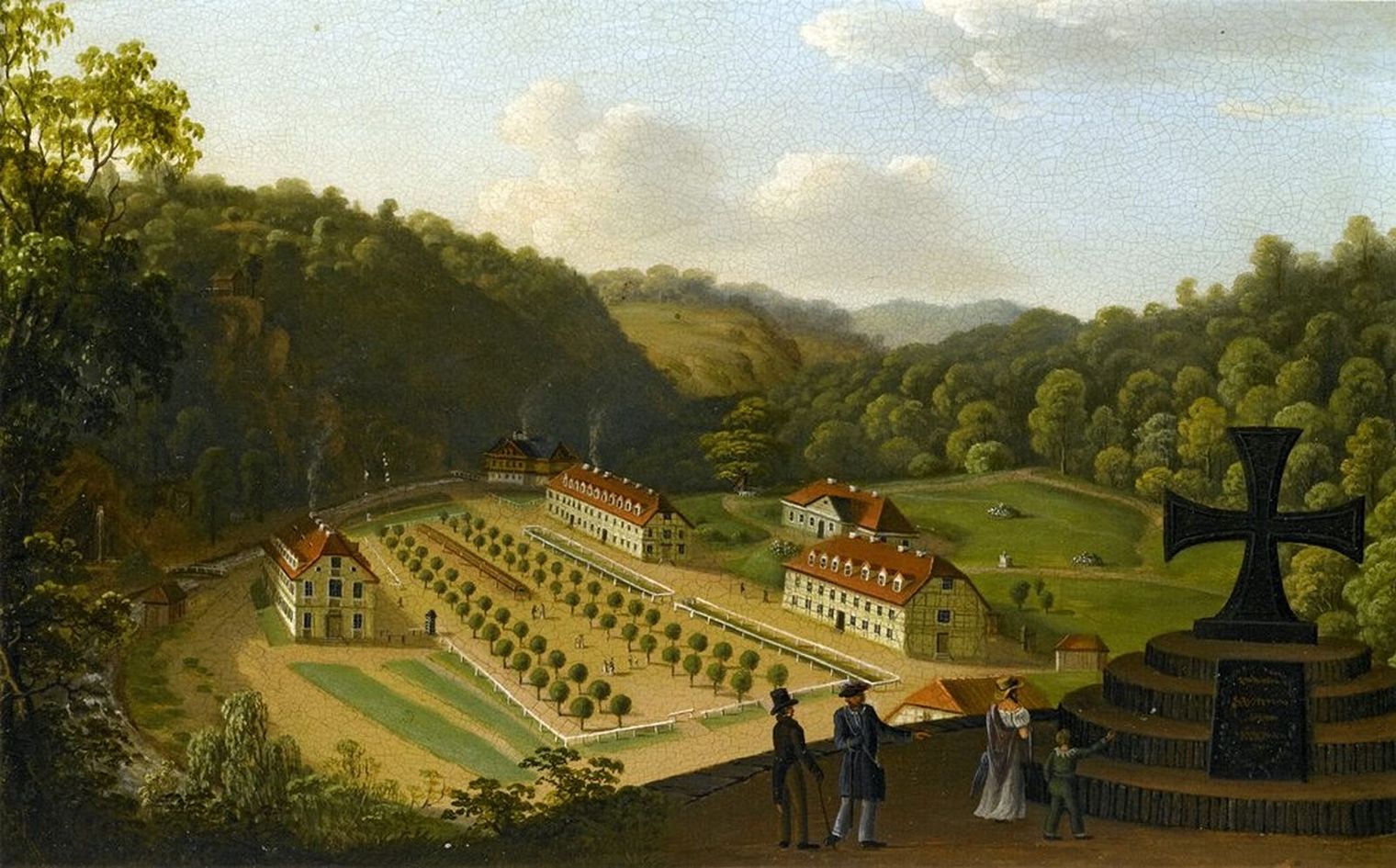
Alexisbad from the Peace Memorial

1830

The motif

This painter’s view looks down from a hill onto the oldest spa resort in the Harz Mountains. Twenty years earlier, in 1811, it had been opened. The area belonged to the small principality of Anhalt-Bernburg, with the secondary residence in Ballenstedt. The idea of establishing a spa came from the search for new sources of income.

This is the most beautiful section of the Selketal Trail, which runs as a cliff path high above the river. Only on a second glance can we recognise the old spa. A six-storey hotel tower from GDR times and a flat building from the 1990s in front of it disturb the proportions; the old spa building had to make way for them. Still preserved are: on the left the bathhouse from 1817, in the centre of the picture the promenade, and on the right the baroque tollhouse, of which only the roof can be seen. The walls of the former logis house are still contained within the picturesque, but unfortunately dilapidated, Reichsbahn hotel. In the best condition is the old Swiss-style cavalier house at the very back of the view; it has been renovated and is now a hotel.

Right next to us stands the Peace Memorial from 1954, created by Paul Einecke (1885–1973) from Harzgerode. At that time, people were still under the fresh impression of the Second World War and hoped, full of reconciliation, for a united Germany without the Iron Curtain and the Cold War. The two lowest steps of the Peace Memorial originated from the former monument with the Iron Cross, as the painting shows. The cross was erected in 1818 and has been missing since 1945.
Alexisbad, Anonym
© www.kollerauktionen.ch
Anonymous

Artist

around  1830

created

Oil on metal

14 x 20 cm

Koller Auctions

...

Hiking tip

The Selketal Trail is a historic walking path from the early days of the spa between Alexisbad and Mägdesprung, leading past many viewpoints. There you’ll find the Schönsicht, the Luisentempel, the Schlotheimplatz with the Birkenhäuschen, the Köthener Hut or the Verlobungsurne (stamp point 77 of the Harz Hiking Needle). From Alexisbad and Mägdesprung you can continue your journey on the Selketal Railway.

More about the Iron Cross of Alexisbad

In the past, the Iron Cross stood on four steps, as the painting shows. It was a symbol of the successful end of the French occupation. The years 1806–1815 had brought great economic and social insecurity and had mobilised unexpected strength for the fight for liberation in everyone. Prince Alexander of Anhalt-Bernburg was therefore fully in tune with the spirit of the times when he crowned the viewpoint of his new spa with the well-known symbol. He used a design by the Prussian master builder Karl Friedrich Schinkel for this purpose. Because his daughter Luise was married to a Prussian prince, he also had a Prussian-loyal plaque affixed, which can be clearly seen in the painting: “To his dear, only son-in-law / Friedrich, Prince of Prussia / dedicated by Alexius, Duke of Anhalt. / MDCCC IXV III.” By the way, many of the spa’s wealthy guests came from Prussia, specifically from Berlin, and must have particularly enjoyed visiting this reminder of their home.

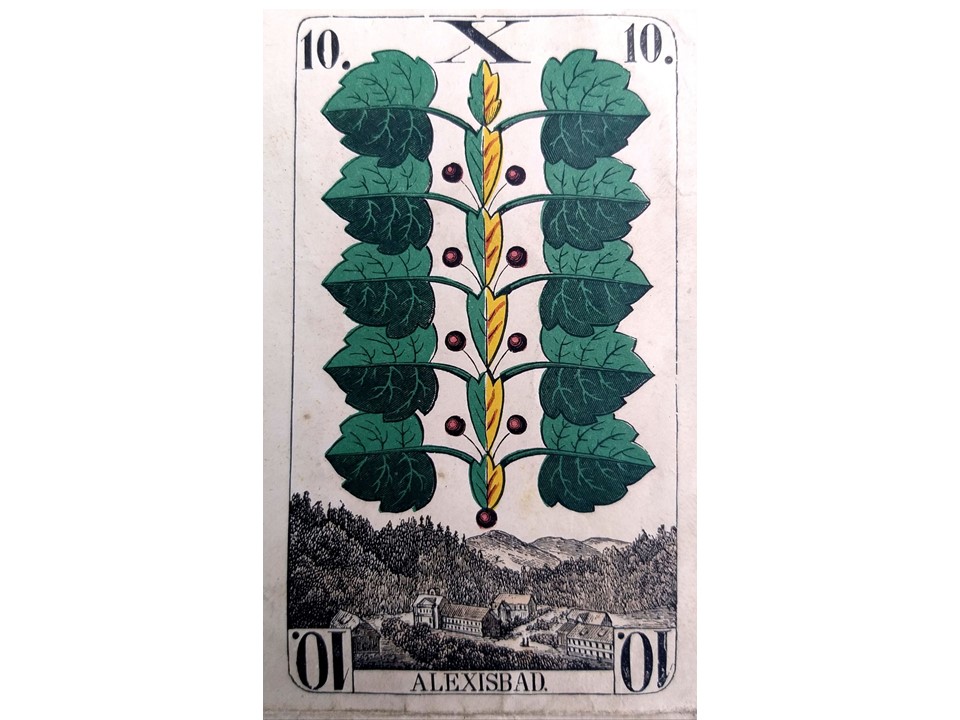
Anonymous, Alexisbad on a playing card, 1884, printed by Lattmann Goslar, Prussian sheet, Goslar Museum, on display in the permanent exhibition

Alexisbad auf einer Skatkarte
©  Goslarer Museum

The location is at the Iron Cross, which, however, no longer had such great importance at that time and was therefore simply left out on such a small view.

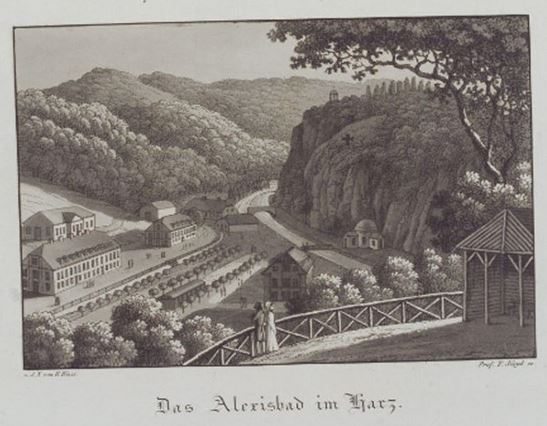
Friedrich Jügel after Johann Heinrich Hintze, View of Alexisbad from Schlotheimplatz with the Birch Hut, 1828, aquatint, sheet size 20.3 x 24.8 cm, Herzog August Library Wolfenbüttel, inv. no. Top. 1:4,1 

Blick auf Alexisbad vom Schlotheimplatz mit der Birkenhütte von Hintze
© Herzog August Bibliothek Wolfenbüttel

In this southern view of Alexisbad, the Iron Cross can be seen, behind it the little house with the Beautiful View. The engraver Friedrich Jügel (1772–1833) worked here from a model created directly in Alexisbad by Johann Heinrich Hintze (1800–1861). So he was actually here, otherwise being from Berlin. Maybe that’s why he emphasised the cross so disproportionately?