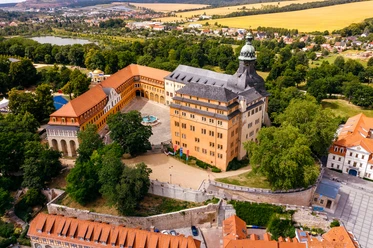

Schloss Heringen has been recognised as a cultural monument of national importance and had extensively renovations in recent years. The walls, which are around 700 years old, are five storeys high (around 34 metres). The fabric of the structure has remained largely intact.
Whilst the town has burnt down five times, the castle has always been largely spared. Countess Clara von Schwarzburg, the daughter of the Duke of Braunschweig-Lüneburg, is the most famous resident of the castle. From 1598 to 1658 it was her widow's residence, after the early death of her husband Wilhelm I Count of Schwarzburg.
However, the history of the castle started long before Countess Clara lived there. From around 1322 to 1327 the Hohenstein counts built a Romanesque castle in Heringen - the "Haus zur Goldenen Aue". At that time, the village of Heringen had probably existed for several hundred years since the early Middle Ages. The castle gave Heringen an economic upswing and granted it the status of a town. At the beginning of the 16th century, extensive renovations turned the castle into a Renaissance style palace.
The castle houses historical finds such as a corner shop, furniture and kitchens from the 1930s and 1950s, a rural outpatient clinic and changing special exhibitions showcasing regional artists.
One highlight is the permanent archaeological exhibition "Das älteste Dorf" (The oldest village), which was reopened in May 2019. Extensive excavations show that the Goldene Aue was already inhabited in the Neolithic era almost 7,500 years ago. This period marks one of the most important cultural and historical changes in human history. The first village in Thuringia was founded right here!
Whilst the town has burnt down five times, the castle has always been largely spared. Countess Clara von Schwarzburg, the daughter of the Duke of Braunschweig-Lüneburg, is the most famous resident of the castle. From 1598 to 1658 it was her widow's residence, after the early death of her husband Wilhelm I Count of Schwarzburg.
However, the history of the castle started long before Countess Clara lived there. From around 1322 to 1327 the Hohenstein counts built a Romanesque castle in Heringen - the "Haus zur Goldenen Aue". At that time, the village of Heringen had probably existed for several hundred years since the early Middle Ages. The castle gave Heringen an economic upswing and granted it the status of a town. At the beginning of the 16th century, extensive renovations turned the castle into a Renaissance style palace.
The castle houses historical finds such as a corner shop, furniture and kitchens from the 1930s and 1950s, a rural outpatient clinic and changing special exhibitions showcasing regional artists.
One highlight is the permanent archaeological exhibition "Das älteste Dorf" (The oldest village), which was reopened in May 2019. Extensive excavations show that the Goldene Aue was already inhabited in the Neolithic era almost 7,500 years ago. This period marks one of the most important cultural and historical changes in human history. The first village in Thuringia was founded right here!
Openings
- Thu + Fri 13.00 am - 6.00 pm
Sat + Sun 13.00 am - 6.00 pm
Mon - Wed closed Price info
- 6,00 €
Accessibility
- Travel for Everyoneavailable - up to the 3rd floor
Directions & Parking facilities
- parking available