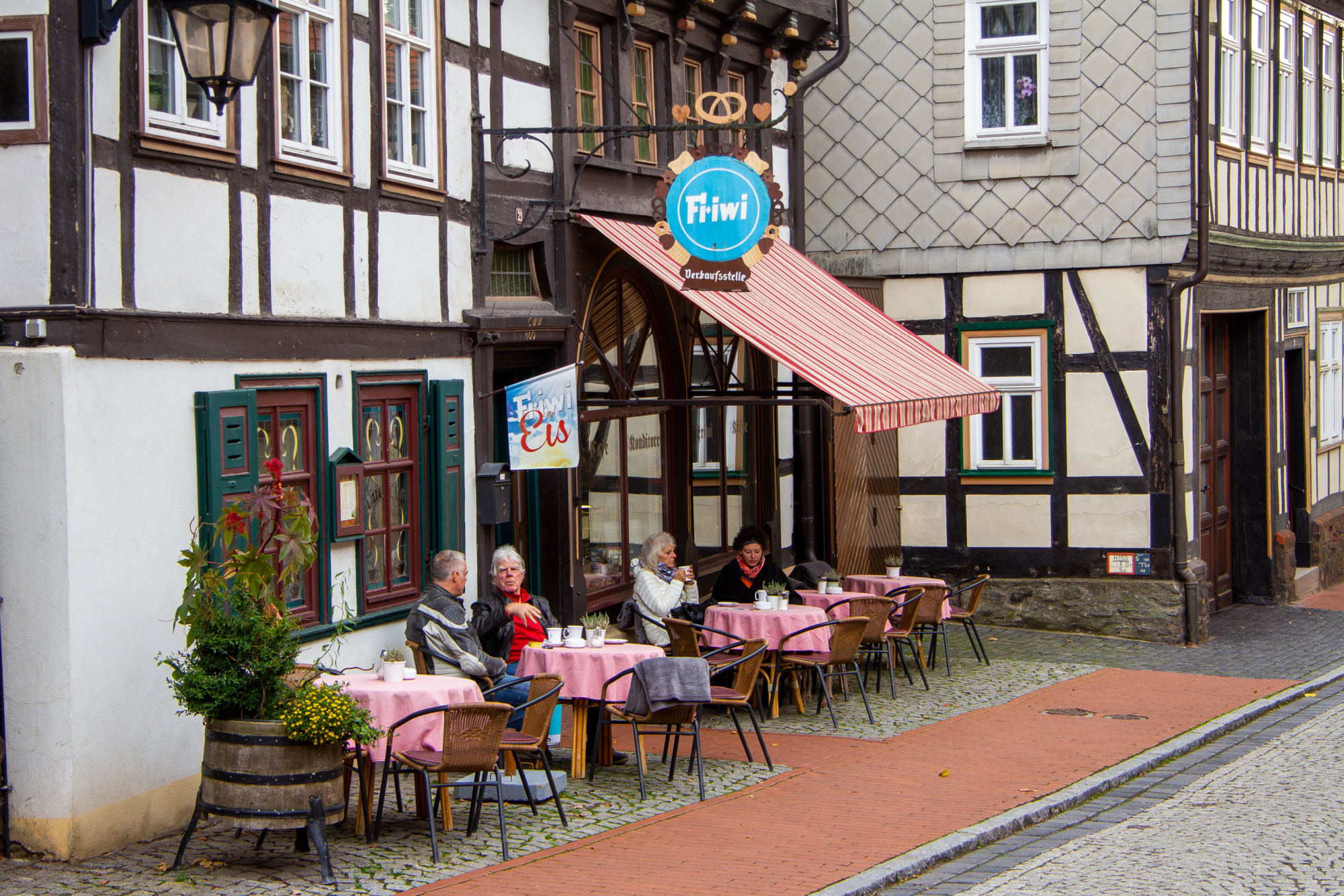
She knows the shortcuts – no doubt about it! Because Nadja Witte calls Stolberg her home; she grew up here, surrounded by forests and hills, a stately castle and historic half-timbered houses. Now in its fourth generation, she runs the Friwi factory and provides people in the region with sweet delights: biscuits, gingerbread, cakes, pralines, rusks. We follow the entrepreneur’s quick steps over the cobblestones. Along the colourful houses – no two are alike – we reach the café from the factory in just a few minutes. "I almost always walk this way at the back. It’s faster and quieter," she tells us, while in her mind she’s already preparing for her next appointment: discussing a wedding cake.
The name Friwi comes from Friedrich Wilhelm Witte, Nadja Witte’s great-grandfather. When he opened his confectionery in the winding half-timbered house at Niedergasse 21, right next to the Princely Consistory, it was already the thirteenth in Stolberg. “And that in such a small place!” exclaims Nadja Witte. It therefore took quite a bit of creativity, determination and courage to build a factory here just a few years later. That’s exactly what Friedrich Wilhelm Witte and his youngest son Georg did. Between 1924 and 1926, at Niedergasse 51, just a few minutes’ walk from the original location, a factory building with a large oven system and modern machines was built. Business was booming. In the following years, the Wittes employed about 180 people from the surrounding area.
“The speciality from the Friwi family business was a special kind of steamed rusk,” we learn from the energetic entrepreneur, and that it won several awards. By now, we are sitting in the modern café inside the factory, exactly in the room where the pre-dough for the Printen used to mature for three to four months in large vats. The “Old Printen Store” no longer exists as it once did, but the sought-after Stolberg Christmas pastry is still made with this long maturing process. The rusk is also still baked according to the old recipe. Together with Stolberger Lerchen, a special sausage from the local butcher, the Sultan rusk is sold in the so-called Stolberger Fresssack, a typical Harz speciality. Since the 1990s, Nadja Witte has been committed to promoting the regional brand. Of around 60 types of pastries, 16 currently carry the desired seal of quality.
Time for a tour. A pleasant scent of chocolate and roasted almonds rises to our noses. We're amazed at how much manual work goes into the products. Four employees are currently preparing the Typisch-Harz award-winning Witch Shards. The first one gently pours melted chocolate from a heavy stainless steel container over the roasted almonds. The next mixes the ingredients carefully and spreads the mixture into a mould full of small holes, which the third one removes with a steady hand and positions anew on the conveyor belt for the next batch. Meanwhile, the pieces of chocolate travel through the cooling section, where a colleague waits for them at the other end. Skillfully, she scoops up the finished treats and lets them slide into a clear plastic bag. She clearly has a good sense of the weight. Still, they are weighed for control. Perfect fit.
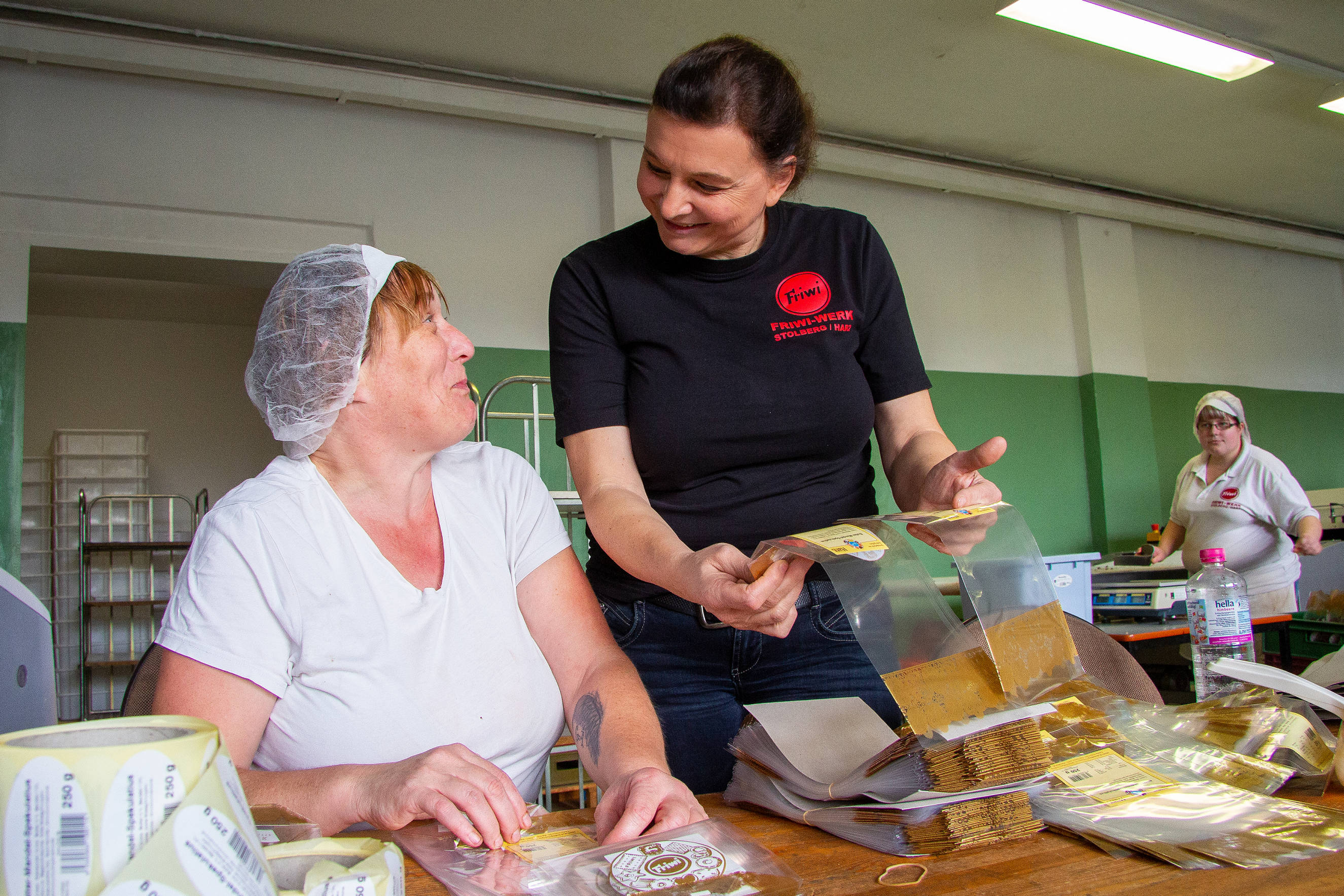
“We produce up to seven types of pastries a day,” explains Nadja Witte in a loud voice to make herself heard over the noise of the machines in the large production hall. She knows the processes inside out, as well as her 30 employees. In a friendly manner, she gives a quick hug to her colleague who patiently sticks labels on bags of cookies. There will be hundreds by the end of the day. The boss shows once more what matters to her: the label must be straight, always with the same spacing. “For uniformity,” she explains to us, adding with a forgiving smile towards her colleague, “It’s her second day at work.” Then she asks the in-house mechanic about the oven. The 50-metre-long unit from the seventies forms the heart of the factory. Without it, the belts would stand still and there would be no cookies. The oven isn’t the only older machine in this listed building. The new, fully enclosed cooling line adjoins seamlessly the impressive glazing machine from the thirties, which, thanks to its glass walls, still gives a fascinating insight into its inner workings. “The new machines aren’t always a blessing,” remarks Nadja Witte, frowning. “While the old equipment runs very reliably and can usually be repaired in-house, the new ones bring problems that take a lot of effort to fix.” Luckily, the tough businesswoman can rely on her partner, who manages the cookie production.
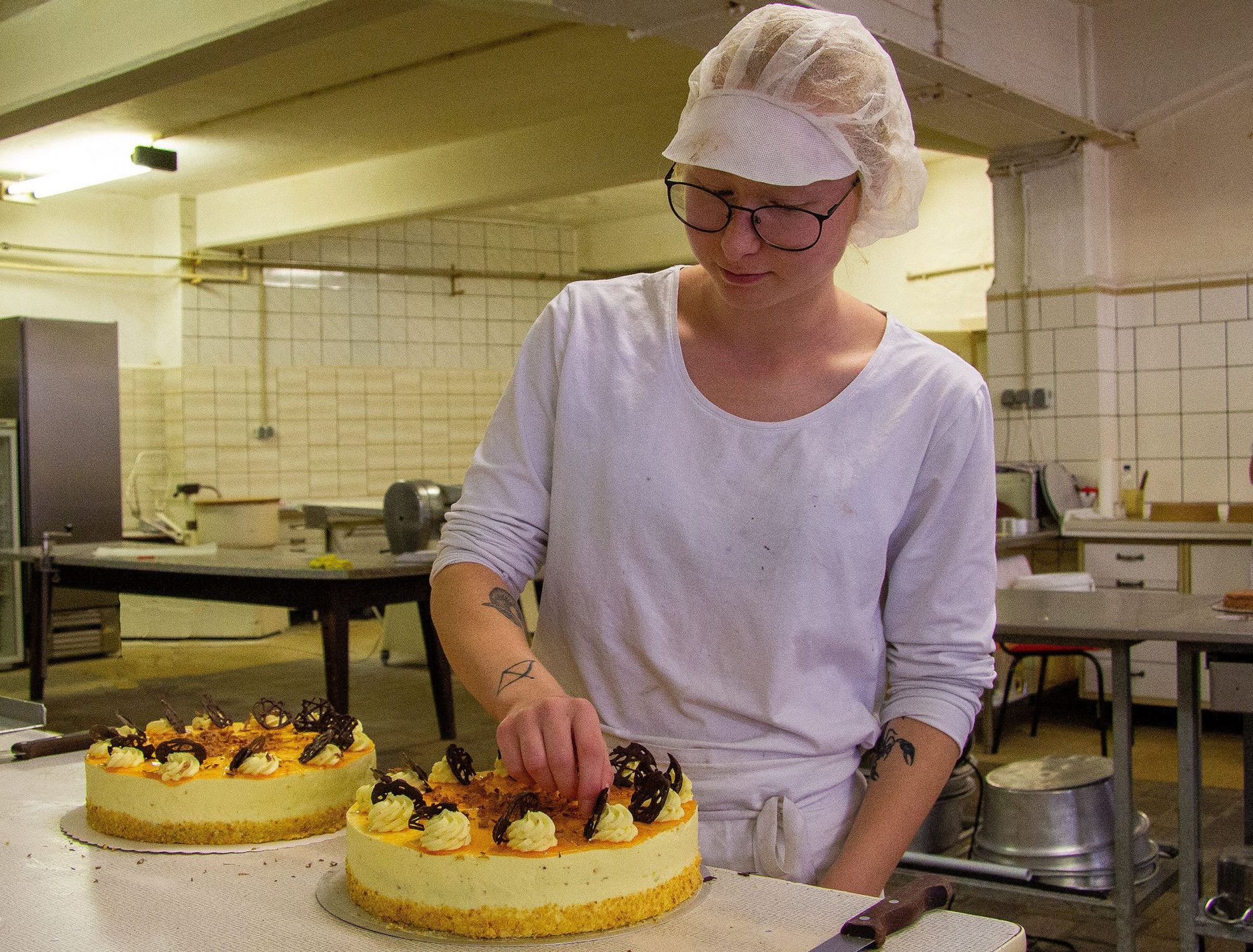
Many of Nadja Witte’s employees were trained by her personally. She wants to give young people in the region a perspective. To nurture their enjoyment in making cookies and cakes, they are given plenty of creative freedom already in their first year, alongside essential routine tasks. Variety is especially important, Nadja Witte knows. She works very closely with the children’s home in Stolberg, and even students can get to know the company during an internship. “Once, a mother organised an internship here for her daughter to show her how tough manual labour is, to encourage her to get a higher school diploma instead. The plan didn’t work. She liked it too much here.” But not all trainees stay at Friwi forever. Some want to leave Stolberg to explore the world.
In contrast to Nadja Witte. She is too deeply connected with her hometown and her business. It’s unmistakable how much the family history means to her. Proudly, she guides her visitors through a lovingly designed museum room inside the factory. Old supplier books and photos tell of days gone by. In a glass display case there’s a collection of historical recipes, still used today to make many Friwi products – from rusk to printen biscuits. On the walls hang large portraits of Nadja Witte’s ancestors. She points to her grandmother Ella. “When her husband Georg Witte suddenly died in 1938, she took over the management of the factory. A single mother with three children.” She did a great job and managed to spark her youngest son Ludwig’s passion for confectionery.
In 1959, he completed his master craftsman’s exam as a confectioner and from then on managed production in the family business. Then, in 1972, came a blow to the family: expropriation. Friwi became the state-owned company “Feingebäck Stolberg”. “For the people here, it was always Friwi!”, recalls Nadja Witte. Her father continued working as production manager until 1979. Then he threw in the towel. Production had changed, and the repression had grown. Even the grandparents, who still lived in a flat on the premises, were denied direct access to their garden behind the factory. A note of sadness resonates when Nadja Witte talks about that time today, which she experienced as a child. Her father built a new livelihood as a self-employed haulage contractor, offered horse riding for children until the fall of the Wall, and took tourists on carriage rides through the town.
When the people of Stolberg gathered in the market square on Christmas Eve 1989 for the traditional carol singing, there was a very special atmosphere. Alongside the usual sense of contemplation and familiarity came voices of awakening and change. “‘Take back your factory!’, people were whispering to us back then.” When Nadja Witte talks about it today, she’s still moved by the support her family received during the time of transition. It’s visibly difficult for her to talk about this part of Friwi’s history. Many emotions and personal experiences are tied to it. The Wittes were the first family in Saxony-Anhalt to apply for restitution – and the last to have it approved by the Treuhand agency. The battle for the factory and its machinery would drag on for three long, nerve-racking years until 1993, when at last, a Friwi biscuit was once again allowed to roll off the production line in Stolberg.
At the same time, master confectioner Ludwig Witte and his daughter rolled up their sleeves. They opened a confectionery in the place where it had all begun once before, and in 1992 a small café. Without hesitation, biochemist Nadja Witte gave up her doctoral position in animal breeding in Nordhausen, took business administration courses and seminars on personnel management, and learned everything important about biscuit and cake production from her father. He continued to work actively until the ripe old age of 75. Her mother still helps out in the factory’s shop, where the entire range is available to everyone. And perhaps, Nadja Witte secretly hopes, one day her son Robert will take over the business.
by Maximilian Schmidt (2020)
-
Friwi-Werk Witte OHG
Niedergasse 51
06536 Südharz OT Stolberg -
+49 34654 502