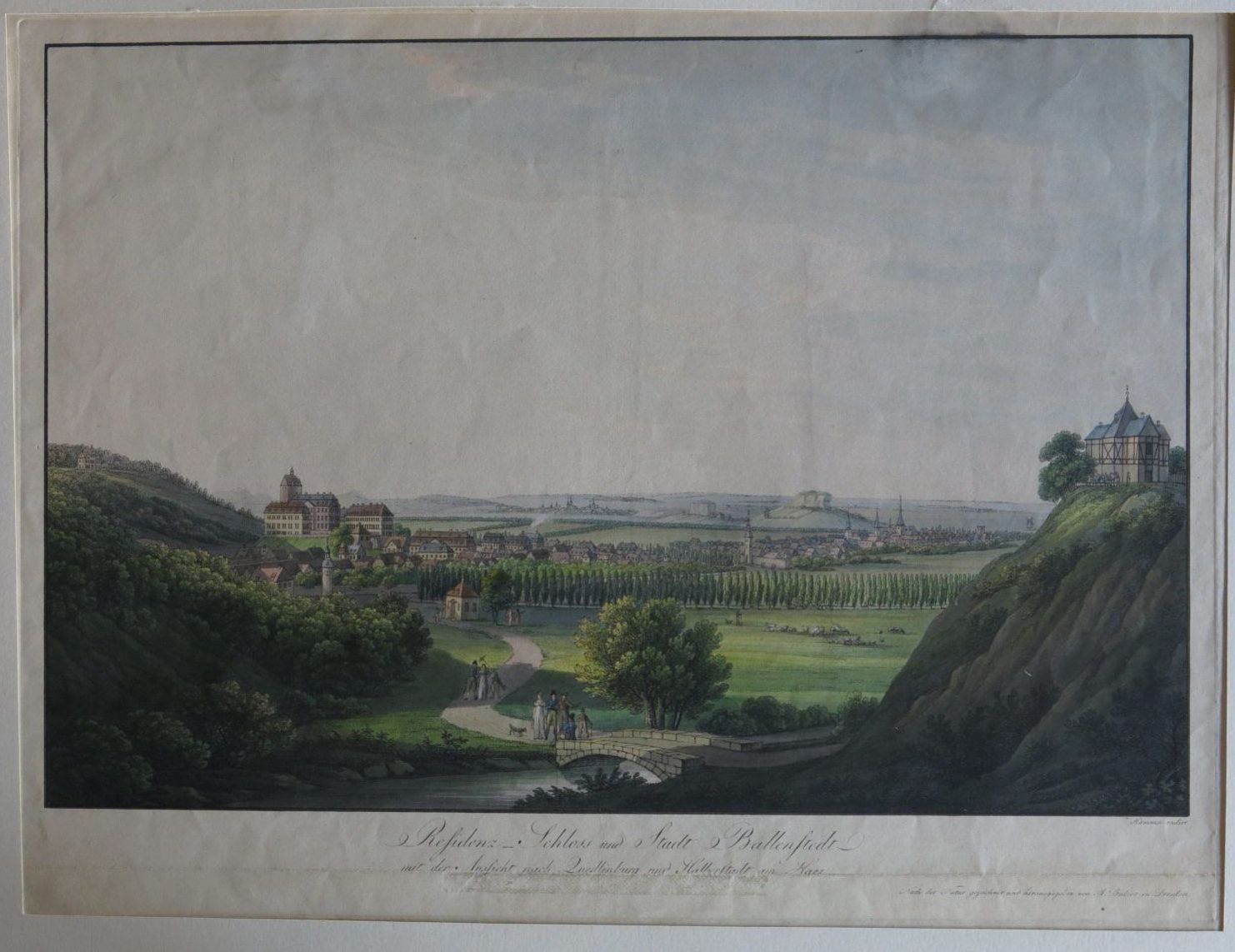
Today, this painter’s view of Ballenstedt is blocked by a forest area, but later we can climb the Bismarck Tower on the nearby Stahlberg for a view. The artist’s vantage point was here, at the only coal deposit in the entire Duchy of Anhalt, whose seams were already exhausted in the early 19th century. The spot invited visitors to linger, as the inn “Zum Kohleschacht” once stood here; a brick successor building still stands nearby. The inn marked, after about an hour, the halfway point of the path from Ballenstedt to Falkenstein Castle. Today, hikers find a seating area and an information board at the former coal shaft.
In the stillness of this place, let’s take a closer look at Andreas Balzer’s remarkable view. He has exaggerated all the hills at least threefold and artfully blended truth with imagination. It’s as if he wanted to show us what Wilhelm Blumenhagen expressed perfectly in his Harz book of 1838: “Here in the Lower Harz lies the inexhaustible treasure chamber of the painter and the poet.” He meant the diverse transitions from wooded hills to towns and viewpoints in the open countryside. Biologists know these as the richest in species. So it is similar with beauty, for the eye craves variety. In such a small region as that of the dukes of Anhalt-Bernburg, visual variety can make everything seem larger. Their famous relatives in Dessau-Wörlitz eagerly demonstrated this through garden design. Ballenstedt had only about 4,000 inhabitants around 1810, when this view was created.
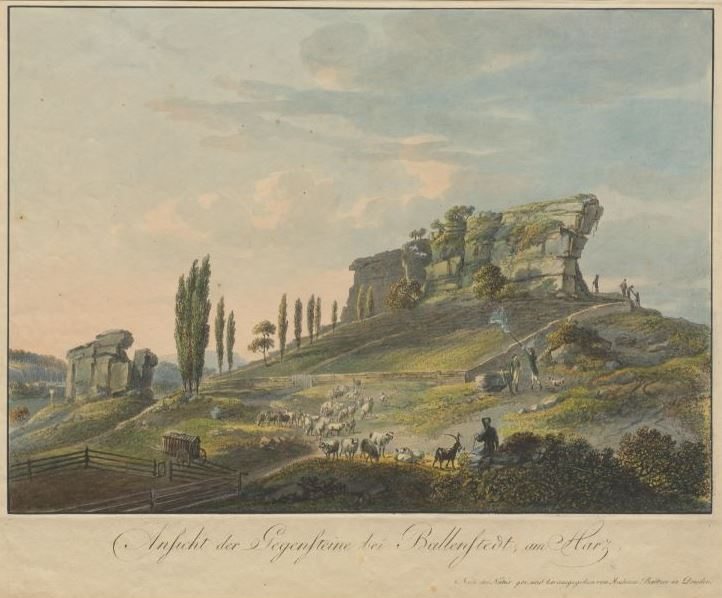
With Andreas Balzer, we get to know the painter’s design toolkit of the time: he guides our eyes along the path to Ballenstedt, and we pause briefly on the bridge in front over the Saubach, just as his strollers do. The highest point is Ballenstedt Castle with the westwork of the medieval monastery church. Balzer places it almost exactly in the golden section, in the left third of the picture. The Gegensteine form the somewhat softer height accent in the right third. This creates tension, and our eyes wander. The town with the four towers in front is imaginary, for Ballenstedt was never that large. The pleasure house on the Triftberg at the right edge of the image is equally fanciful, probably moved here from the Meiseberg, but important as the beginning of the visual story. The view as far as Quedlinburg is realistic, while the distant silhouettes of Regenstein and Blankenburg behind Ballenstedt Castle are artistically shaped.