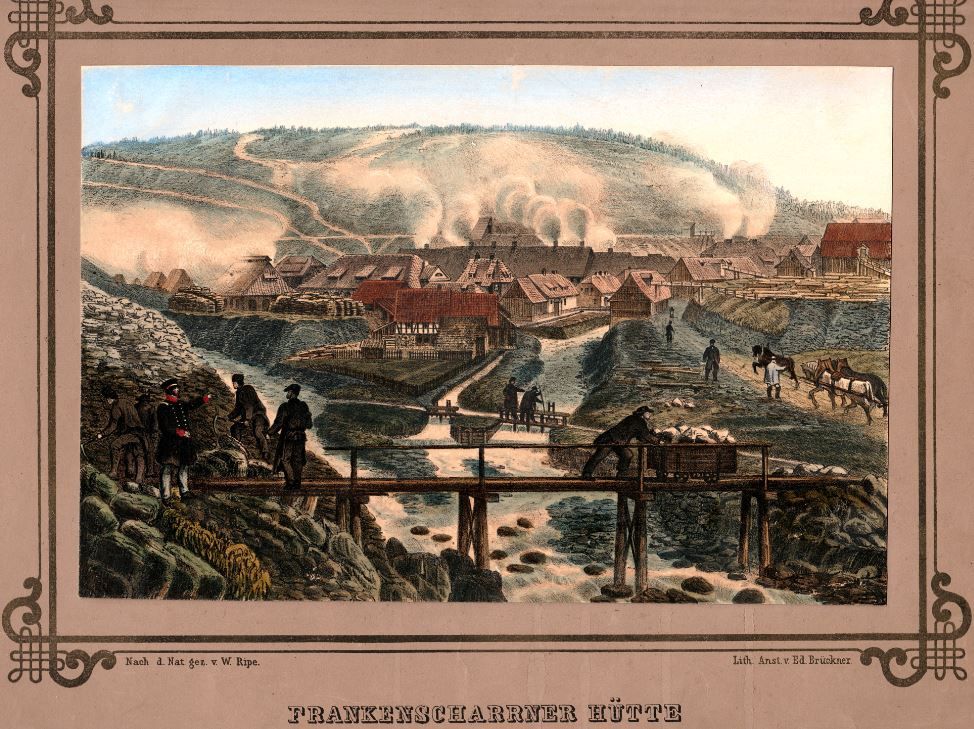
Nothing here is as it once was, and yet it’s one of the most fascinating painter’s views, giving a lot to think about. Our viewpoint isn’t that of the painter but higher up and outside the right edge of the painting. Up here, on the crest of the sand heap at Hüttenkopf, there’s a seating area along the Geopark nature trail and an information board that explains this place to us. Wilhelm Ripe’s actual position was down by the B 242, roughly where today’s “Frankenscharrnhütte” bus stop is located. There’s nothing left there now except the confluence of the Innerste and Zellbach, perhaps an old mine tunnel entrance, or more hidden away, the loading ramp of the smelter station built later on.
Back in the day, the Frankenscharrn was once the largest smelting works in the entire Harz region. It processed silver and lead ores from the famous mines around Clausthal and Andreasberg, from the late Middle Ages up until 1967. Goethe had already been here on his first trip to the Harz in 1777, when the works had just received a new blast furnace. Anyone who worked in that smoke, where there wasn’t a single tree far and wide, didn’t grow old but suffered from chronic lead poisoning, “as if their insides were being torn apart by the smelter cat.” In 1822, Villefosse listed ten furnaces here for smelting lead and silver, 153 workers, 14 water wheels, and a need of 110,400 measures of charcoal. That’s why in Ripe’s painting the foreground naturally shows the delivery of the required ore and timber, as well as the removal of slag.