© Fotoweberei & Schloß Wernigerode GmbH

Devil’s Wall near Weddersleben

1833

The motif

Our location is by the Weddersleben Devil's Wall, which in this beautiful section is completely free of trees and therefore looks so monumental. Legend has it that the devil wanted to build the wall in a single night. His realm was the Brocken, and he wanted to extend it into the Harz foreland. He had made a bet with God the Father. But then the rooster crowed, morning came, and he had to leave his work unfinished, though in rage he hurled a few more rocks. These strangely encrusted sandstone formations still lie today in the hilly Harz foreland. They naturally captivated artists as well, though identifying the more than forty Romantic-era Devil’s Wall paintings remains a special task for local historians. And the question of whether Carl Blechen was here by the Königswand or rather at the Hamburger Wappen has yet to be conclusively answered.

What is certain is that the Devil’s Wall is one of the oldest natural monuments in Germany. Already in June 1833, the royal Prussian district administrator Carl Weyhe forbade the local community of Weddersleben, under penalty of up to five talers, from breaking off stones from the Devil’s Wall. In December, this decree had to be repeated, “since it cannot be tolerated that the Devil’s Wall, which adorns the entire region, be destroyed by breaking off stones.” The devilish name and the force and diversity of these stones fascinated not only painters. Above all, they sought ways to express the diabolical — with vigorous strokes, dark clouds, moonlight, or like Carl Blechen, with a swarm of crows.
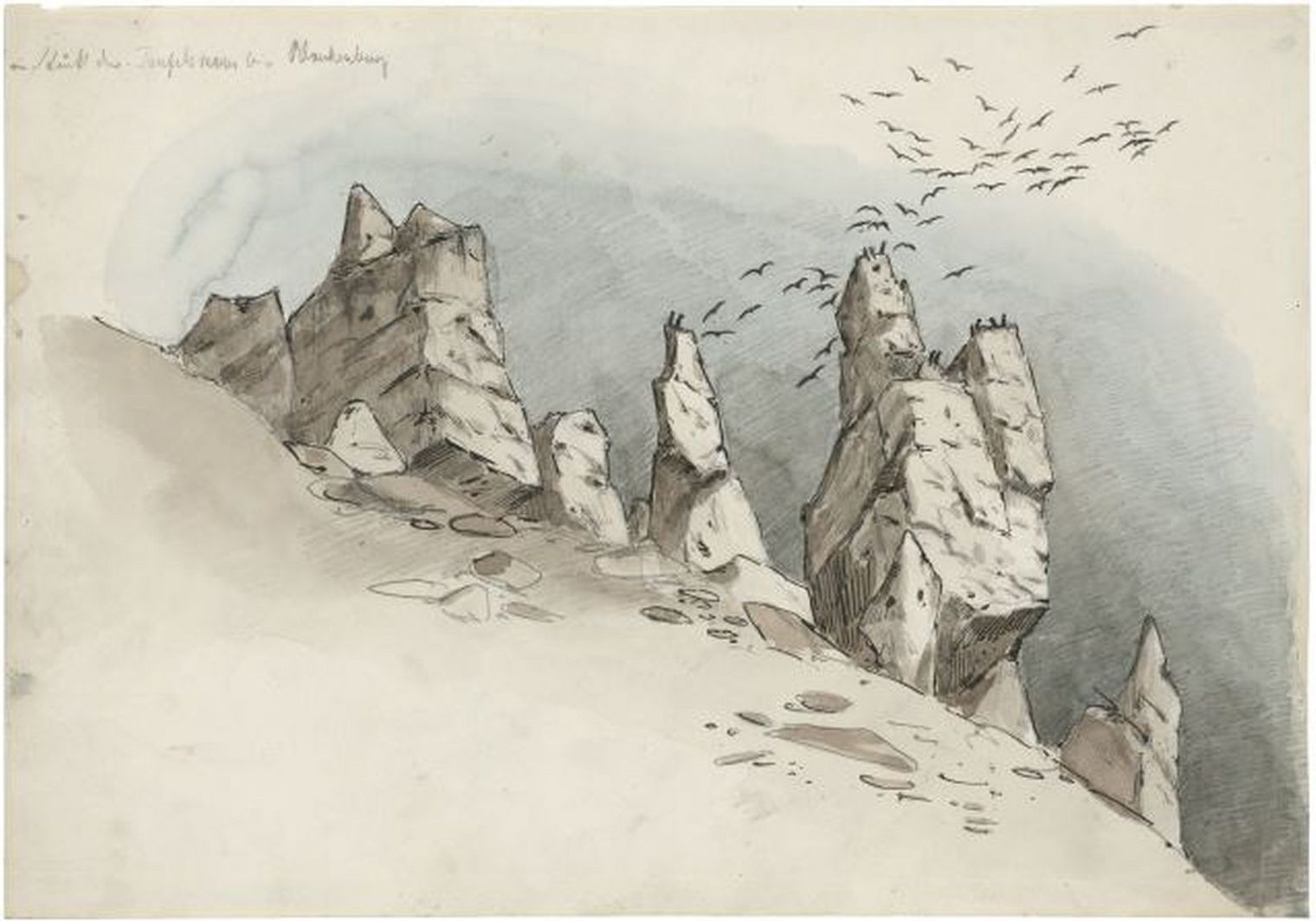
Teufelsmauer von Blechen
©  Kupferstich-Kabinett, Staatliche Kunstsammlungen Dresden, Foto: Herbert Boswank
Carl Blechen

Artist

September  1833

created

Brush with coloured ink on paper

22.8 x 33 cm

Inv. no. C 1928-69

Dresden State Art Collections, Kupferstich-Kabinett

Hiking tip

From Blankenburg to Ballenstedt, the Harz Devil’s Wall Trail connects the different sections of the Devil’s Wall over a distance of 27 kilometres. The sandstone rocks, rising up to 20 metres above the hills, are deposits from an ancient sea that were silicified under high pressure, later tilted, and then oddly eroded by the Bode River and the Ice Age. It’s a very special hike, partly following the Harz Witches’ Trail, where good footwear is recommended. At the Devil’s Wall near Weddersleben, there’s also a stamping point for the Harz Hiking Pin.

About the artist

Carl Blechen (1798–1840) was a brilliant Berlin landscape painter of the Romantic period who deeply impressed his contemporaries. He was granted only a short creative period of barely ten years, during which his journey to Italy in 1828/29 marked a highlight. From 1831 onwards, he taught at the Berlin Academy and was loved by his many students for his unconventional manner. Some of them accompanied Blechen on his brief ten-day trip to the Harz Mountains in September 1833. On 13 September, they went through the Ilse Valley to the Brocken, where he apparently stayed overnight. Descending, he followed the Bode River via Schierke to Rübeland and turned from there to Blankenburg, where he drew at Regenstein and on the Teufelsmauer on 16 or 17 September. From there, it was not far to Thale, though there was no path along the Teufelsmauer yet. Blechen then spent a few days in the Blechhütte near Thale and explored the Bode and also the Selke Valleys from there. On 24 September, he made the last drawing of his journey, already back in Ilsenburg.

For comparison

Heinrich Brandes, Teufelsmauer, around 1850, pencil, washed in brown and grey on brownish vellum, 42.6 x 56.1 cm, Herzog Anton Ulrich Museum Braunschweig, inv. no. ZL III/1602 

Teufelsmauer von Brandes
© Herzog Anton Ulrich-Museum Braunschweig

Heinrich Brandes (1803–1868) came from Braunschweig, first studied natural sciences before devoting himself to art, and after his journey to Italy became a drawing teacher in Braunschweig. More than ten drawings and several paintings featuring motifs of the Devil’s Wall show how much this subject fascinated him.

Heinrich Brandes, Teufelsmauer near Neinstedt, around 1850, pencil, washed in green and brown, highlighted with white bodycolour on greenish vellum, 42.7 x 57.8 cm, Herzog Anton Ulrich Museum Braunschweig, inv. no. ZL III/1606

 Teufelsmauer bei Neinstedt von Brandes
© Herzog Anton Ulrich-Museum Braunschweig

This could depict the Adlerfelsen (on the right) and the Devil, two striking rocks of the Teufelsmauer between Neinstedt and Weddersleben, and perhaps in the distance the Hoppelnase near Langenstein, more than 15 kilometres away. Such varied views over the foothills of the Harz are still today one of the special charms from the heights of the Teufelsmauer.