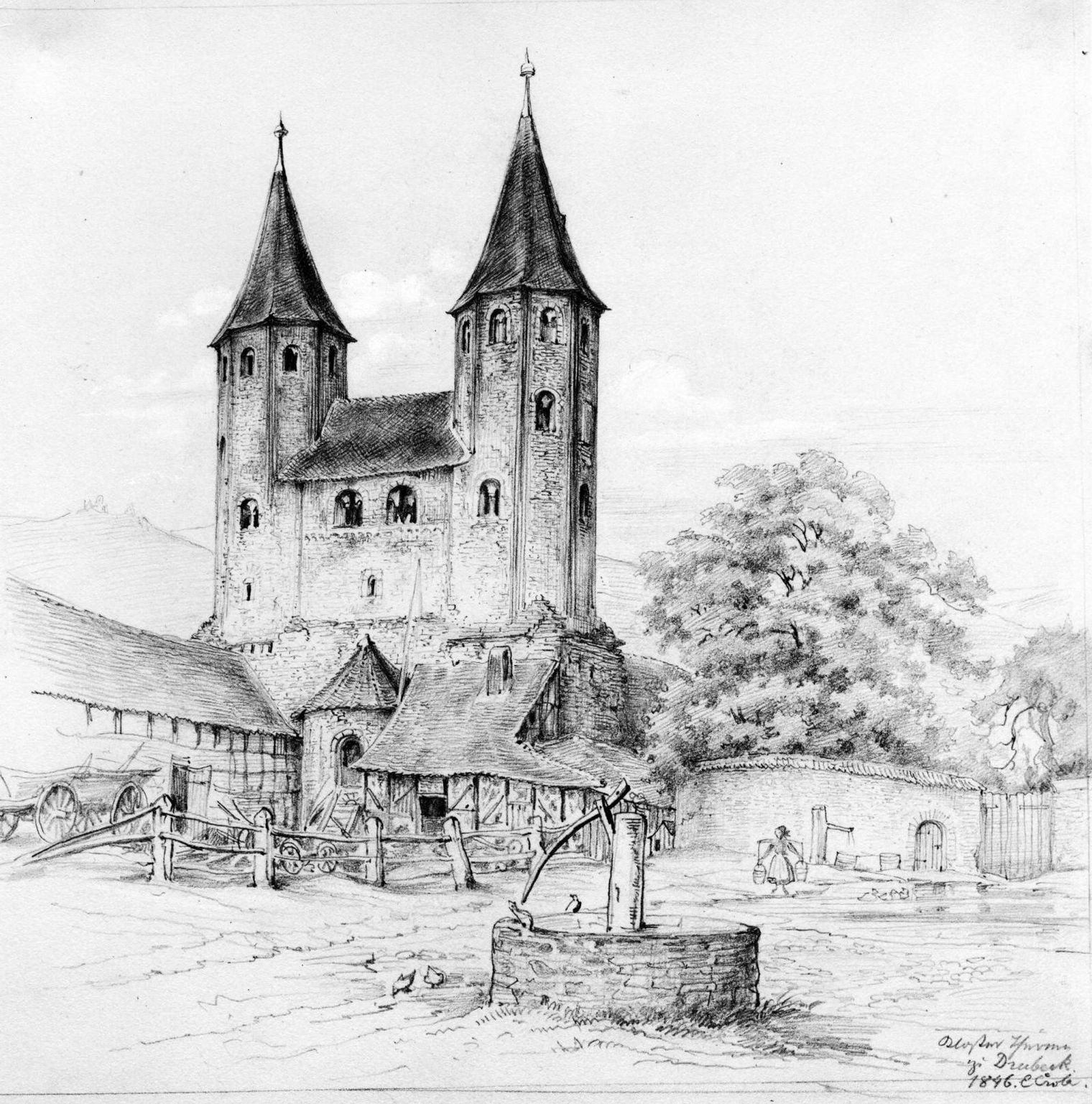
Anyone entering the monastery grounds from the southwest, next to the new Eva Hessler House, has exactly this painter’s view of the mighty westwork of the former Benedictine monastery church of Drübeck. The building dates back to the 12th century, with origins reaching back to Emperor Otto’s time. Constructed from thick limestone blocks, the building is only sparsely decorated. As a landmark, it lies on the northern slope of the Harz Mountains between the artists’ towns of Wernigerode and Ilsenburg, and yet it was rarely depicted. The few painters who did portray it were among the first to recognise that the Romanesque architecture in the Harz region is something truly unique. Like a string of pearls, the imperial monasteries surround the Harz: Halberstadt, Quedlinburg, Gernrode, Memleben ….
Elise Crola does not have a strong interest in the Middle Ages; she is a painter, not an architectural historian. But through her precise depiction, we are confronted with a contrast between the petty concerns of everyday life and magnificent architecture. It’s a motif she painted several times, and this version is the most beautiful of them all.