© Fotoweberei & Schloß Wernigerode GmbH

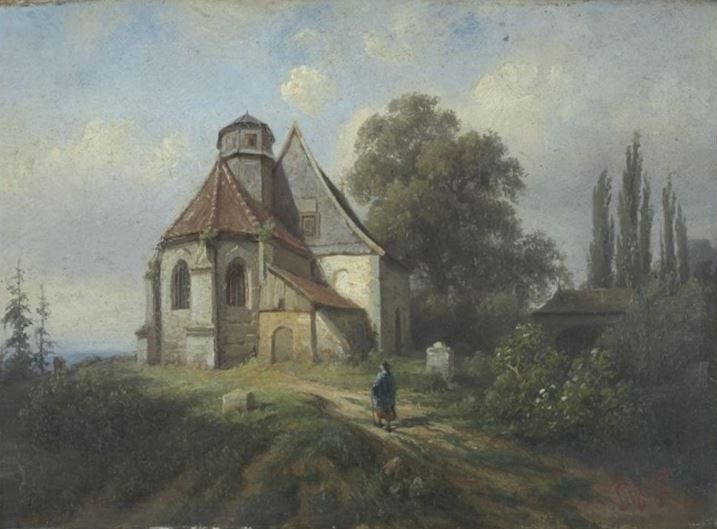
Ellrich Church of Our Lady

1854

The motif

This small church on Marienberg is almost still preserved as it appears in the painting. It is a building from the 15th century. But the history of the church goes back to the year 876, when it was mentioned for the first time. Anyone who steps to the right, to the shady north wall of the church, will find a portal stone bearing the head of a curly-haired man – more than 800 years old and very mysterious. This quiet place has not often been depicted. The painter Heinrich Litzmann came from Mecklenburg and had a special feeling for it. He donated this picture in 1854, the same year he painted it, to the art association of his adopted home Kiel. Perhaps Litzmann wanted to tell the people of Kiel: Look, even in simple form, greatness can be found.

Anyone who travels along the Karst Trail to Ellrich in the Southern Harz should climb the narrow path with the wooden railing up to Marienberg. From there, you'll have the most beautiful view of the small town.
Litzmann
©  Kunsthalle Kiel
Heinrich Litzmann

Artist

1854

Created

Oil on canvas

21 x 29.5 cm

Kiel Art Gallery

Inv. No. 1

Hiking tip

In Ellrich, there are hiking destinations for an entire week. Whether you go north into the town’s forest full of gorges, rocks and viewpoints, or north-east towards Sülzhayn and the Steinmühlental valley. A walk from Ellrich to Walkenried should definitely be part of it. The route leads across the former inner-German border and sometimes along it, but above all through "Himmelreich" (Heaven) and "Hölle" (Hell). "Hell" was the infamous satellite camp of the Dora-Mittelbau Concentration Camp (today a memorial site) in the disused gypsum factory Juliushütte near Ellrich. The remaining structures are well documented and vividly show the inhumane nature of the National Socialist state. (5 kilometres, 1 1/2 hours)

About the artist

The painter Heinrich Litzmann (1824–1910) came from Gadebusch in Mecklenburg. In Berlin, he studied painting and then, between 1850 and 1880, drew and painted in many quiet corners of the German regions. For the Berlin publisher Alexander Duncker, he created views of castles and manor houses from places such as Pomerania, Silesia, and Posen. Later, Kiel became his adopted home. His brother, a well-known gynaecologist, lived there, and the city was also more peaceful than Berlin.

For comparison

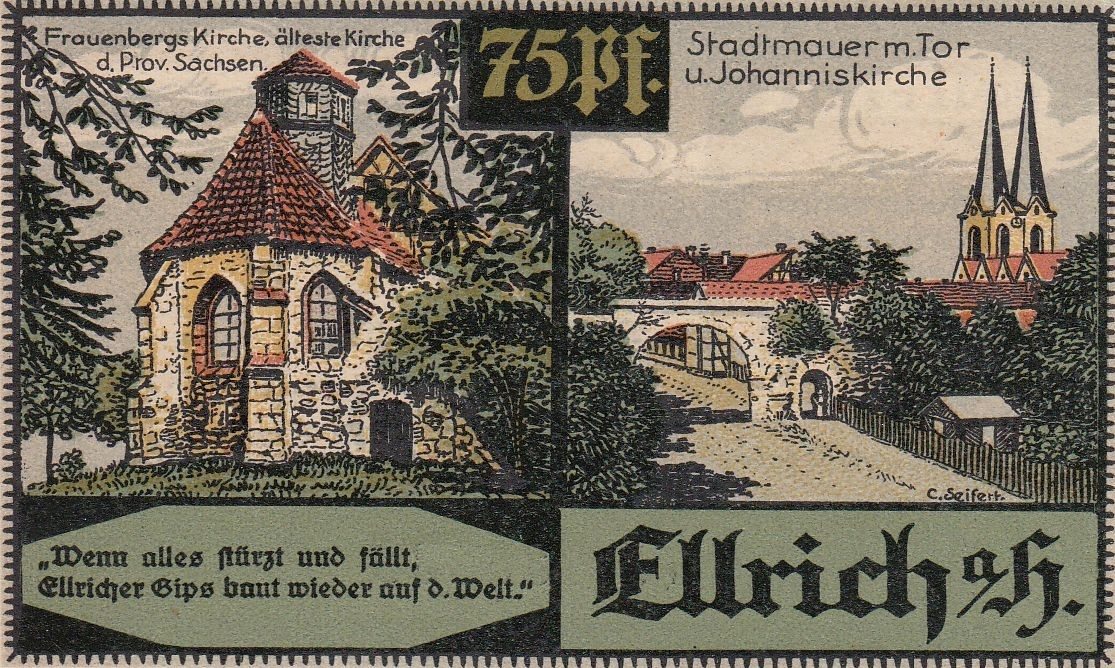
View of the Church of Our Lady in Ellrich on an emergency banknote, 1921, on loan from a private collection, Historical Collection Walkenried

Frauenkirche Ellrich
© Heimatgeschichtliche Sammlung Walkenried

"When everything crashes and falls / Ellrich gypsum rebuilds the world." A bit megalomaniac, this saying. Ellrich lived off its gypsum deposits and used its emergency money in 1921 for advertising. The First World War was still weighing on people’s minds. Beside the grief over the gaps in families, there was hardship. It was the time of the global economic crisis. Money was printed in large quantities, and towns and communities were being inventive in finding attractive ways to portray this crisis. People tried to comfort themselves over Germany’s defeat with a nationalist tone like this Ellrich saying. However, all the money printing led to inflation and to major wage losses for all workers.

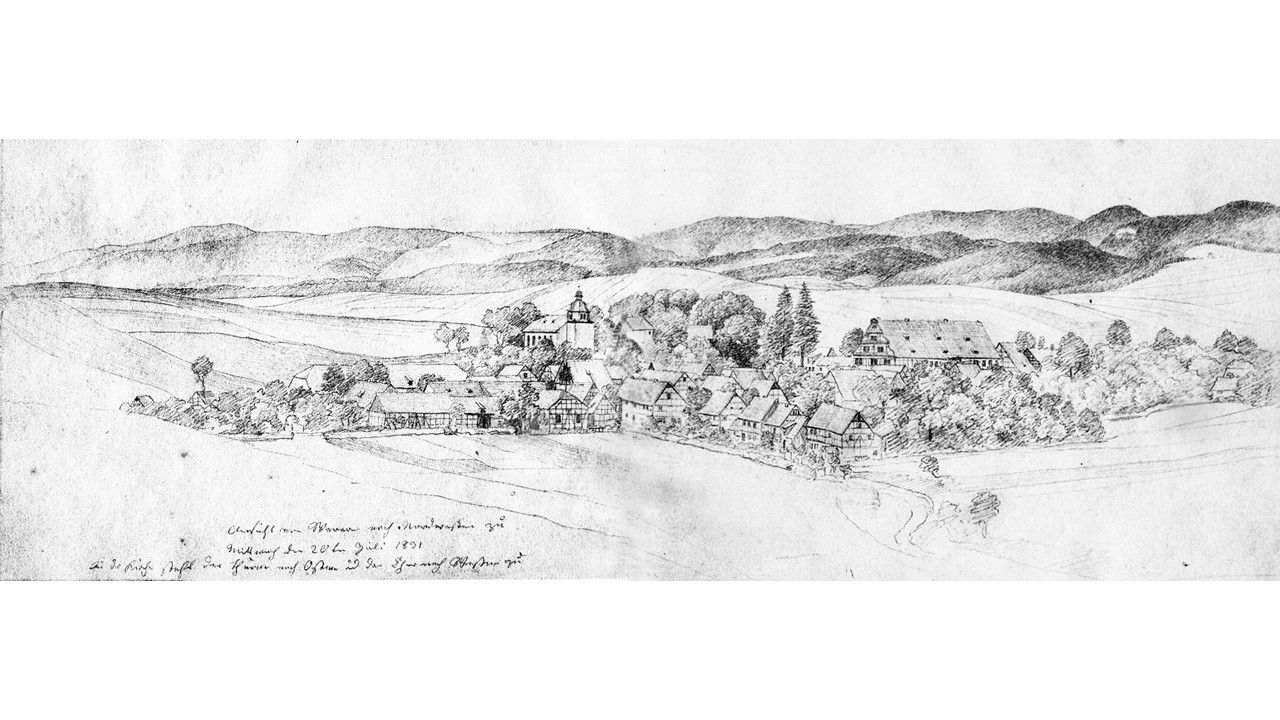
Carl Hasenpflug, Werna, 20 July 1831, pencil drawing in a sketchbook (open 24.6 x 17.5 cm), Municipal Museum Halberstadt

Hasenpflug
© Städtisches Museum Halberstadt

The painter Carl Hasenpflug lived in Halberstadt north of the Harz Mountains. How did he come to the small village of Werna near Ellrich in the Southern Harz? Because his Halberstadt patron, Spiegel von Desenberg, had relatives and a castle here, whose beautiful location he might already have raved about. Carl Hasenpflug recorded four drawings of Werna in his sketchbook; here you can see the view from the southeast with the Harz in the background. The beautiful Renaissance castle of the von Spiegel family towers above the other houses. It has been gradually restored since it became the property of the district of Nordhausen in 2011. This sketchbook only became known in 2002 following the major Hasenpflug exhibition in Halberstadt and shows the artist’s meticulousness even in small drawings. By the way, Hasenpflug also explored the nearby Walkenried Monastery Ruins from Werna and kept depicting them in his paintings afterwards. Thus, Hasenpflug’s stay in the small Werna connects his early work as an architectural painter with his later period as a painter of monastery ruins.