© Fotoweberei & Schloß Wernigerode GmbH

Goslar from Klusfelsen

1829

The motif

This painter’s view calls for a bit of wandering, because even though the spot on the slope of Peterberg is easy to find, the hillside today is no longer a park like in the painting, but a forest with beautiful old beeches and ashes. The view of Goslar and the Rammelsberg behind it is only possible further up the Petersberg; finding the pond requires an extra walk, and a closer exploration of the rocks is needed anyway.

While sandstone rocks are more commonly preserved and serve as legendary landmarks at the Devil’s Wall near Thale, the Klusfelsen of Goslar stands entirely alone. It too was once part of a sea about 120 million years ago, whose compacted sands were tilted by 90 degrees when the Harz fault blocks rose up. Empress Agnes is said to have had the Chapel of St Mary built into this rock in the 11th century when she founded the St Peter’s Monastery on the mountain. Even in Bleuler’s time, a hermit still lived here. In 1983, the people of Goslar restored the chapel and also placed a replica of the old statue of Mary. Every year at Christmas, a service is held here.
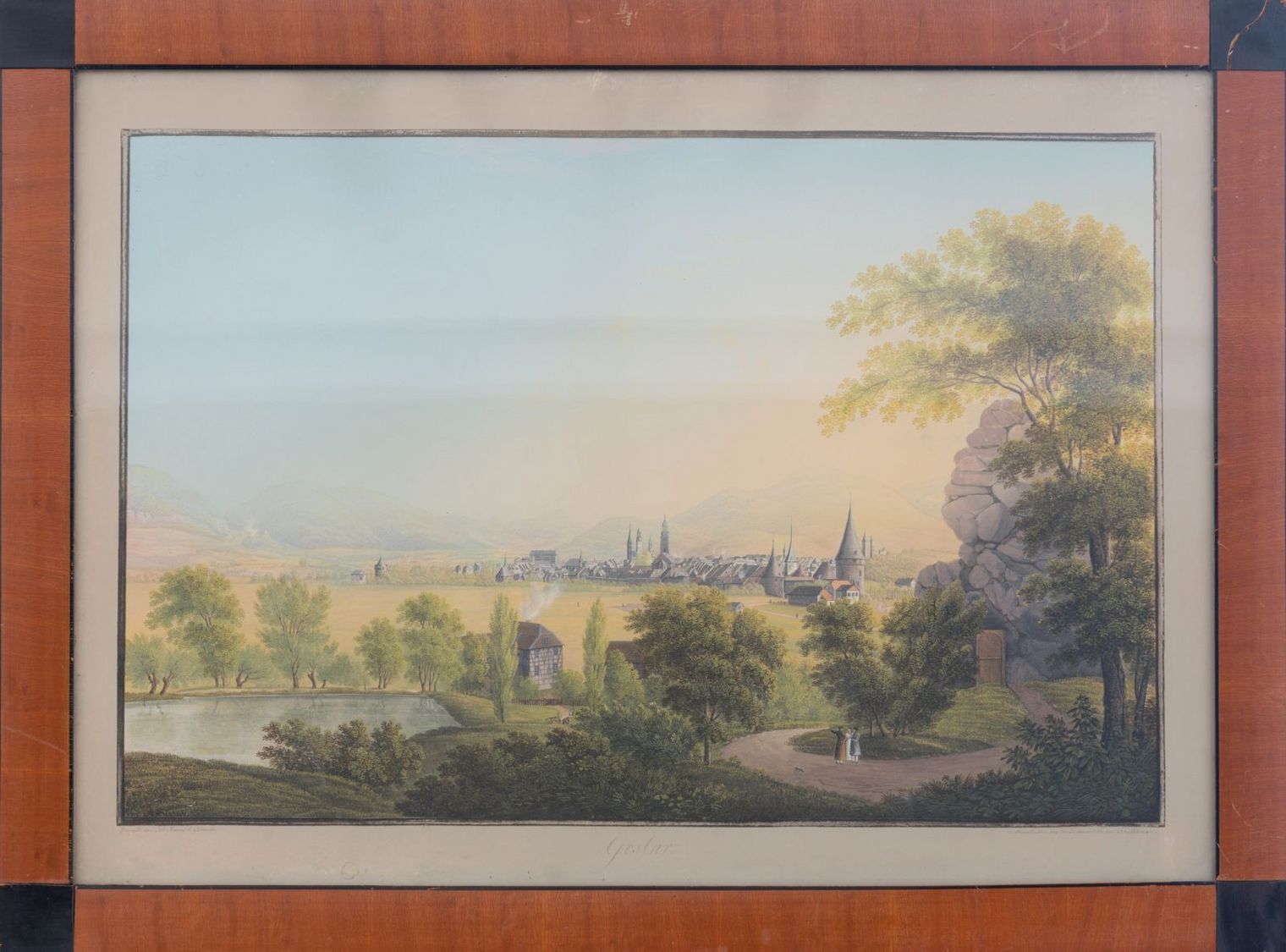
Klusfelsen Goslar, Bleuler
©  Schloß Wernigerode GmbH
Johann Ludwig Bleuler

Artist

at  1829

created

coloured outline etching

47.4 x 65.0 cm

Inv. No. Gr 104

from the collections of Schloss Wernigerode GmbH

Hiking tip

Far too little known is a circular hiking trail that leads from the Rammelsberg World Heritage Site in the south, past the Maltermeister Tower on the eastern side around Goslar, all the way to Petersberg and the Klus Rock. Along the way, you’ll find plenty of raspberries and wonderful views across meadows towards the old town, with the Imperial Palace, Market Church, and the Zwinger Tower as important landmarks. The way back can be taken through the town centre. (9 kilometres, 2.5 hours, signposted)

About the artist

Johann Ludwig Bleuler (1792–1850) was born in Feuerthalen into a family of painters. This Swiss town, not far from the Rhine Falls, was at that time a well-known name throughout Europe. For their motifs, the brothers and their father travelled all over Europe, even as far as St. Petersburg. What made them special was that they drew all their subjects on site themselves, although they sometimes adopted already familiar picturesque views. In the Harz Mountains, Johann Ludwig Bleuler considered four motifs worthy of depiction: Wernigerode, Falkenstein Castle, Clausthal, and Goslar from the slope of the Petersberg with the Klusfelsen.

From Feuerthalen, the Bleuler family supplied views as large and vividly coloured as oil paintings, yet affordably reproduced as etchings. Those who couldn’t afford paintings chose Bleuler’s coloured etchings or prints beautifully overpainted with white tempera (gouache). When the moods and the staffage varied, everyone felt they held a unique piece in their hands. Let everyone rejoice in their Bleuler, in which so much craftsmanship and effort have been put! Just as Nathan the Wise advised in his famous parable of the rings.

For comparison

Oehme & Müller after H. Schultz, Goslar from Petersberg, around 1840, lithograph, sheet size 50.7 x 61.7 cm, Herzog August Library Wolfenbüttel Top., 18b:6

 Klusfelsen Goslar, Schultz
© Herzog August Bibliothek Wolfenbüttel

In this large-format lithograph, the slope of Petersberg is still completely bare; today it is forested and you can only catch glimpses of Goslar here and there. Bare like the Rammelsberg in the background, which was slightly "shifted" here in order to show three of Goslar’s highlights along one visual axis: in the foreground the remarkable Klusfelsen with its park-like surroundings, then the Breite Gate as a well-fortified entrance to the tower-filled town, and behind it the source of its wealth — the mountain with the best ores in Europe, rich in silver.

Georg Melchior Kraus, The Hermitage near Goslar, September 1784, chalk drawing, grey wash, 29.5 x 45.2 cm, Klassik Stiftung Weimar/Museums, Goethe’s possession, KHz/AK 3217

Klusfelsen Goslar, Kraus
© Klassik Stiftung Weimar Museen, Foto: Olaf Mokansky

The Klus Rock was also one of the geologically interesting sites that Goethe and Georg Melchior Kraus drew during their Harz hike in September 1784. The location of this drawing, from a south-eastern perspective, can be identified quickly — behind it lies the fence of today’s retirement home. Once again, the accuracy of the depiction is striking! However, comparison shows that the surprisingly bright hollow, described on a nearby panel as ancient and cultic, is not 250 years old. As so often, a look at reality helps! The drawing also reveals that the rock on the left is missing about a quarter today — simply sawn off to make the path easier to walk.