© Fotoweberei & Schloß Wernigerode GmbH

Hohnstein Castle

1800

The motif

Very picturesque high ruin walls characterise Hohnstein Castle. Nature and the ruins create an idyllic harmony. That is exactly what the unknown artist felt and therefore let go of accuracy. Because of this, the exact spot where the painter stood cannot be determined. We might choose the courtyard of the upper castle beneath the old beech tree, which could be a descendant of the slender trees seen in the etching. There are wide views everywhere, not only from the rebuilt keep.

The castle was the ancestral seat of the Lords of Hohnstein, who gained a leading position in the Southern Harz during the 13th century. Their influence extended to Scharzfeld and Lauterberg in the west, Rothenburg and Artern in the east, and Sondershausen in the south. Yet the family eventually declined and died out. Hohnstein passed to the Lords of Stolberg, who expanded the castle into one of the largest in the Harz. With the development of cannons during the Thirty Years’ War, that era came to an end. Today, besides the romantic ruins, a guesthouse with a panoramic terrace and beautiful deciduous forests with winding paths attract visitors, with the lovely Neustadt lying below.
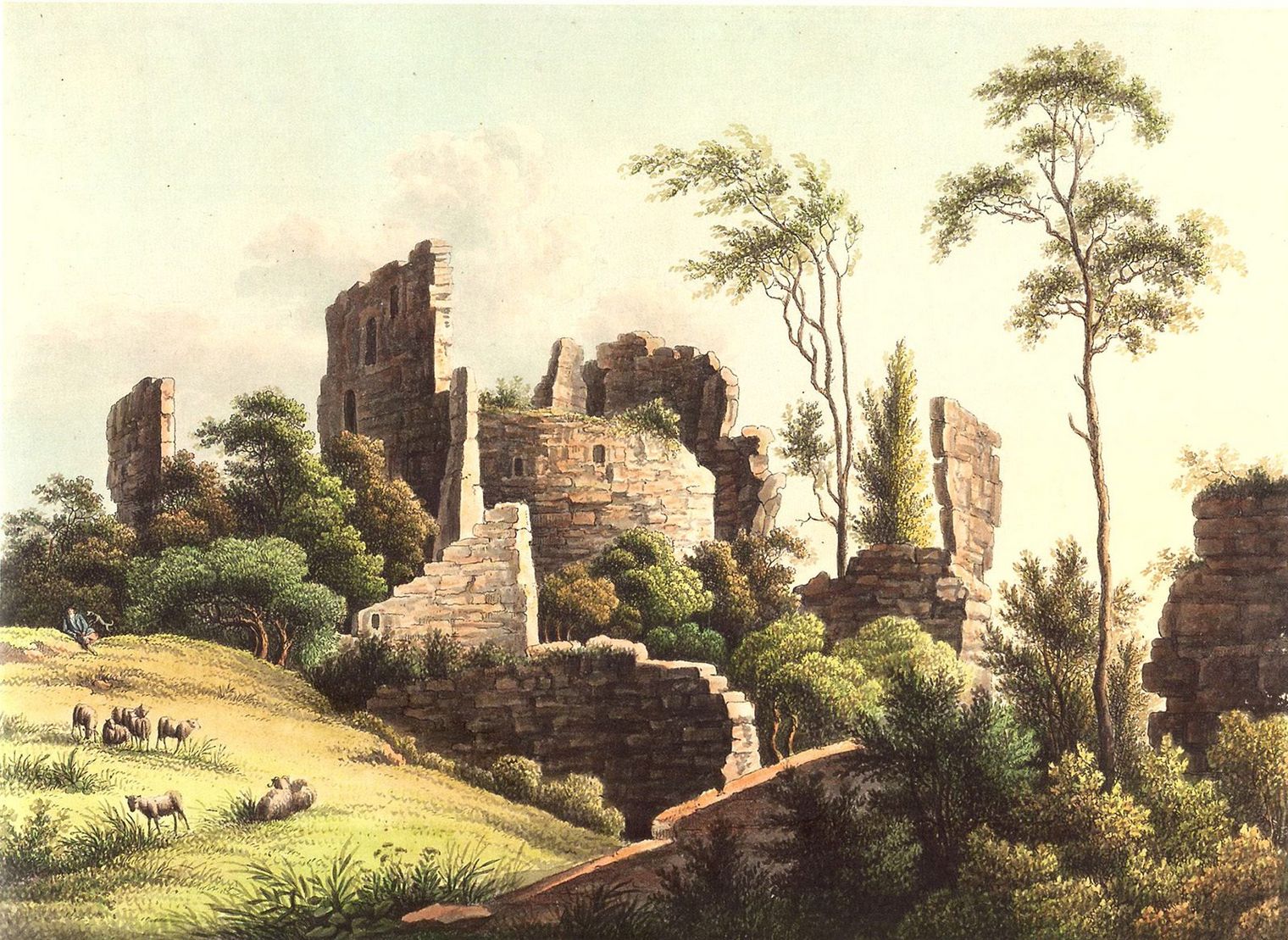
Anonym
© Sammlung Bode, Hamburg
Anonymous

Artist

around  1800

created

coloured outline etching

published by Morasch in Dresden, print size 35.5 x 25.7 cm

Bode Collection

Hamburg

Hiking tip

A climb from Neustadt is well worth it, but anyone who prefers an undisturbed hike should avoid the car park at the forest swimming pool and using the access road uphill. A nicer option is the ascent along the nature trail restored in 2005 from Neustadt Castle or from the Löns Trail, with detours not only to Hohnstein but also to Heinrichsburg. (Circular route without detours, 5.5 kilometres long) Along the way, you can spot occurrences of red porphyry on the slopes, the stone from which the castle was built.

For comparison

Album leaf showing a view of the ruins of Hohenstein Castle, around 1820, etching, published by Wiederhold Göttingen, image size 7.6 x 13.0 cm, from the collections of Schloss Wernigerode GmbH

Wiederhold
© Schloß Wernigerode GmbH

Twenty years later, an album leaf faithfully repeated our painter’s view. Only the sheep changed their posture. What is an album leaf? It was an affordable invention for anyone who didn’t want to paint something themselves in friendship books or memory albums, but preferred to use an already reproduced view, which they only had to add a saying and their dedication to. This was very popular among students. Göttingen was a university town, and the publisher Johann Carl Wiederhold discovered this market gap, which became an important field of work for him.

After a drawing by Carl Duval, Neustadt and Hohnstein Castle, 1841, coloured lithograph, image size 10.2 x 17.8 cm, from: 

Duval
©  Sammlung Städtische Museen Nordhausen

from: Thuringia and the Harz, with their curiosities, folk tales and legends, Sondershausen 1841, collection of the Municipal Museums Nordhausen, Inv. No. V 1357 K2

In his 1860 hiking book about the Harz, Gustav Adolf Leibrock also praises Hohnstein Castle: “Hohnstein is one of the most beautiful and most noteworthy spots … The view from these ruins captivates almost longer than the ruins themselves.” There are many depictions of Hohnstein Castle; painters such as Wilhelm Eichler, Georg Heinrich Crola or later Richard Thierbach also created paintings of it. The writer and lithographer Carl Duval (1807–1853), who was born in Nordhausen, probably chose his viewpoint on the vineyard and was thus able to depict both the Neustadt Palace – a Baroque building from the 18th century, still lovingly preserved today by an association – and the ruins of the castle above it in one image.