© Fotoweberei & Schloß Wernigerode GmbH

Ilfeld

1759

The motif

This is a painter’s view from above, well worth the climb, even though the castle hill is now covered with forest and only here and there allows a glimpse through. We enjoy the peace and quiet while, below us, the traffic on the federal road B4 makes noise. Today’s busy north–south connection through the Harz once was the lifeline of Ilfeld. For the Counts of Ilfeld in the 12th century, for the monastery they established, and for the school that was later set up there after the monastery’s dissolution, which was well regarded far beyond the region. And also for Goethe, who spent the night here in 1777 at the inn Zur Krone and, through a knot hole, observed something astonishing that inspired the scene in Auerbach’s Cellar.

For the draughtsman and etcher Johann Ludwig Meil, it was just a walking path up to the castle ruins, since as a teacher he lived on the school grounds in the old monastery right next to Ilfeld’s church. In the view, the church appears like a gate to the Harz in the middle of the road, but a little more than 100 years ago it received a new building beside the road. Of the old half-timbered houses in Meil’s etching, the slightly elevated building on the right-hand side of the street shows the former inn Zur Krone, which is still preserved – as is, by the way, the knot hole.
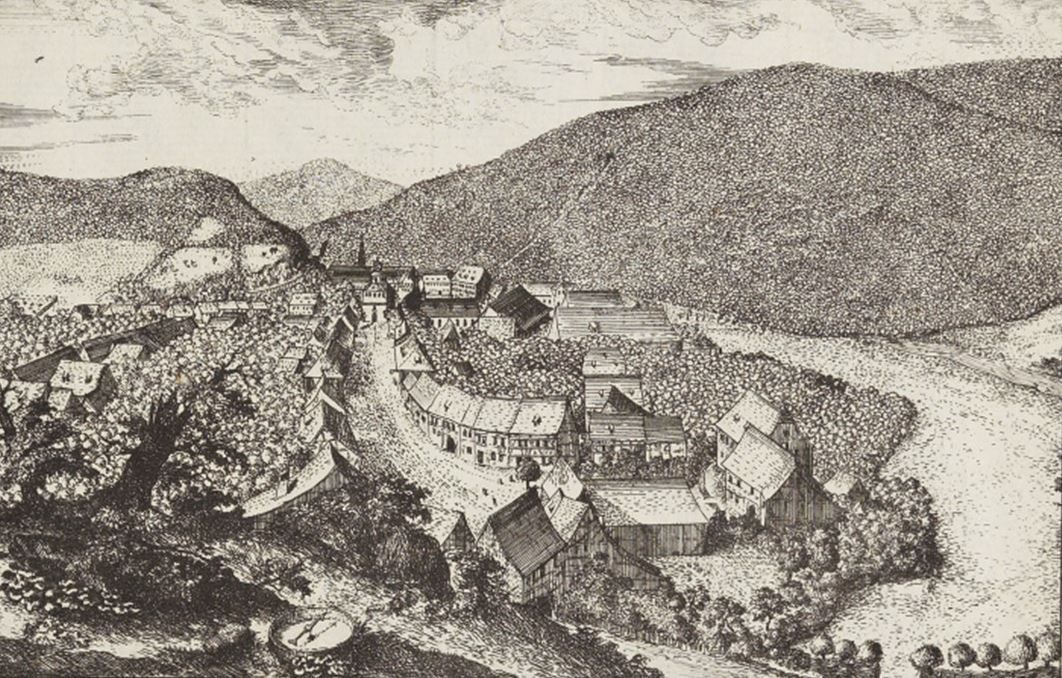
Meil
© Herzog August Bibliothek Wolfenbüttel
Johann Ludwig Meil

Artist

1759

created

Etching

Record size 10.8 x 16.3 cm

Herzog August Library Wolfenbüttel

Top. 18a:19.1

Hiking tip

In 1898, with the connection to the Harzquerbahn from Nordhausen to the Brocken, tourism came to Ilfeld, and popular trails extend northwards to the Kleines Bodetal and the Rabenklippen. But in earlier times, Ilfeld was a mining town. The circular hiking trail around the place shows this, leading past the alabaster quarry at Ochsenloch and even a gold panning site. (About 2 hours)

About the artist

Was this artist a namesake or perhaps one and the same person: painter, draughtsman, etcher and sculptor for Nord- and Sondershausen? And also a teacher in Ilfeld? Born in Arnstadt in 1729 and died in Ilfeld in 1770? There is a need for further research. We only know that in 1759 he created this view of Ilfeld – a lone wolf, long before the romantic discovery of the Harz. A souvenir sheet for the pupils or their parents? In the spirit of the Enlightenment, Ilfeld made a great effort for the entrusted young souls who joined at the age of 15 and completed their secondary education here. Teachers remained deeply and gratefully remembered. “Apart from that, all pupils of Ilfeld enjoy the same treatment and discipline, and no difference is observed except that which the diversity of natural dispositions puts into the hands of reasonable teachers”, it says in an announcement from 1749.

For comparison

John Woods after Adrian Ludwig Richter, Ilfeld, 1838, image size 10.4 x 15.7 cm, from: Wilhelm Blumenhagen, Walks through the Harz, 

Richter
© Schloß Wernigerode GmbH

in: The Picturesque and Romantic Germany, Leipzig 1838, from the collections of Schloss Wernigerode GmbH

The spot where Adrian Ludwig Richter made the sketch for this steel engraving was in the spa gardens of Ilfeld. A memorial stone has marked the location for several years now. At that time, the area was still undeveloped; it is June in the picture and the hay harvest season. As always, Richter lovingly and romantically portrays the work and togetherness of people in his landscape scenes. At the front, a couple in love; just behind them on the left, a father trying to spank his son across his knee, while the sister pleads passionately for him.
The Leipzig publisher Georg Wigand had Richter’s drawing engraved on steel in London, since in Germany steel engraving was still in its early stages, and there he could not find such a skilled engraver. He must have been there, as we have sketches by him from 22 September 1833 made in the Selke Valley, from Gernrode, and from the Bode Valley.

Martin Gensler, Access to the Crypt of the Ilfeld Abbey Church, 21 August 1857, watercolour over pencil on paper, mounted on cardboard, 30 x 42.5 cm, Hamburger Kunsthalle, inv. no. HK-2011

 Gensler
©  Hamburger Kunsthalle

To this day, this Romanesque crypt has been preserved, but it is not mentioned in the Romanesque Route or in travel guides. The donor’s plaque, showing Elgar II of Ilfeld and his wife Lutrud when they founded the Premonstratensian monastery of Ilfeld in 1189, still stands in the vestibule. In 1546, the monastery became a school and a centre of humanist education, which ended with the enforced conformity in 1933 and the establishment of a National Socialist educational institute. After the destruction of Nordhausen during the Second World War, the Nordhausen hospital was set up there. Now it is the Neander Clinic, named after the first rector of Ilfeld, Michael Neander (1525–1595). By prior arrangement and as part of events, it is possible to visit the crypt or also to pray there. The Hamburg painter Martin Gensler (1811–1881) visited the Harz several times. His view shows the access from the crypt to the cloister, which still exists today. Even back then, this place must have been an insider tip, as depictions of it are rare.