© Fotoweberei & Schloß Wernigerode GmbH

Ilsenburg iron foundry

1854

The motif

The viewpoint is located at the Handwerkerhof Ilsenburg, on the grounds of the former Count Stolberg foundry, which has a tradition of over 300 years in cast-iron art. From 1833 onwards, modernisation took place and the roof of the new foundry became a viewpoint in Ilsenburg – with a terrace and railing. Visiting the factory could be combined with enjoying nature and viewing the Ilsestein and the Brocken. Shortly afterwards, several painters created views from this spot, including Ernst Helbig. Since then, visitors to Ilsenburg have not come only for the nature of the Harz, but also to see the world-famous iron foundry and order its products: fans, paperweights, boxes, jewellery, figures or even furniture made of iron.

Down by the pond were the workshops of the modellers so important for Ilsenburg’s success; on the right, the roof of the foundry inspection building still rises behind the foundry. This is where Eduard Schott (1808–1895) worked, to whom Ilsenburg owes its world fame. He was tirelessly active until the age of 81 – artistically, in supervision, and also in technical innovation. With his crystallisation process, he managed to give iron smooth surfaces and sharp edges like nowhere else.

Today, the painter’s view is obstructed, and the pond has been filled in. However, some parts of the old foundry buildings still stand and are being carefully restored.
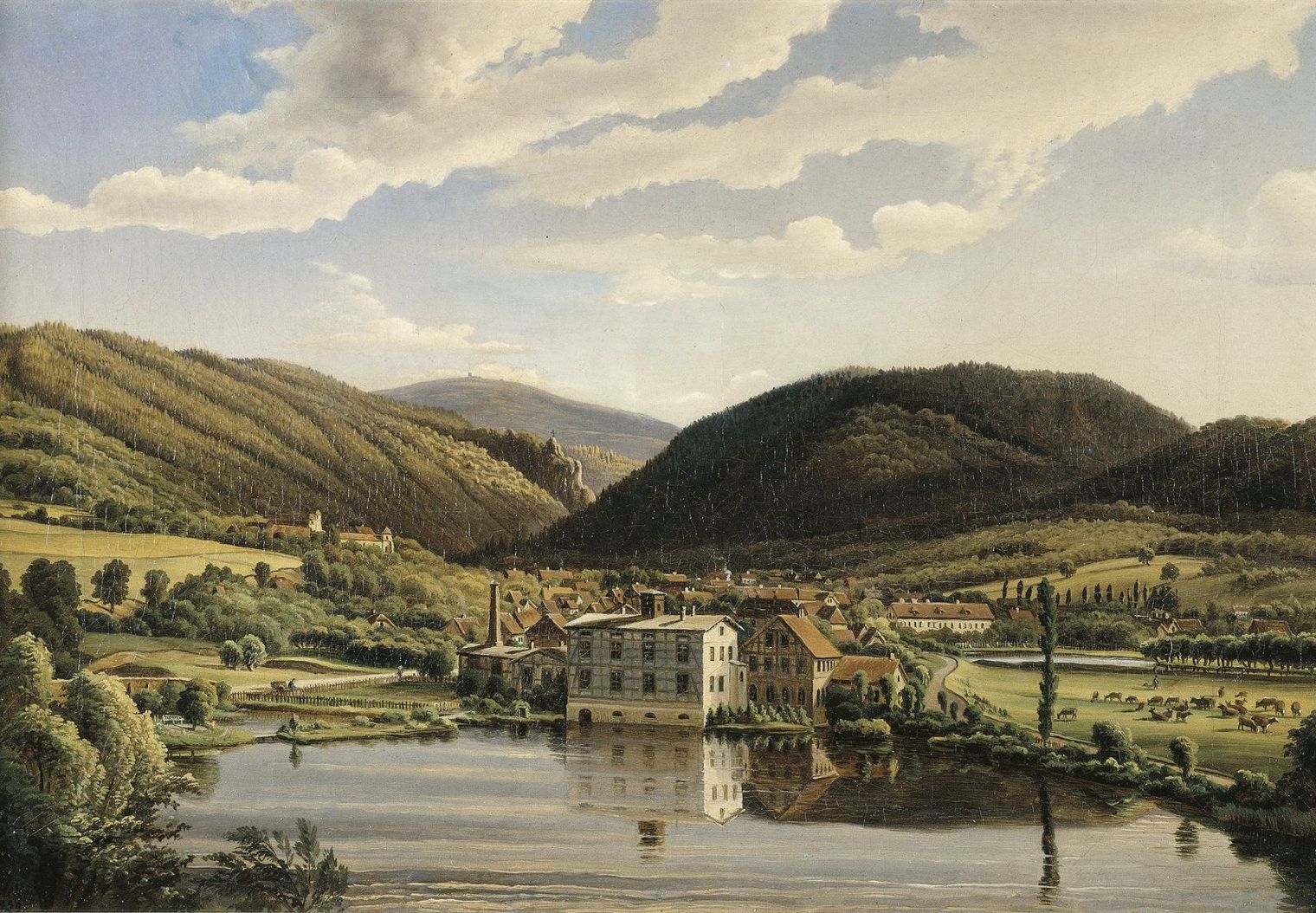
 Ilsenburg, Helbig
© János Stekovics
Ernst Helbig

Artist

1854

created

Oil on canvas

32 x 48 cm

Private collection

.

Hiking tip

In the truly charming Ilsenburg, you can still find plenty of industrial history. To explore it, there is the Iron Trail “From Ore to Metal”. It not only stops at the iron foundry, which since its privatisation in 1993 has again proudly borne the traditional name Fürst-Stolberg-Hütte. It also leads to the Ilsenburg Ironworks and Technology Museum. There you can find depictions and models of the old Ilsenburg art foundry.

About the artist

Doris Derdey worked for many years in the museum, in Wernigerode and at Falkenstein. Through extensive research, she brought the forgotten Harz painter Ernst Helbig back into our awareness. In the church records of Stolberg/Harz, she deciphered his origins as the fifth child of the head gardener. In Dresden, she found his traces between 1824 and 1830 and even wrote to Oslo, where the diary of his Dresden teacher Christian Clausen Dahl is kept. Doris Derdey searched in Halberstadt, where Helbig tried his hand at lithography and copying works by Carl Hasenpflug from 1830 onwards. She went through the entire Wernigerode Intelligenzblatt from 1843 to 1861 to find adverts and notices about Helbig, and in the Wernigerode archive she found letters to the count with moving pleas for commissions and money. She also eventually found tax records mentioning him from 1857 onwards as disabled and paralysed, unable to pay the monthly tax of two silver groschen. In Halle, she read the diary of his friend Friedrich von Suckow, who ordered five paintings from him at alarmingly low prices. At last, she found in the administrative records of the Johanniter hospice in Mansfeld evidence of his death in poverty and blindness in 1866. On the 200th anniversary of the painter’s birth in 1802, she was finally able to present an exhibition in Wernigerode and a catalogue of works with 128 paintings. In 2007, Doris Derdey died at only 63 years old after a short, serious illness. Without people like her, who carry out their work with intelligence and empathy, nothing works anywhere—least of all in culture.


For comparison

Wilhelm Ripe, Ilsenburg viewed from the Iron Foundry, around 1865, drawing with brush and black ink on tinted paper, sheet size 56 x 76 cm, Bode Collection, Hamburg

Ilsenburg, Ripe
© Sammlung Bode, Hamburg, Foto: János Stekovics

Here we can see what Ernst Helbig and others left out in their depictions because they were standing at the viewpoint. As always, Wilhelm Ripe was interested not only in art but also in the life and work of people, and for that, he stepped further back. This way, we have an image of the blast furnace building with the foundry, the boiler house (with its slender chimney) to the left, and in the foreground heaps of slag and additives with many workers and two visitors, to whom a third person is explaining something. Tourism was not only interested in nature but also in technology.

Georg Heinrich Crola, The Ilsenburg Iron Foundry with the Two Blast Furnaces, 1849, oil on canvas, 30 x 45 cm, Ironworks and Technology Museum Ilsenburg, inv. no. V 1142 K2, on view in the permanent exhibition 

 Ilsenburg, Crola
©  Hütten- und Technikmuseum Ilsenburg