This scenic painter’s view in the northern part of the city is now surrounded by Nordhausen’s most beautiful villa district. Just a few steps away stands the Art Nouveau villa built in 1907, now home to the Meyenburg Art House, which has been a new cultural venue with its art exhibitions since 2002. In our painting, the building would appear in the back on the left, roughly where the sheep are grazing. Behind them, a few poplars rise in the painting and mark the Stolberger Straße, which still exists today. In the distance is the Kyffhäuser, beside it a marvellous full moon. From Nordhausen’s city centre, you can spot St. Petri, St. Blasii, and, on the far right, the Schützen Tower; the chimney in the middle of the painting belongs to the Hagen Brewery. In front of it there used to be inns, because the painter, just like we do today, stood at the edge of the so-called Gehege. It was the favourite walking spot for the people of Nordhausen. They had planted the trees as early as 1740 and made sure that no pastures would destroy the lovely grounds. Walking outside the city gates, appreciating beauty, and caring for it became a civic virtue – especially in Nordhausen, as it was an old imperial city.
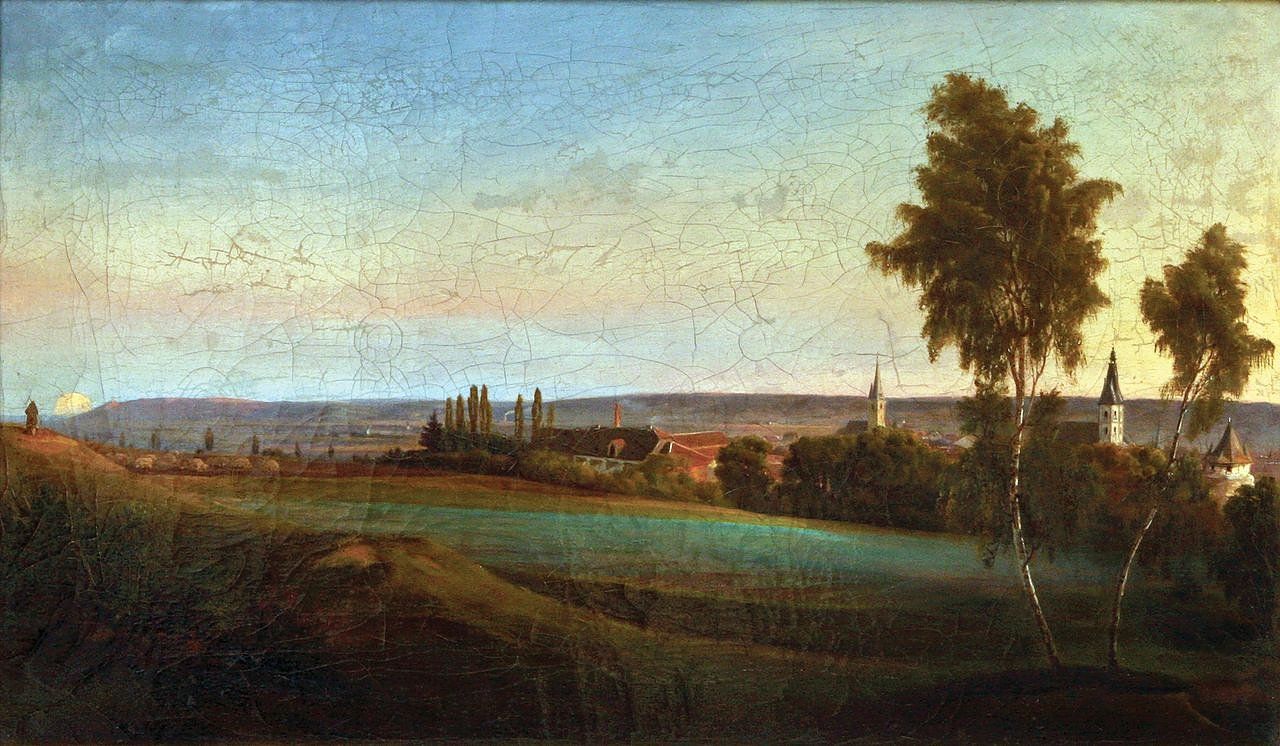
Artist
created
45 x 70 cm
Collection of the Municipal Museums of Nordhausen
When was the last time you simply closed the front door behind you and went for a walk? Nordhausen, the city so badly wounded by Anglo-American bombers in early April 1945, has achieved an extraordinary amount in rebuilding. Old and new stand side by side, inviting you to compare them. There are surprisingly many walking paths away from the streets, forming a lovely route from north to south: through Hohenrode Park and the city park, Gehege and Promenade into the town centre, and from there along the Zorge River to the lido and Möwensee Lake. (approx. 7 kilometres, 1 ½ hours)
We know too little about Wilhelm Eichler, but enough to imagine that he served painting modestly and with great dedication. He came from nearby Ellrich and grew up in Nordhausen, but his parents couldn’t support him much financially. Nevertheless, at the end of the 1820s he went to Berlin to learn painting. Peter Ludwig Lütke was then a professor of landscape painting in Berlin, who passed on to the young man his love for detail and his careful glazing technique. Eichler remained faithful to this style throughout his life, even when others wielded their brushes more quickly. We find him in Nordhausen at various addresses as a painter; he also tried his hand at photography for a few years and painted plants for the city’s well-known botanist Wallroth. Until his eyesight weakened with age. He died in Nordhausen in 1872, childless, so the city inherited some of his paintings, which are still preserved here today and shown in special exhibitions.

As early as 1830, the Nordhausen wildlife park, today the city’s oldest nature park, hosted the first evening concerts. In 1852, an open-fronted concert hall was built. The depiction of a summer concert seems surprisingly modern. Snacks are brought to the tables, some citizens stroll around, others stand and listen to the music. A fire and already gas lanterns illuminate the park, and gas lamps also light the bandstand. This bandstand has been preserved and is still used for events today.

The writer Carl Duval wrote in 1839 about the park, the former Geiersberg, not only that women who wanted to go for a walk would go up the Geiersberg, but also the following: "... What sum would one pay in Berlin or Hamburg to have such an exceedingly charming spot, such a hill adorned with the most beautiful trees, nearby. Among the most splendid groups of trees one walks as if in a green cathedral."