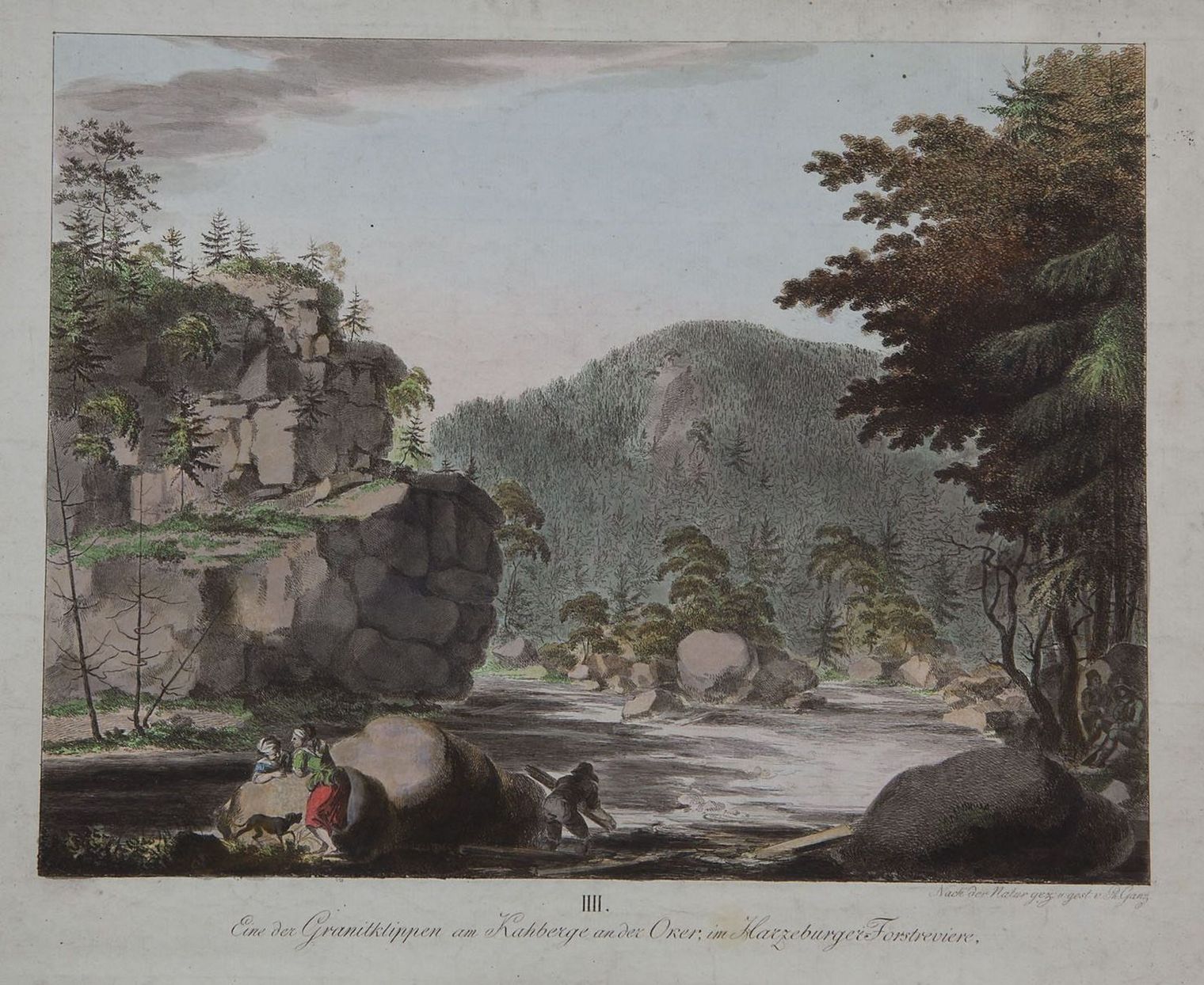
Our painter’s vantage point in the granite-rock landscape of the Oker Valley isn’t easy to find this time. But the rock still survives in its original form, and once you’ve found it, the comparison is all the more fun. The first clue is the direction of the Oker’s flow — we’re looking downstream. Also, the rock is no longer directly in the water, as the Oker’s course was slightly altered. There’s now ground in front of the rock, and instead of the river, there’s a ditch that once served one of the many industrial mills in the valley. This is the area around the Kahberg Cliff, not far from the Marienwand, where the largest rocks in the Oker Valley lie close to the water. A more comfortable hiking path now runs along the road in this section, which of course means missing out on the most beautiful part.
The granite rocks — sometimes jagged and layered, sometimes smoothly rounded — were the main attraction for the first painters in the valley. With the construction of the road, the two inns marking the north and south ends of the valley, and the waterfall built in 1863, more and more visitors began to come. But the road also brought industrialisation. Today, the valley path takes you past old mills and factories, dams, and impressive canal structures, some of which run high above the hiking trail.