© Fotoweberei & Schloß Wernigerode GmbH

Osterode Hohe Warte

1760

The motif

If you’re searching for painters’ viewpoints, you also need to think about the old paths. If you want to find those ancient routes, you have to detach yourself from modern conditions and go back several centuries. The Devil’s Watchtower southeast of Osterode is a good place for that. It was built in the 13th century and is part of a system of towers whose watchmen communicated with each other and could quickly pass on signals about anything unusual they observed. On the Uehrder Hill south of Osterode stood the next tower already — the lords at the Old Castle in Osterode, an imperial fortress, wanted to be informed in time.

Of course, such watchtowers stood along important roads, even if, until the end of the 18th century, these roads were mere tracks. The Devil’s Watchtower was located on the High Road, whose name has survived to this day in the Osterode–Düna section. The High Road, or Via Regia, was the great east–west axis of the Empire, and even Roman coins have been found along it.

The painters travelled those major routes by stagecoach or on foot. Away from them, there was simply too much uncertainty and the danger of getting lost. Did the painter perhaps replace the watchtower with the Old Castle in Osterode and merge impressions of a journey into a single painting?
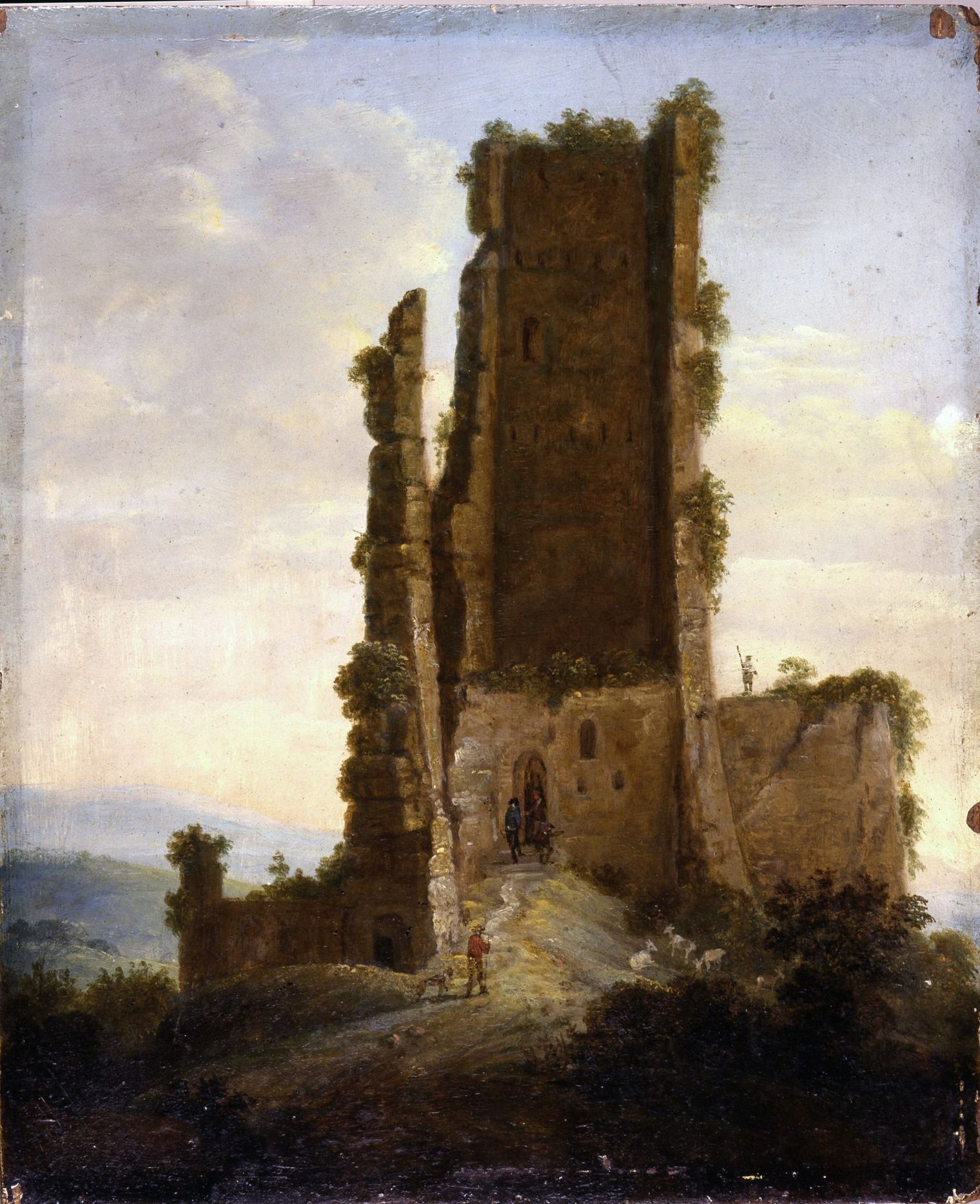
Osterode, Weitsch
© Osterode, Weitsch
Pascha Johann Friedrich Weitsch

Artist

around 1760

created

Oil on wood

21.3 x 17.3 cm

Municipal Museum

Brunswick

Hiking tip

A circular hiking trail from Osterode via Düna and Ührde passes the Teufelswarte, the Uerderberg-Warte and the Old Castle of Osterode. We can reflect on the topography and the painter’s imagination in our watchtower painting, which shows a square tower that doesn’t exist anywhere here. It’s a surprisingly beautiful tour through a hilly landscape with views of the Harz Mountains from the south (about 15 kilometres, 3 hours, partly following the Karst Hiking Trail).

About the artist

Pascha Johann Friedrich Weitsch (1723–1803) did everything with great passion. At the age of thirty-three, as a soldier, he threw himself into painting, forgot everything around him and did nothing but sit and learn, for he had nothing but his talent. But from sitting indoors so much, he became quite ill, and we owe thanks to the good doctor Benedikt Brückmann for the right diagnosis. Weitsch needed to get back out into the fresh air and walk, for many days and weeks. That’s what he did, and while walking, Weitsch also came up with the idea of putting Harz motifs onto porcelain. So the story of the artistic discovery of the Harz region began around 1760 with a doctor’s recommendation — one that still applies to everyone today who spends a lot of time indoors.

Walking makes you healthy, a true story

“[…] I am no longer a soldier, but now a painter, thank God … and so he left the military after 12 years of service completed. – His liveliness and his diligent and constant painting, and the fact that many now sit while painting porcelain, gradually brought him to hypochondria, so that he himself did not know what was wrong with him. – The physician Brückmann, a friend of his due to their shared love of art, immediately recognised the ailment and taught him to walk again; his strength was gone, and so he took him out onto the street, which they did together for several days, until he had to walk alone again every day, and thus returned to his usual health. He had never had a serious illness; the main reason for that was a cheerful, healthy nature and, alongside it, a strict sense of order in eating and drinking – and continuous diligence, working industriously until just a few days before his death. –

(…) During the Seven Years’ War, there was not much to earn at the porcelain factory, therefore the painter W., now a master, always painted in oil and thus earned a living for his family. At this time, his affliction of hypochondria made him believe every day might be his last. After the war, a table service was commissioned by the Duke, for which W. also had to paint a sample plate; he depicted a neighbouring area of the city of Brunswick and named the place underneath the plate. – The Duke liked this plate so much that he wanted W. to paint the entire service with towns, villages, districts, and hamlets from the land of Brunswick – this entirely cured his hypochondria, as he undertook a walking journey along the Weser with a messenger who carried his things, in order to sketch towns and villages for the purpose of the service.” (Recorded by the painter’s son in 1815)

For comparison

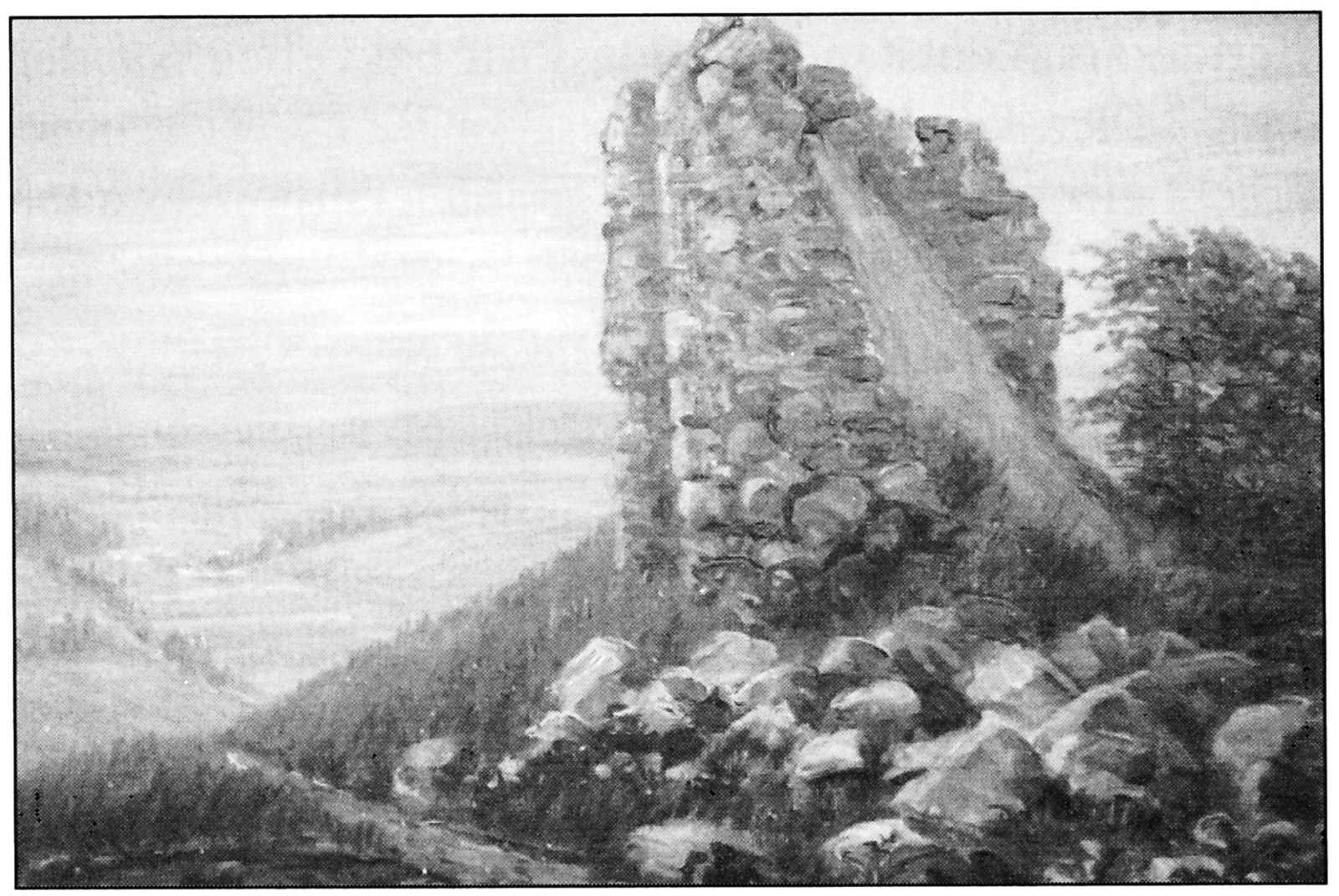
August Freckmann, Hohe Warte (Devil’s Watch), 1920s, oil on canvas, reproduction: Local History and Heritage Society of Osterode, whereabouts unknown 

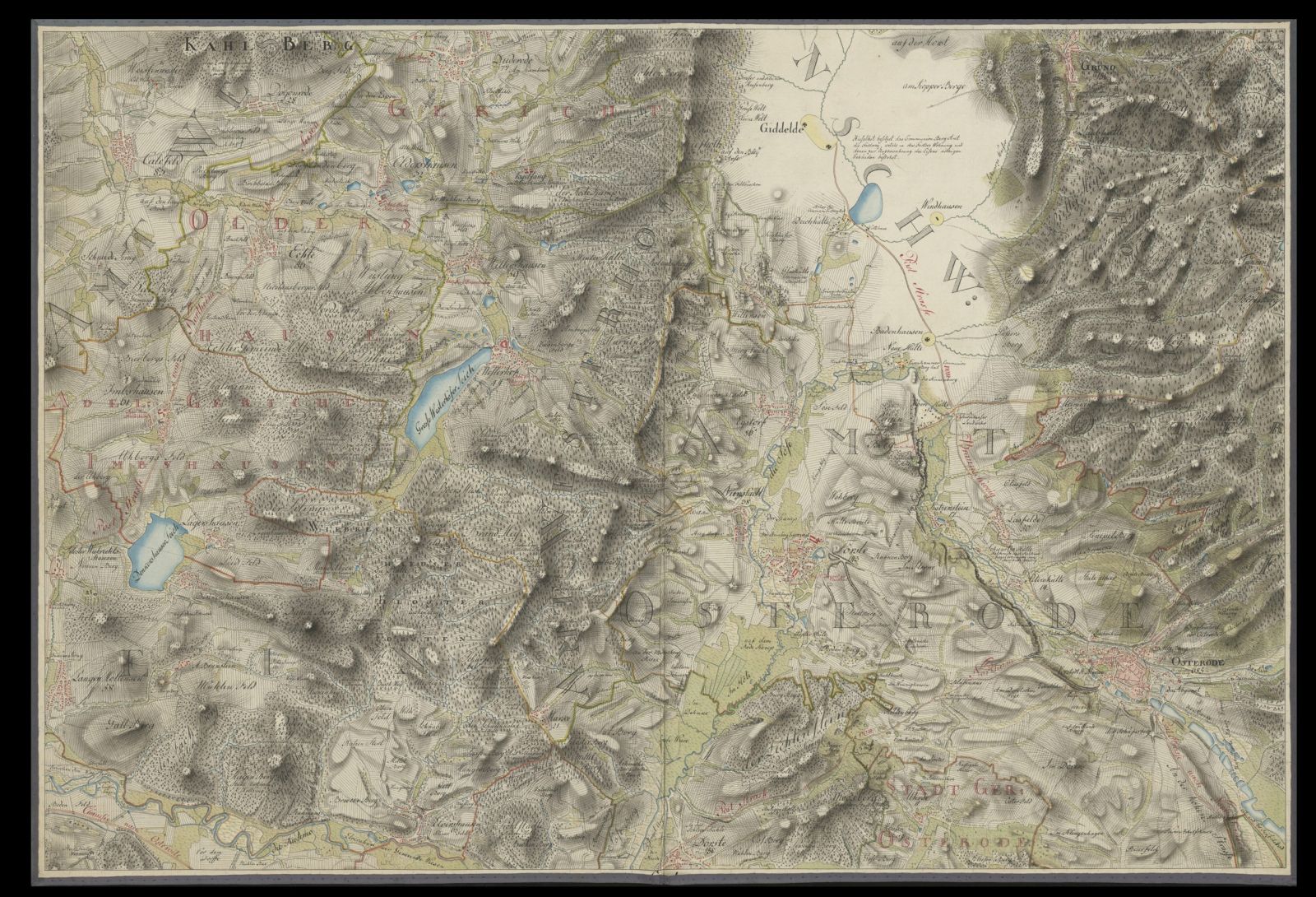
Georg Siegesmund Otto Lasius, Electorate of Hanover survey, 1783, hand drawing, Berlin State Library, Prussian Cultural Heritage, catalogue no. N 25564 sheet 143

This map is characterised by great attention to detail. Georg Siegesmund Otto Lasius (1752–1833) created an impressive work here. The sheet shows the area from Bad Grund to the Teufelsbad near Osterode, but only the section from Osterode to the Warte is reproduced here. It is curious that today’s Teufelswarte is referred to as “Halbe Warte”. Was there a watchtower of which only one half was still standing, as Weitsch shows in his painting from 1760?

Above all, the map shows that the old roads ran along the ridge rather than through the swamp, unlike today’s B 243, which was only built as a state road between Hildesheim and Nordhausen in 1937. At that time, the valley of the Apenke had a much denser sequence of ponds than today, including the Kleine and Große Teufelsbad.
Here on the Hohe Straße between Herzberg and Osterode, Johann Wolfgang von Goethe was also travelling in August 1784, at least his heavily loaded carriage was. He rode, as we know.