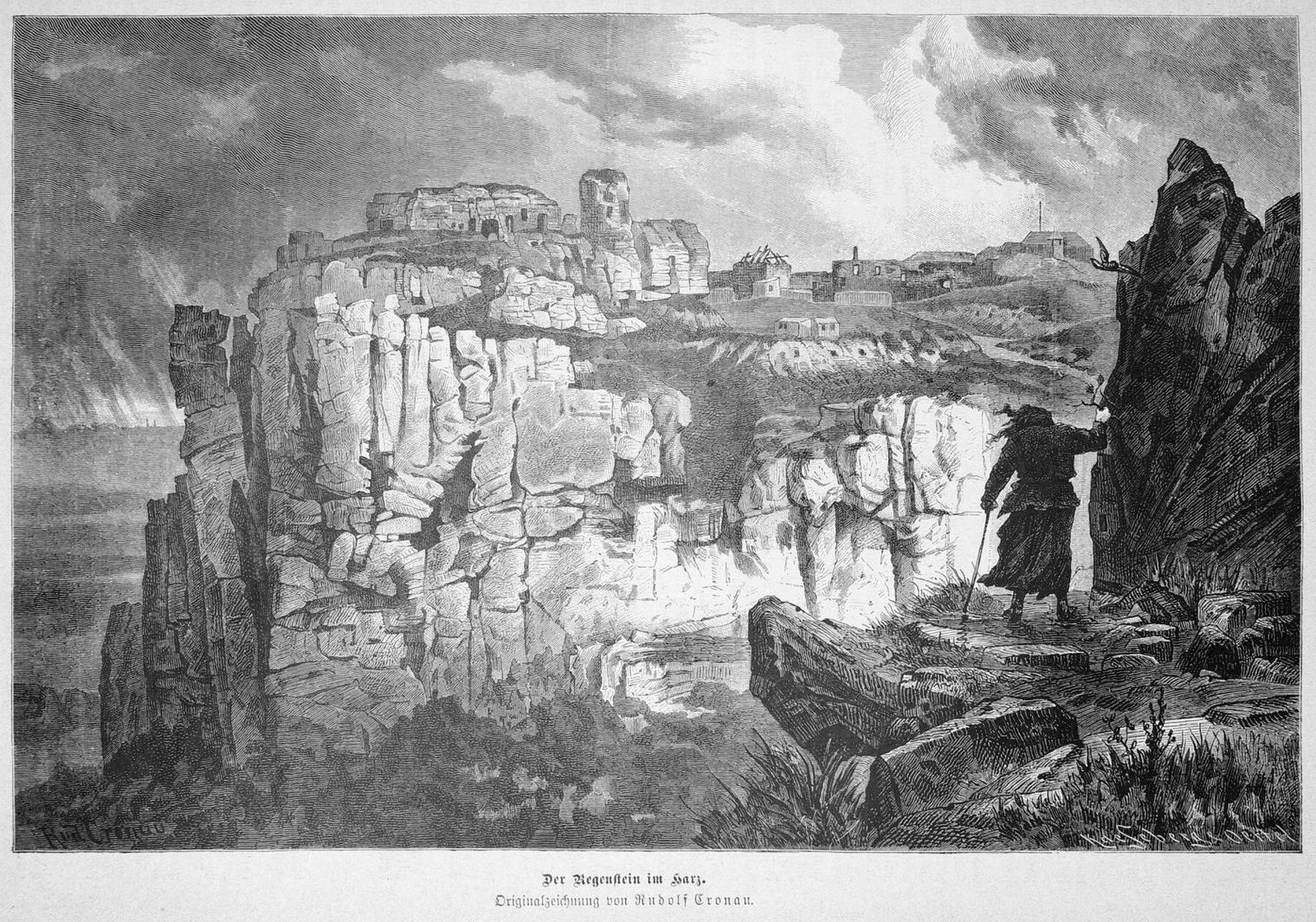
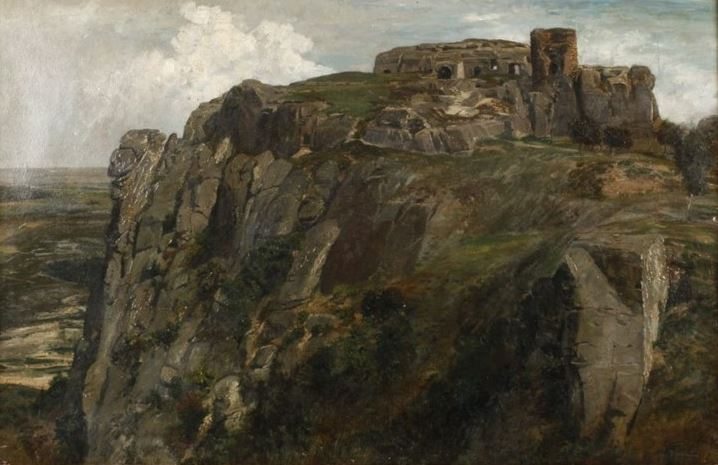
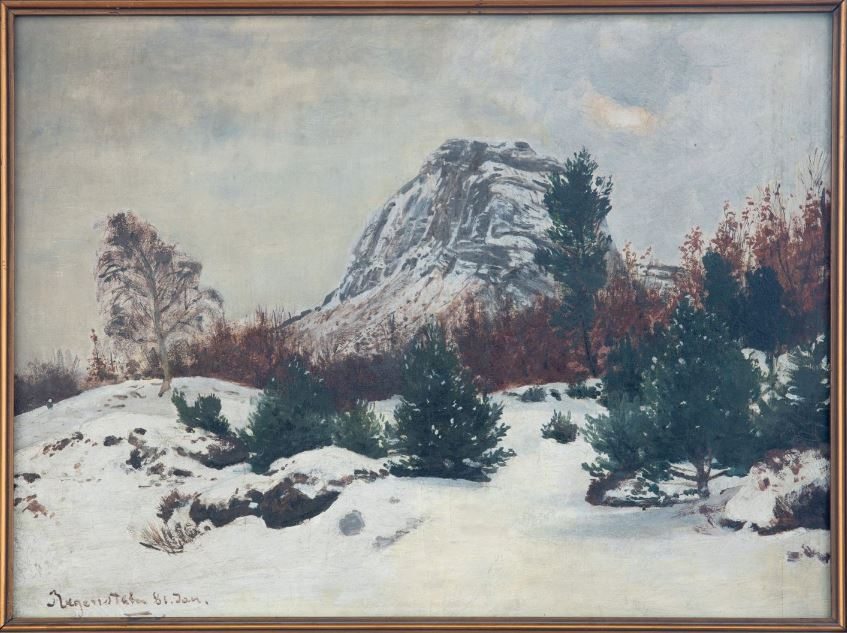
With the painter’s vantage point at Bastion Scharfe Ecke, we have taken up the most common Regenstein view, although only about a third of the many depictions chose it. Maybe Regenstein is the unknown favourite among the painters’ viewpoints. The wall of the impressive sandstone cone drops 80 metres, with a castle perched on top. It was turned into a fortress from 1671 onwards, but during the Seven Years’ War in February 1758 it was thoroughly demolished by the Prussians. The powder magazine exploded during the process. Since that time, the violence inflicted on the mountain and its stubborn resilience have been part of the fascination with the ruins of Regenstein that still lives on today.
At the end of the 18th century, the preferred view was from the valley, where the rock appears as a broad cylinder. The Romantic painters with experience in Italy saw in the treeless hilly landscape lying in the Harz rain shadow a kind of German Campagna: red-brown burnt grass, violet heather, and white sand – with the blue sky above. The Papenberge, Heimburg, and Ziegenberg also became subjects for artists. The realism of the Weimar school of painters discovered, at the end of the 19th century, the rain-soaked rock with its brown-green mosses and the snow under the leaden sky above.
The painter and journalist Rudolf Cronau had a special idea for his Regenstein painting. In the foreground on the right, he invents a rock that doesn’t actually exist.