© Fotoweberei & Schloß Wernigerode GmbH

Romkerhall Waterfall

1900

The motif

The Oker Valley has two inn poles, between which stretches, for an hour and a half on foot, a Saxon Switzerland made of granite. The Oker North Pole is the forest inn, but its South Pole is Romkerhall.

Our location is at the upper end of the Romkerhall Waterfall, which plunges 64 m into the depths here as the longest waterfall in the Harz. The waterfall was created in 1863 by the innkeeper Lüer. For this purpose, water from the Kleine Romke is diverted at the top and channelled through a ditch, along which it’s nice to walk, all the way to the Romker Cliff. The innkeeper completed his inn in the same year, 1863, and expected many guests. Why not: the main road through the Oker Valley had been expanded a few years earlier, at great effort and by blasting away many rocks, so that people could now travel here by carriage. The people of Bad Harzburg had set an example in 1859 with their Radau Waterfall, which, built in a strategically favourable spot by the road with an inn beside it, had become a popular excursion destination for spa guests. The Oker Valley achieved similar tourist attraction, and in terms of waterfall height, it easily surpassed that of Bad Harzburg. The Romkerhall innkeeper even had a leaflet printed in the 1930s praising the waterfall as “the landmark of the Oker Valley.”

Since, as always, A is followed by B, the Oker Valley has also been developed into a through road for car traffic. There’s a large car park here, which is regularly overcrowded on summer weekends.
Romkerhall Ansichtskarte
©  Schloß Wernigerode GmbH
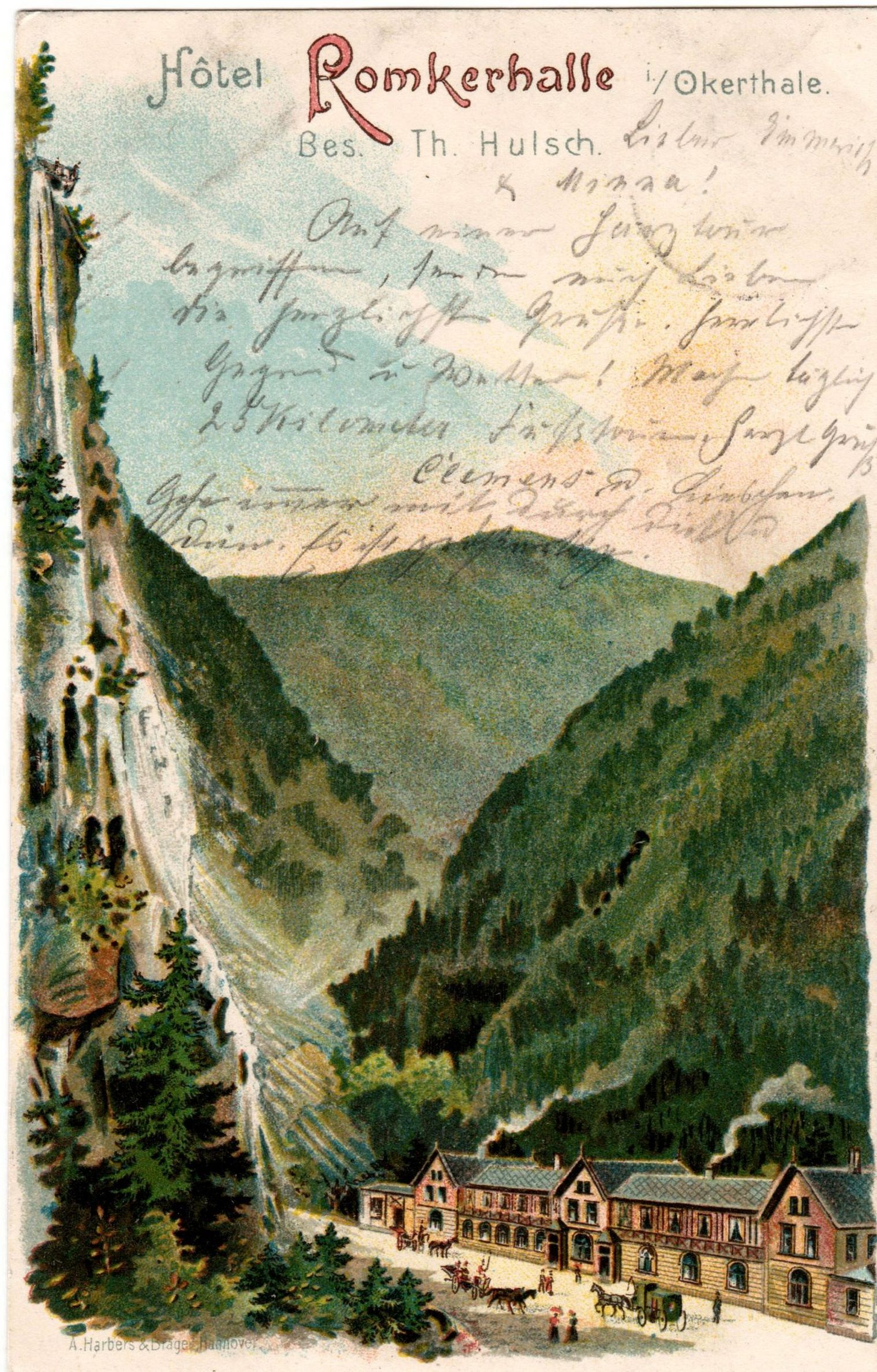
Postcard of the Romkerhaller Waterfall with Romkerhalle

.

around  1900

created

Printed by Hans Wasserkampf & Co Hannover

14.2 x 9 cm

from the collections of Schloß Wernigerode GmbH

.

Hiking tip

To the left of the waterfall, a steep serpentine path leads up to the Romker Cliff, which has been levelled into a platform and secured with a railing. Here, you stand at the top of the waterfall. It’s more pleasant to walk along the wide path by the Kleine Romke, even though it’s considerably longer. A network of circular hiking trails leads to individual cliffs such as the Treppenstein, the Mausefalle, or the Old Man of the Mountain.

by unknown painters

Painters have the advantage over photographers in that they can show us places that don't actually exist. It isn’t possible, without risking one’s life, to capture both the rock with the waterfall and the Romkerhall Inn in a single picture – unless you float in front of the rock face and adjust the perspective. But who would ever think about that? Our eyes take it for granted, because we have learned to see through painters. The photographic comparison is sometimes disappointing; that’s probably why, until the First World War, picture postcards were mostly painted. We want to be amazed!

Our eyes wander up to the steep, dangerous point above and, sliding down the waterfall, find relief below in the inn. Down here, one could also buy the inexpensive colour print of the postcard, which had replaced the hand-coloured large and costly view sheets of earlier times. The client, of course, was the clever Romkerhall innkeeper. Both postcards bear the names of printing houses in Hanover. But the names of the painters, as doubly independent labourers, have vanished.

For comparison

Postcard of the Romkerhaller Waterfall with Romkerhalle, posted 1900, printed by A. Harber and Bräger Hannover, 14.2 x 9 cm, from the collections of Schloß Wernigerode GmbH

Romkerhall Ansichtskarte
© Schloß Wernigerode GmbH

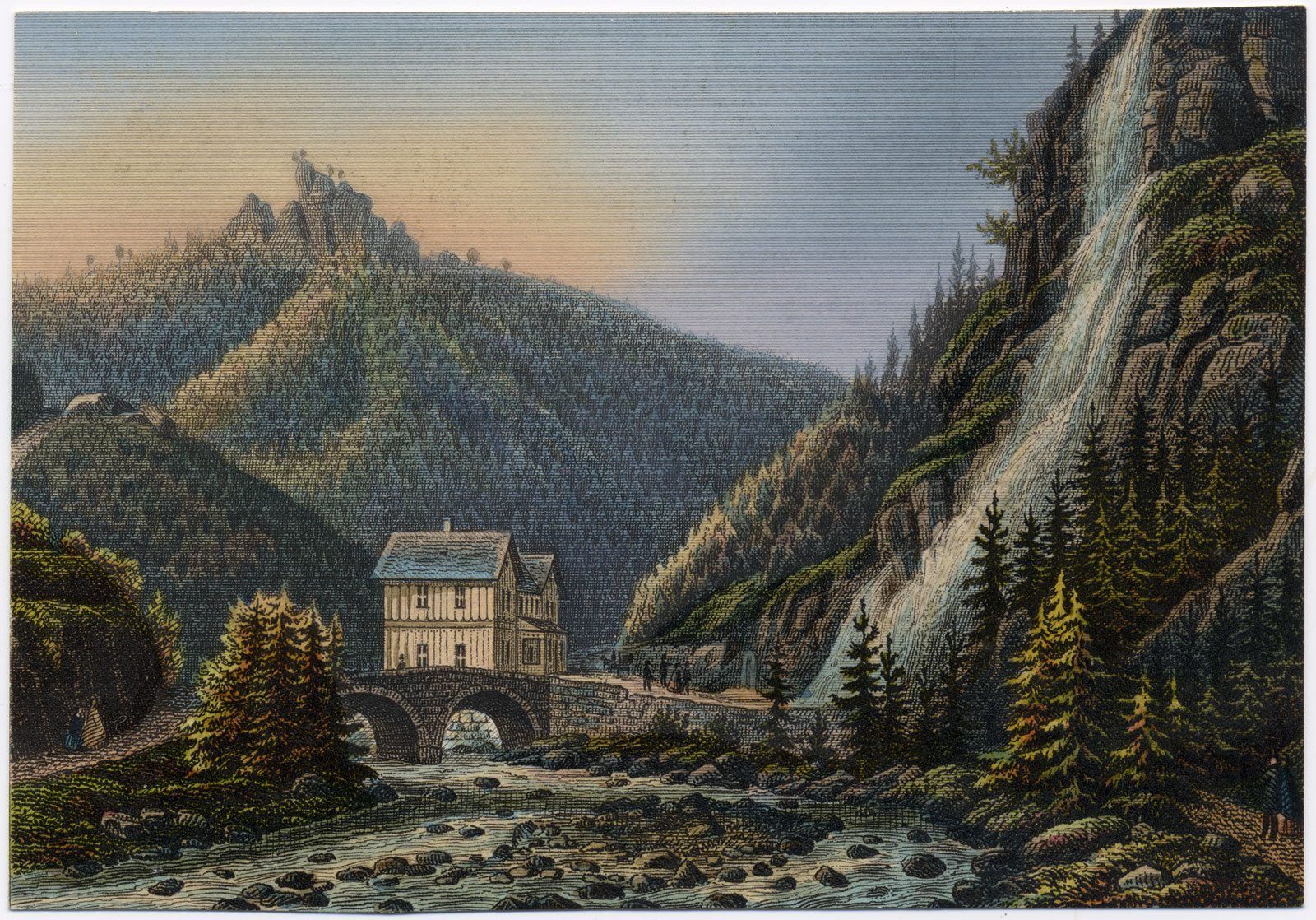
Albert Schule after Wilhelm Ripe, Romkerhall and Romkerhaller Waterfall, 1864, coloured steel engraving, image size 6.3 x 9.1 cm, from: Brückner’s Harz Album (1864), Bode Collection, Hamburg

 Romkerhall, Ripe
© Sammlung Bode, Hamburg

It can clearly be seen here that the Romkerhall guesthouse, built in 1863, originally consisted of two gabled buildings that were connected to each other. The guesthouse was soon enlarged to three gabled buildings, which it still has today. Wilhelm Ripe took his position by the Oker Bridge, built in 1861, with the Rabenklippe rising above the guesthouse.