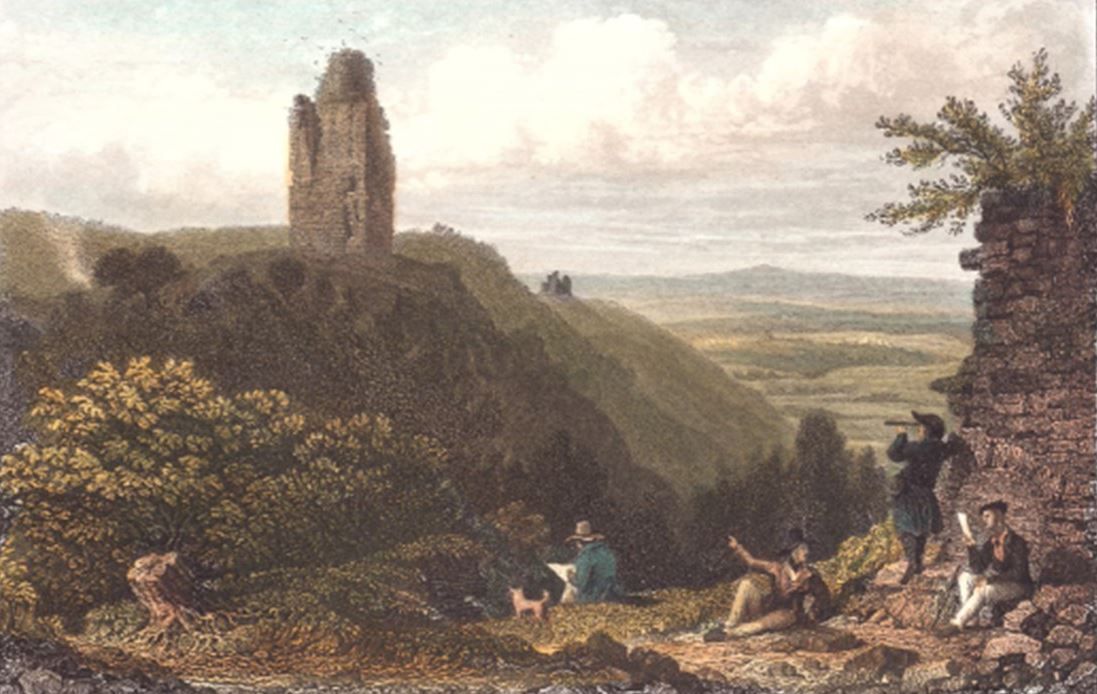
The location of this painter’s view was the old Kyffhausen Imperial Castle, more precisely its lower castle. From here we look across an abyss towards the upper castle at the Barbarossa Tower, behind it on the slope the Rothenburg, to the right the Golden Aue, and in the distance the Harz Mountains with the Brocken. Of course, the Barbarossa Tower got its name from the famous legend which says that the Hohenstaufen emperor still lives here beneath the mountain and that one day the divided Germany will finally be united again. The castle was a popular place to visit, especially during times of national threat in the Napoleonic Wars and the Wars of Liberation. This is shown by the Dresden painter through a group of young men in the foreground; he even included himself in the picture. Today we stand on the terrace of the Kyffhäuser Monument and can enjoy the same view. But the view from the lower castle is blocked by the monument, built from 1890 to 1896. Old castle walls were removed to make way for massive new terrace walls. The Wilhelmine Germany that marched off to strike twenty years later was already presenting its dreams of unity here as the fulfiller of Emperor Barbarossa’s vision. The picture preserves our memory of one of the largest German castles, over 300 metres long, and encourages reflection on patriotism and nationhood – difficult issues for us Germans.
Artist
created
Image size 9.8 x 13.8 cm
The Picturesque and Romantic Germany, Leipzig at Wigand, 1838, from the collections of Schloss Wernigerode GmbH
The small and distinctive Kyffhäuser ridge is easy to hike and repeatedly offers beautiful views of the plain lying over 250 metres below. Following the ridge line and mostly away from the road, a hiking trail – part of the 37-kilometre-long Kyffhäuser Trail – links the two castles of Kyffhausen and Rothenburg, which also mark the highest points of the Kyffhäuser (5 kilometres, 1 hour).
This steel engraving was also published, like the steel engravings by Adrian Ludwig Richter, in the popular multi-volume work “Picturesque and Romantic Germany”, which was released by the Leipzig publisher Georg Wigand and hit the spirit of the age perfectly by combining literary travel impressions with images. But not in the volume about the Harz — in the one about Thuringia! The Dresden painter Otto Wagner (1803–1861) created the Thuringia drawings. He didn’t observe people as closely as Richter did; his figures remain mere decoration. Take a look, for comparison, at Richter’s view of nearby Sangerhausen. By the way, there were also painters who counted the Kyffhäuser among the Harz mountains — for example, in a Harz series from 1828 — perhaps simply because of the view across? Historically, though, the fertile soil of the Golden Aue between the Harz and Kyffhäuser has belonged to Thuringian territory since the time of the legendary Thuringian kings from the Agilolfing dynasty. Still, Harz painters repeatedly included the Kyffhäuser in their print series, and even today the Harz and Kyffhäuser cooperate in tourism. After all, what would the Kyffhäuser be without the view across to the Harz?

The location of this painter’s view, like the older coloured steel engraving from 1838, is the lower castle of Kyffhausen Imperial Castle. The main subject is the Barbarossa Tower, with Rothenburg in the background and the Brocken further away. Was the artist of this steel engraving really there in person, or did the creators in Hildburghausen rather use the older model? Clue 1: they don’t name an artist. Clue 2: the location and details of the Barbarossa Tower match exactly. Clue 3: the Gothic window on the left isn’t recorded elsewhere; it’s an artistic addition.
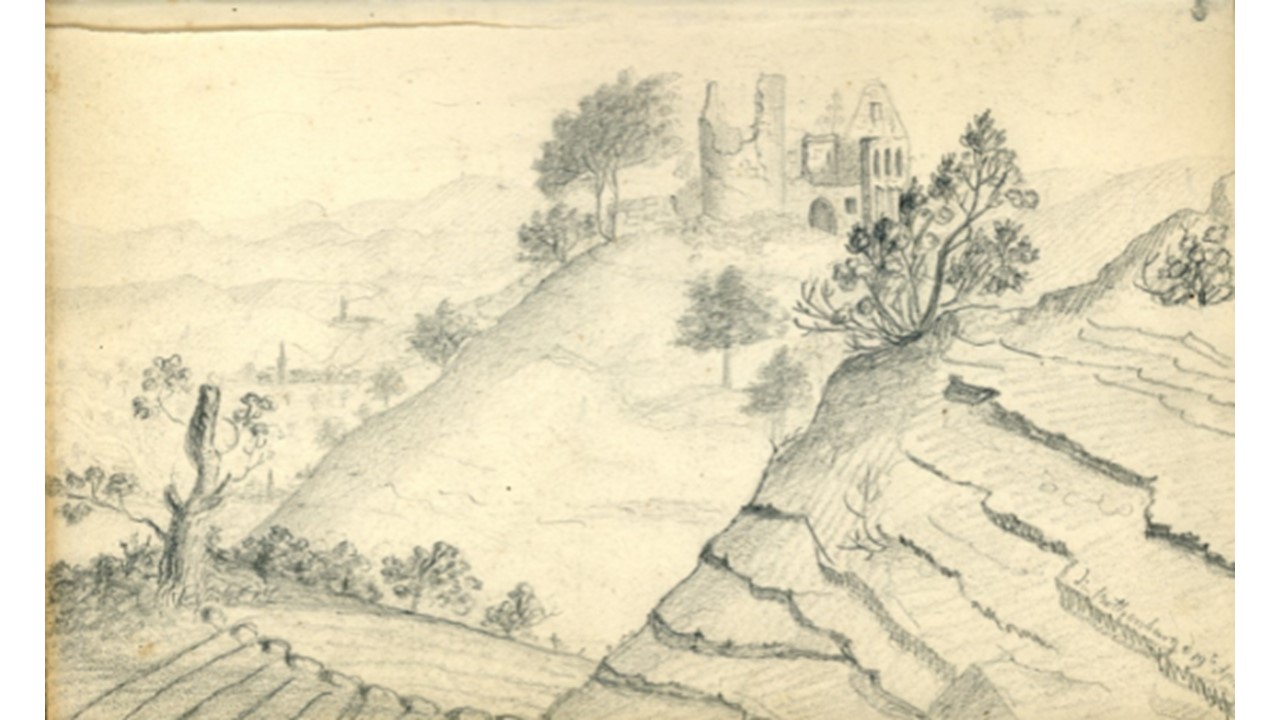
The Rothenburg was also a meeting place for patriots during the Wars of Liberation. The Barbarossa legend of the Kyffhäuser and the red colour of the sandstone contributed to this. The aspiring pastor Albert Baur was one of them, by the way a friend of Father of Gymnastics Friedrich Ludwig Jahn, whom he had visited earlier in April 1830 in his exile in Freiburg /Unstrut. Reaction had long since returned. As a theologian, Baur was not allowed to study in Prussia or obtain a parish position in Berlin. From Belzig/Fläming, he submitted several applications, all of which were rejected. All his mail reached him opened and censored until the lifting of the gymnastics ban in 1844. Baur shows us on the left in the valley the small town of Kelbra and the castle complex, naturally before the later extensions that were built when some red sandstone remained from the construction of the Kyffhäuser Monument in 1896.