© Fotoweberei & Schloß Wernigerode GmbH

Wernigerode Castle

1850

The motif

The town hall may be the most charming architectural highlight in the town of Wernigerode, but the castle high above it also offers a breathtaking view of the Harz Mountains. “Hardly could an inhabited castle have a more remarkable location than the one in Wernigerode on its high hillside.” These words were written in 1834 in Zimmermann’s Handbook of the Harz Mountains.

The castle stands on a rocky spur of Agnesberg. The actual summit of the mountain, however, is 20 metres higher and that’s the spot from which our painter viewed it. This elevated position, which unfolds the landscape behind before our eyes, is the special charm of this picture – something a comparison with an ordinary veduta quickly reveals. In the drawing by Georg Heinrich Crola, we still see the castle in its baroque form under Count Henrich of Stolberg-Wernigerode. Back then, quiet Wernigerode was known as the “place in the corner”. One generation later, however, came a reconstruction of such lavishness and density of ideas, decorations and materials that it would mark both a high and final point of the historicist era. Neuschwanstein might come to mind here, and that wouldn’t be an exaggeration. Visitors can see, for example, the banquet hall where emperors dined, the smoking lounge, the writing cabinet, the neo-gothic castle chapel and, of course, the royal rooms that once awaited guests from Berlin.
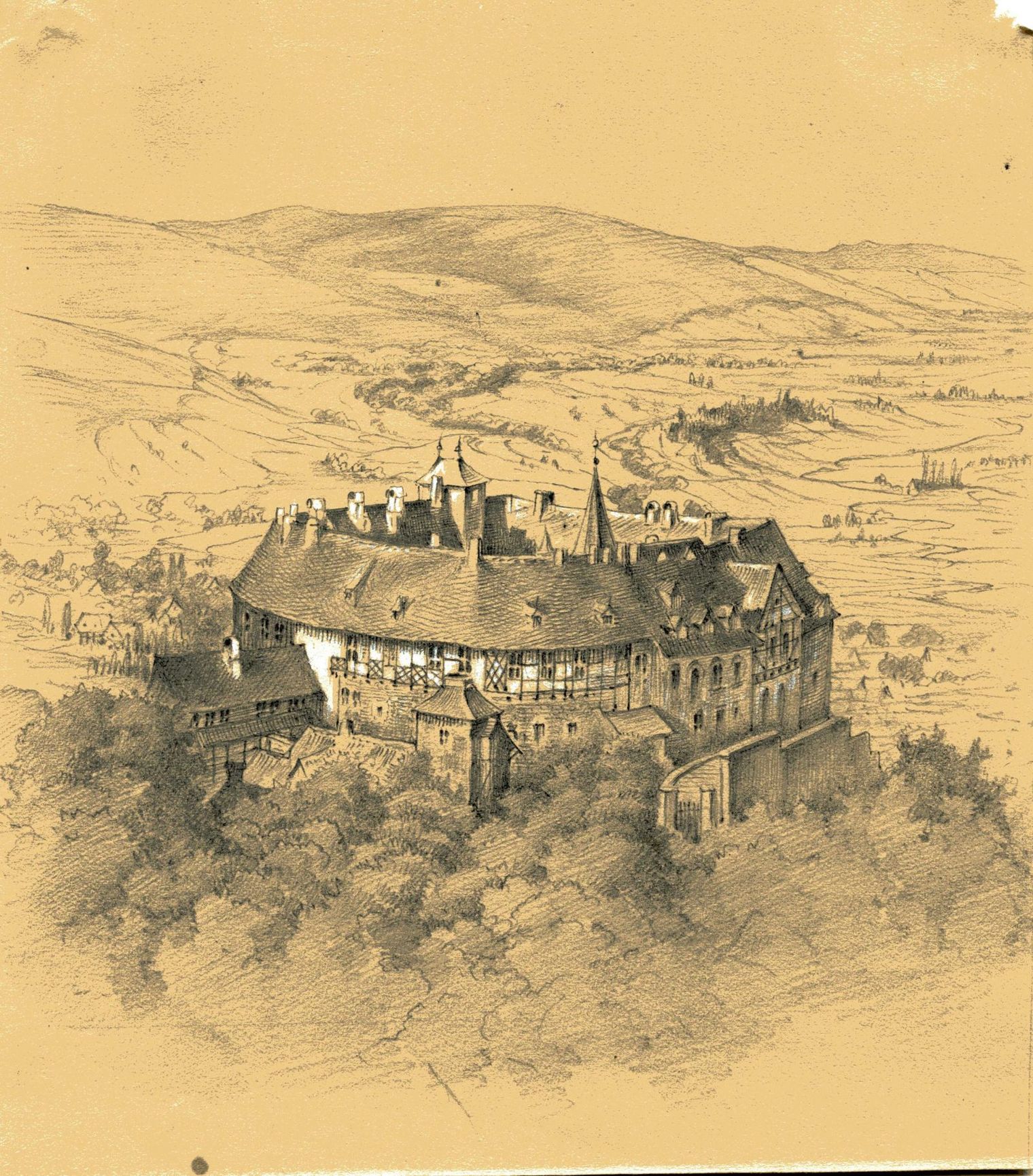
Schloss Wernigerode, Crola
©  Schloß Wernigerode GmbH
Georg Heinrich Crola

Artist

around 1850

created

Pencil on cardboard, heightened with white

16.2 × 14.1 cm

from the collections of Schloß Wernigerode GmbH

.

Hiking tip

The Malerblick viewpoint on Agnesberg is also a stamping point of the Harz Hiking Badge. It’s just a ten‑minute walk from the castle to here and yet it’s a quiet place. A walk on to the wildlife park, the former forester’s lodge Christianental, is recommended. Over a hundred years ago, artists already found a good inn there, just as hikers and walkers do today.

About the artist

The landscape painter Georg Heinrich Crola (1804–1879) had lived in Ilsenburg since 1840 with his wife Elise Crola, and both left behind an extensive body of work depicting beautiful Harz motifs, which, unfortunately, is now scattered. But Crola was not simply a painter of the Harz region – he was an artist of national importance, whose works are sought after by major museums in the art trade. He was an attentive observer not only of landscapes but also reflected deeply on life and the people around him, never shying away from voicing his opinions. A man of character, then, who attracted friends, colleagues, and students. In Berlin, people were already openly considering establishing an Ilsenburg branch of the Academy of Fine Arts. There is usually something special in his landscape paintings. In this drawing, it is the view into the castle courtyard and up to the slopes of the Harz above – a motif that he, incidentally, repeated once more for Count Henrich of Stolberg-Wernigerode.

For comparison

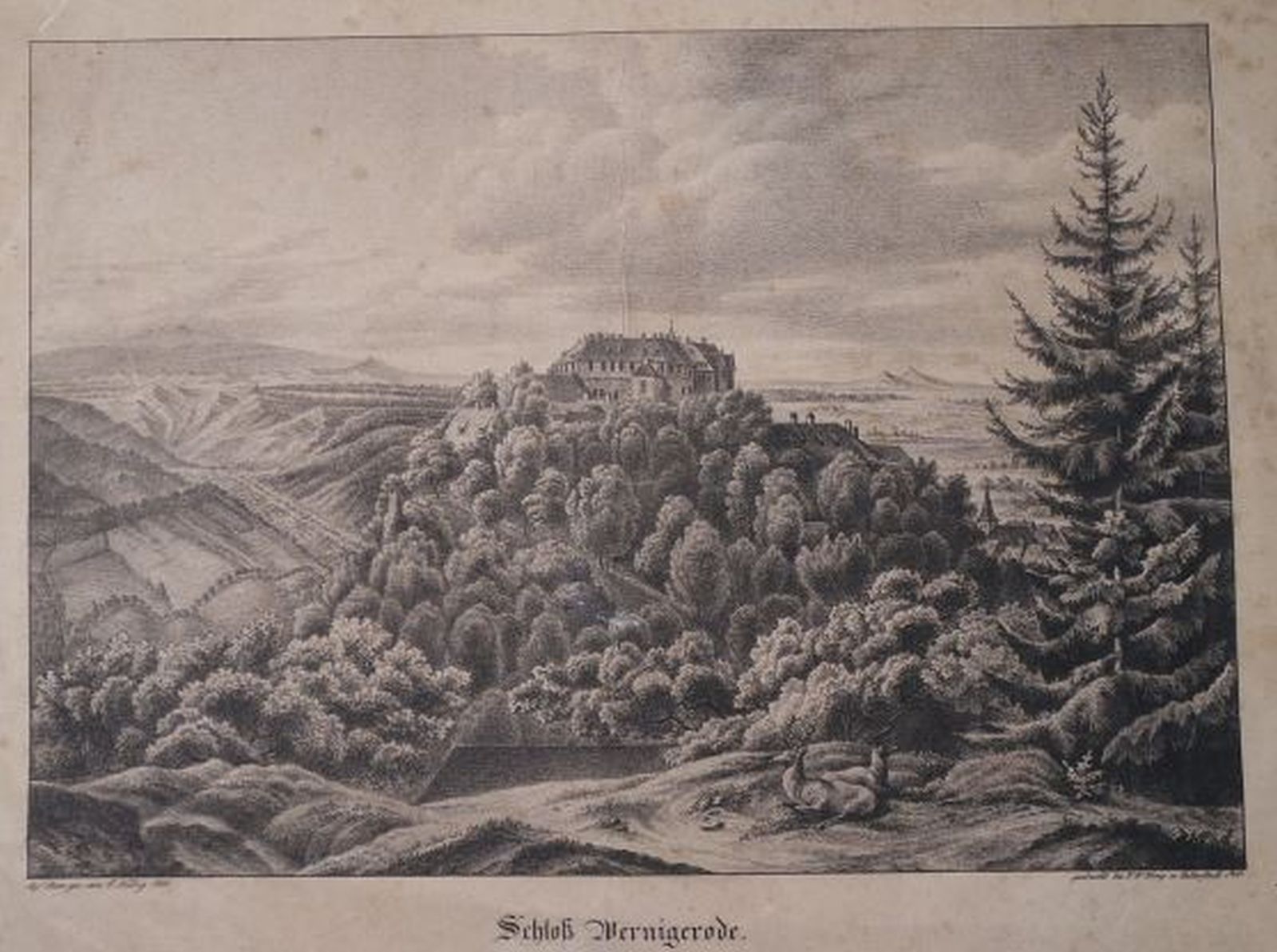
Ernst Helbig, Wernigerode Castle with a view of the Brocken from Agnesberg, 1831, lithograph, sheet size 27 x 38.4 cm, published by F. W. Wenig, Halberstadt, Blankenburg City Archive (Harz), formerly Museum Schloss Blankenburg, Inv. No. V741 K2

Schloss Wernigerode, Helbig
© Stadtarchiv Blankenburg

Ernst Helbig’s view of the castle from Agnesberg is not taken from as high up as Georg Heinrich Crola’s. Yet those few metres make all the difference for Crola, whose view unfolds the landscape like a carpet. For Ernst Helbig, however, this early lithograph was mainly a source of income, showing a tourist spot meant to remind buyers of their visit to Wernigerode. By the way, we know this print from only one copy, and it bears the marks of time: creases, tears, foxing and light-induced browning. Specialists in museums and collections are responsible for preserving such unique pieces. These traces in particular breathe age – almost 200 years in this case.

Bert Heller, Wernigerode Castle in Winter, 1947, oil on canvas, 1947, 59.7 x 80.3 cm, Harz Museum Wernigerode, Inv. No. K 2738

Schloss Wernigerode, Heller
© Harzmuseum Wernigerode, Foto: Norbert Perner

The painter and designer Bert Heller (1912–1970) ended up here as a war refugee from the East – just like 75,000 others in the Wernigerode district. He stayed until the end of 1949, then took on assignments in Berlin, received the National Prize in 1951, became a university teacher, even rector of the Art Academy in Berlin, and died there in 1970. During his short time in Wernigerode, he created a series of views, including the motif of Agnesberg. The skeleton of the dead tree still reminds of what has just been overcome. One of Heller’s impressive murals has also been preserved in the town hall, showing a procession of refugees and another of people moving into the future.