© Fotoweberei & Schloß Wernigerode GmbH

Wernigerode Town Hall

1867

The motif

Painter’s views tell stories: the marketplace painting of Halberstadt speaks with pride, while the town hall of Wernigerode, the city’s most important landmark, radiates cheerfulness. It dominates the northern side of the market square.

Few people know that the town hall used to be a playhouse and was given to the council of the small town by the ruling prince of Stolberg-Wernigerode because he no longer needed it. That’s why, even today, colourful figures of jesters, musicians, and even a May Queen still dance on the town hall’s façade. They remained and were joined by more figures when the townspeople rebuilt, extended, repaired, and improved their town hall from 1498 onwards.

Many think that the town hall, with its beautiful bay towers, was built in one piece. But a closer look and a comparison with old paintings reveal how much has changed! Entire buildings were added on!

Isn’t it strange that this town hall could become the symbol of the city? There are similarly beautiful half-timbered town halls elsewhere. But none has been depicted as often as the one in Wernigerode. Perhaps pictures are like snowballs – one gets things rolling, and each painting leads to the wish for new ones, especially when it’s about such a surprisingly charming building.
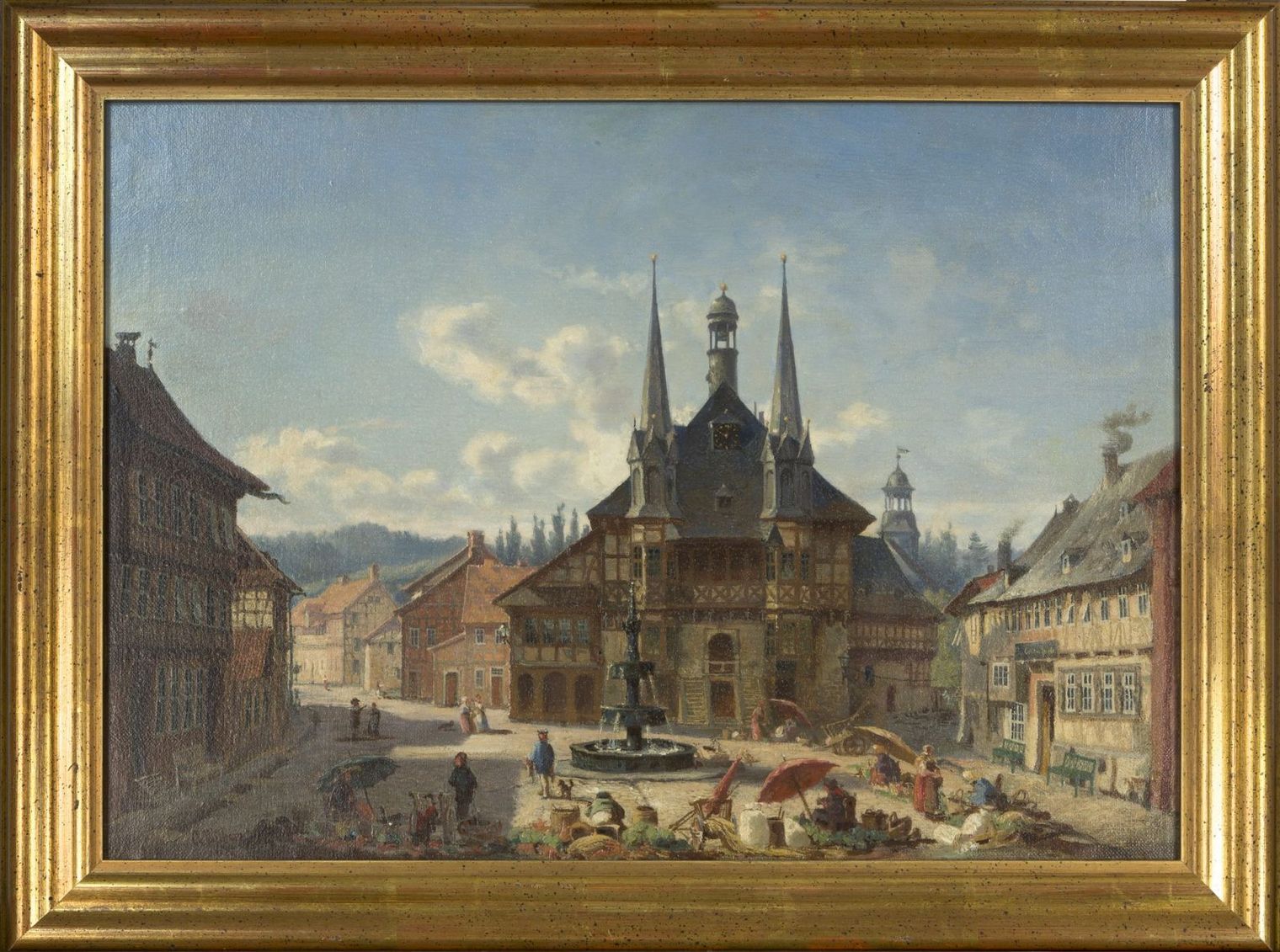
Rathaus Wernigerode, Wilberg
© Harzmuseum Wernigerode, Foto: Norbert Perner
Christian Wilberg

Artist

1867

Created

Oil on canvas

31 x 44 cm

Harz Museum Wernigerode

Inv. No. 3114, on display in the permanent exhibition

Hiking tip

Recommendation for a city walk 

The town began on the Klint, a quiet corner just a few steps to the right behind the town hall. Here you’ll also find the Harz Museum with its treasury, which also features many other views of Wernigerode and Harz by various painters and, of course, the original paintings of the town hall itself.

About the artist

The painter Christian Wilberg (1839–1882) was still completely unknown when he created this painting of the town hall in the sunshine. Six years earlier, he had worked as a room painter with his father in Havelberg, and now he was a decorative painter in Berlin. All still wage work for the sake of his wallet. Since his trip to the Harz Mountains in 1865, he had repeatedly tried his luck at exhibitions with Harz-themed works. In the small painting from 1867, he also surprises with a rich market display of local vegetables, and it’s probably quite accurate to say that the citizens of Wernigerode were not queuing here or posing picturesquely as a more refined Berlin painter might have shown us.

In 1870, the 31-year-old Wilberg set off for Düsseldorf to study painting. Later, as a painter of famous places like Pergamon or Potsdam, he became somewhat famous himself, and in 1882 the National Gallery in Berlin even dedicated a solo exhibition to him.

For comparison

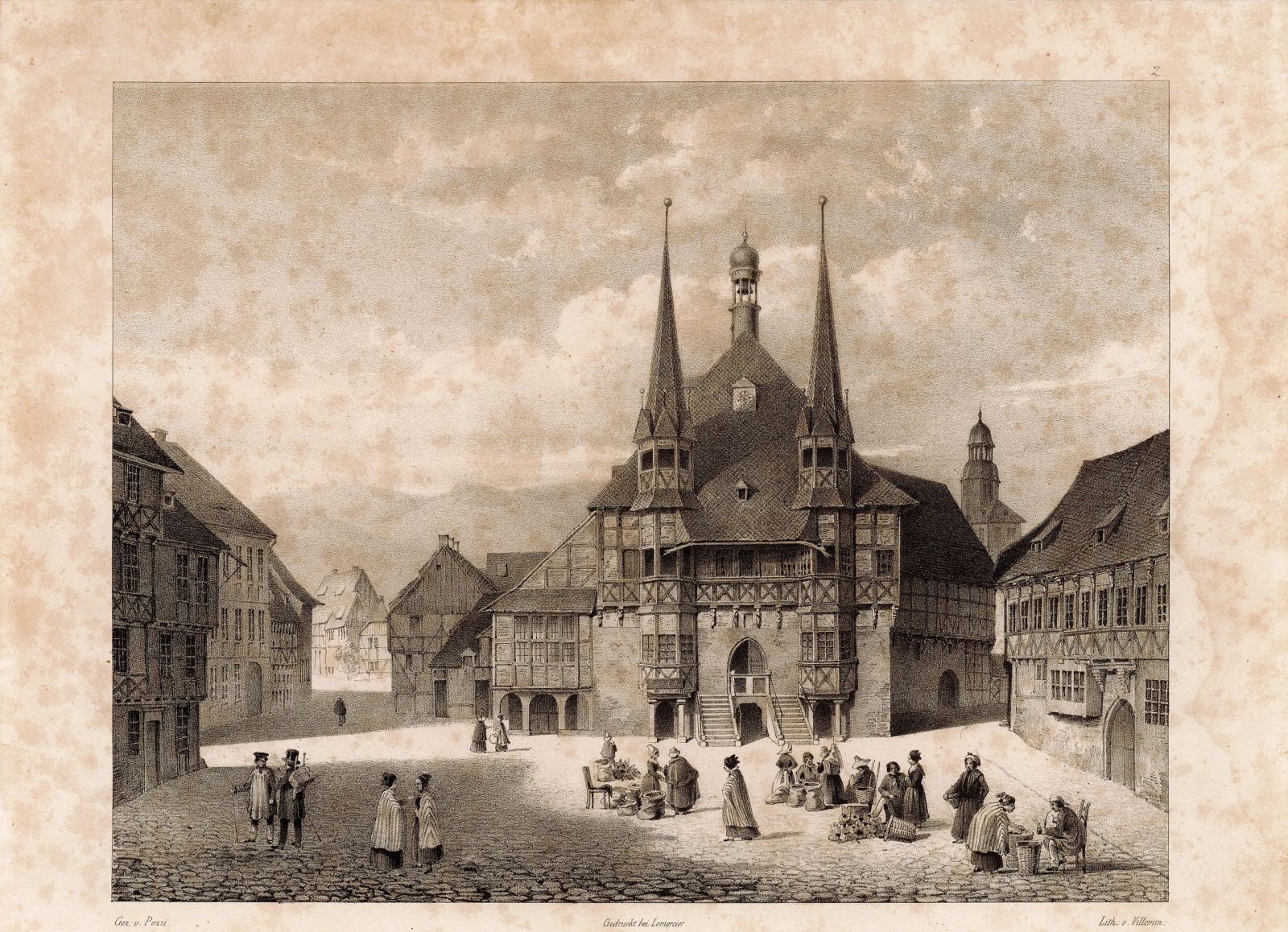
Charles Villemin after Carlo Ignazio Pozzi, The Market Square of Wernigerode with the Town Hall, 1848, lithograph, sheet size 23.5 x 29 cm, from: Puttrich, Monuments of Medieval Architecture, Issues 31–32 (1848)

 Rathaus Wernigerode, Pozzi
© Harzmuseum Wernigerode

Harz Museum Wernigerode, Inv. No. K 3253 

The Wolthäter Fountain on the market square is not yet shown here, even though the print was published in 1848. Its construction was delayed until 1849. But that isn’t why the fountain is missing. The draughtsman Ignazio Pozzi from Dessau (1766–1842) had visited Wernigerode quite some time earlier and had already died in 1842.

Charles Hoguet, Wernigerode Town Hall from the east side, 1861, oil on canvas, 100 x 66 cm, permanent loan from the Hamburger Kunsthalle in the Harzmuseum Wernigerode

Rathaus Wernigerode, Hoguet
©  Harzmuseum Wernigerode, Foto: Norbert Perner

on display in the permanent exhibition

Such a market on the east side of the town hall probably never existed. But it's painted with such artistic finesse that we’re willing to believe it. The painter Charles Hoguet (1821–1870) was a Berliner of Huguenot descent who received formative artistic training in Paris and Normandy. Of course, he also paid a visit to the Dutch Baroque. Theodor Fontane wrote enthusiastically about him, saying he made small things great with his art. Hoguet didn’t strive for academic positions but for a kind of sfumato, a sensuality that still finds passionate admirers today. And in the permanent exhibition of the Harzmuseum Wernigerode, it’s definitely worth a visit.