Harz Ceramics Altenau

Where clay comes to life

The final metres lead steeply upwards. Then the narrow road ends right in front of the studio, where a sign in the window invites you to step into the cosy little house at the edge of the forest in Altenau. The somewhat hidden Harz Pottery Altenau is meant to be searched for, found, and discovered!

The clay kingdom stretches across the entire ground floor. As different as Irene Schukies’ works may be, they all have one thing in common: clay. "This raw material is fantastic, a material with almost inexhaustible possibilities for creative work," enthuses the lively woman from the Rhineland, brushing the back of her hand through her pinned-up hair. Her fingers still shimmer grey and damp from the work on the potter’s wheel, which stands just behind the open door in the workshop. Irene Schukies has learned pottery from the ground up. "At the start of my training, I had to throw cups for six months straight," she recalls, laughing. We can immediately witness her professionalism and skill: she sits on a small stool in a corner of the studio. In front of her, the wheel spins with a lump of pottery clay that she has separated from a ten-kilo block. The material she uses is a special clay mixture from Rhineland-Palatinate. At first, the supplier had great difficulty navigating the narrow, steep road. By now, the driver confidently reverses his lorry up the hill to the house with ease.

The old little house immediately captivated Irene Schukies. "We had searched in many parts of Germany for a new home and place to work," her husband Christian Zineker tells us. "At the foot of the Mühlenberg in Altenau, we have now settled." And they have truly arrived, even though things don’t always run smoothly when "cheerful Rhinelanders" meet rather reserved people from the Upper Harz. He has been involved in the Altenau Round Table, serving as spokesperson since 2017, is a member of the local tourism association, and co-founded the Altenau Citizens’ Association in 2019. Through the Typisch Harz network, she has now built many fruitful connections with like-minded people across the region. 
 

From funkenmariechen to creative artist

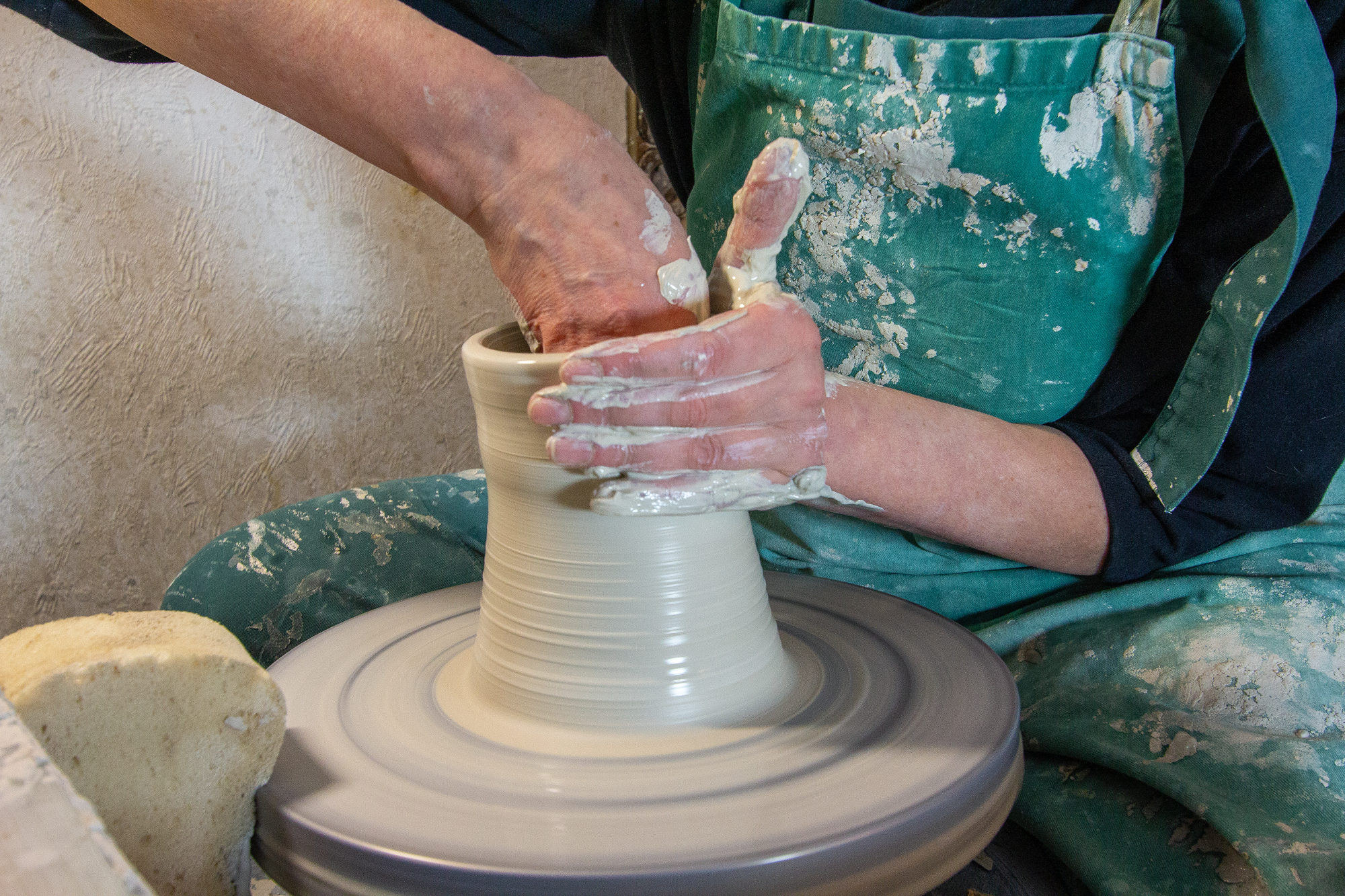
Typisch Harz – Harz-Keramik Altenau | Die Wandung einer Vase wird modelliert
© Thorsten Schmidt, Schmidt-Buch-Verlag

The lump of clay rotates on the wheel; moistened by Irene Schukies’ damp hands. She presses her fingers or her palms powerfully into the stubborn material, giving the still shapeless form a centre of gravity. From there, symmetry slowly begins to emerge. Everything is in swift, rotating motion. Now her thumbs first press down from above on the wet mass, then her fingers. An opening appears, becomes larger, deeper. Irene Schukies is fully focused. The muscles of her entire upper body are visibly straining. A wall rises. And then, pushing quickly upwards, a cylindrical hollow form takes shape. The goal becomes clear: a vase.

Irene Schukies transfers the energy of movement from the production process into her motifs. This results, for example, in snapshots of moving animals as appliqués on cups. A desire for movement, a joy of dance. Even as a child, Irene Schukies tested boundaries for years as a majorette and, with her group, even became German Champion in formation dance. “We all enjoyed the applause on stage,” she recalls. “But success only came through really hard training.” And through discipline. She still benefits from that today. 

After school, she trained as a retail saleswoman in textiles and managed a branch. Before long, she realised that she was longing for something different. She joined alternative artists who lived and worked in a disused stucco factory in Bonn. “Here I was allowed to be who I am,” Irene Schukies reflects with shining eyes, “and above all I realised what makes me happy. It was the manual work, the physical aspect.” She worked in various trades and discovered pottery for herself. After an apprenticeship in a medium-sized company that was soon swept away by the flood of cheap ceramics from the Far East, she studied design at the Ceramic Technical School near Koblenz. “I received lots of creative inspiration there and above all learned the technique of plaster mould making.” Thanks to her solid training, she can now create her earthen ideas either by throwing on the wheel, casting into a mould, or building freely by hand — or by combining several techniques. This results, for example, in the unique pottery from the Typisch Harz award-winning series of cups, mugs, bowls, dishes, plates, jugs, pitchers, tins...

Craftsmanship that tells stories – every piece is unique

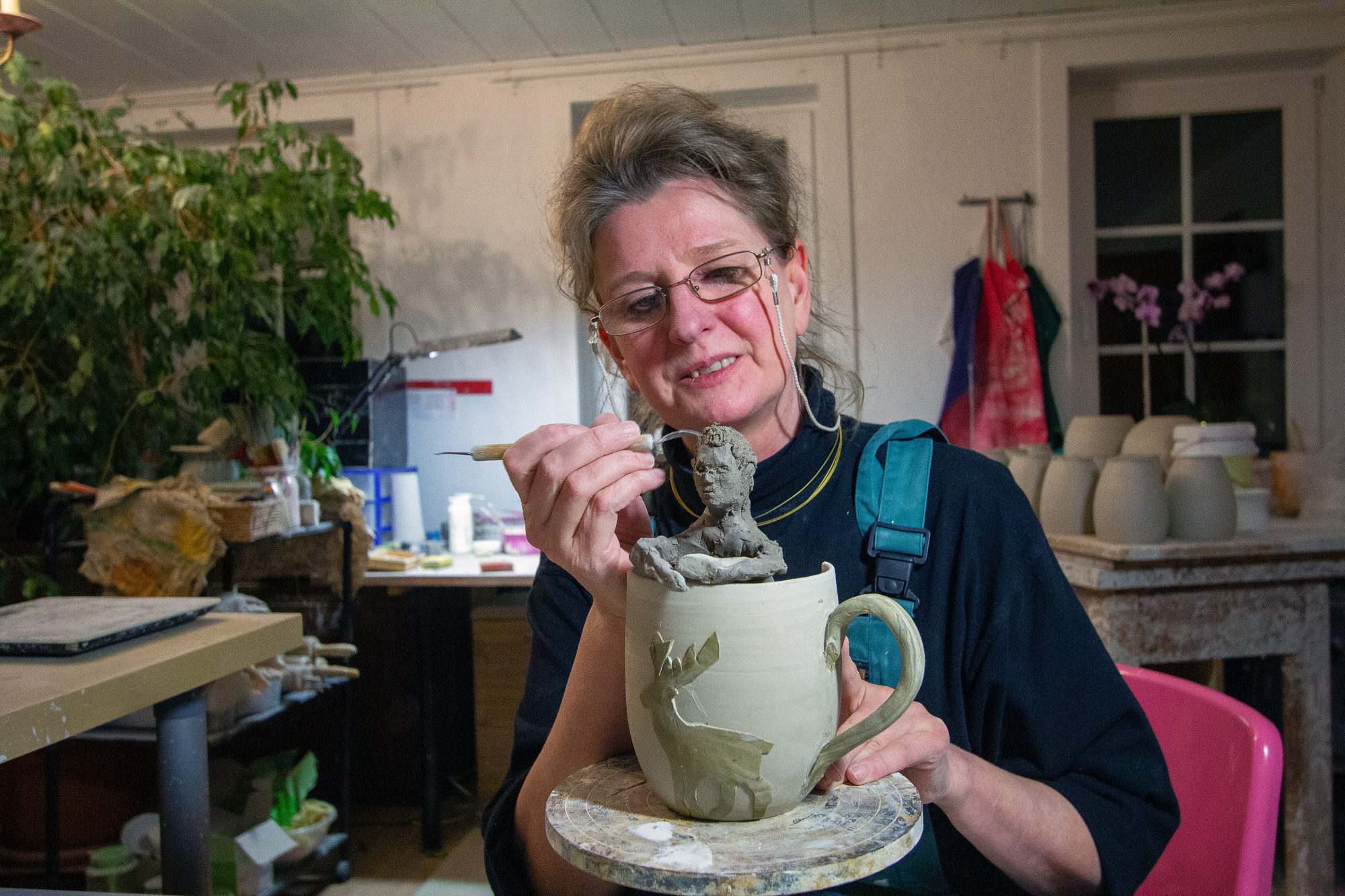
Typisch Harz – Harz-Keramik Altenau | Am Modell der Selfie-Tasse
© Thorsten Schmidt, Schmidt-Buch-Verlag

At the spinning wheel, Irene Schukies uses a scraper to help shape the round form of the vase. The cylinder widens, forming a kind of short neck. She reaches her fist into the dark opening, her whole forearm disappearing. The wheel keeps spinning rapidly while the wall and the base of the vessel are being shaped. Thin and fragile. Refined. The potter needs both strength and sensitivity. She has trained this for years – through pottery, but also through dancing, drawing, sculpting, and even lyric writing. She doesn’t limit herself, but instead looks for what suits her across different art forms, to take it with her to the next stage of her development. Much of what Irene Schukies has done so far in life is art or touches artistic ground. Yet she doesn’t see herself as an artist: "That makes me feel restricted, bound to the constraints of the commercial art world," she says thoughtfully. "But I mainly want to realise my ideas and visions. That’s why I simply see myself as a creative person."  

The vase on the potter’s wheel has reached its final shape. A little bit of "finishing" follows, then Irene Schukies slows down the wheel and places the vessel on a table to dry next to other raw pieces. After about eight hours they will be "leather hard" and can then be refined further. Perhaps with a deer, a lynx or a wild boar, to add to the popular Harz series. "I’m searching for the original," explains Irene Schukies. "I’ve found it in the Harz Mountains," she adds, handing us a finished milk jug with a squirrel motif. The jug clearly combines traditional craftsmanship with a modern spirit in both appearance and feel. The handle and squirrel decoration mimic fibrous brown wood and feel similar, while the jug itself remains understated with its light glossy glaze. 

In the early years, Harz Keramik Altenau could be found at many markets and shops around the region. Today, most sales happen in the studio’s showroom and in their own online shop. This is managed by Christian Zineker. In one corner of the shop, spotlights, a tripod, and a camera are set up to photograph a two-tone jug for its online presentation. "Our next advertising project is to place a giant cup in front of the studio, which will serve as a stage for selfies," the potter’s husband tells us. The eye-catcher is set to be ready by spring 2020 and will invite passers-by to join in the photo fun, sharing their snapshots on social media. A model of the photo cup is already on the drying table during our visit. A cheerfully handmade clay figure looks playfully over the rim of the cup. 

They give their customers a lot of freedom when shopping. Everyone can put together their own tableware collection. "We’re often amazed by the combinations," they admit. "It’s so exciting to watch customers make their choices, and during conversations we sometimes even get new inspiration for our work." Items that are temporarily sold out are quickly remade and sent to customers’ homes. They are also happy to fulfil special design requests. "We want to create something with our craft that industry can’t deliver. That brings satisfaction and spreads by word of mouth." It’s a satisfaction that exists on both sides – for the buyer as well as the maker. Anyone who takes a little time when visiting the Altenau studio can feel this sense of satisfaction. While searching, finding and discovering.
 

                                                                                                                                                                                                                                                                         by Thorsten Schmidt (2020)
 

© Thorsten Schmidt, Schmidt-Buch-Verlag

Contact