© Fotoweberei & Schloß Wernigerode GmbH

Bad Harzburg spa gardens

1868

The motif

Our location is in today's spa gardens of Bad Harzburg, still gently crossed by the babbling Radau stream. Here, the bronze sculpture of a lady on a donkey is our starting point, as its model was a drawing by Adolph Menzel. He stayed here for several weeks in July 1868.

The lady on the bronze donkey is Menzel’s beloved sister Emilie; in his drawing, you can also see his sister’s children on another donkey – three-year-old Otto and five-year-old Grete. Menzel’s brother-in-law, concertmaster Hermann Krigar, also took part in the lively caravan of Berliners. Menzel depicted all four of them in a woodcut picture sheet. Donkeys and mules were more patient than horses, and at that time they were part of the spa experience. A travel guide from 1855 mentions a number of 40 animals. They carried visitors up to the ruins of the Harzburg or to the Brocken. The people of Bad Harzburg wanted to recall those old times when they financed and inaugurated the monument in the summer of 1989.

Harzburg’s rise as a spa town began with donkeys and a railway connection and ended with complete infrastructural accessibility, allowing city dwellers to bring their urban comforts here and use them at any time. Bad Harzburg is a typical example of this development. In 1841, the town obtained the first railway connection in the Harz region, and soon an entire rail network spread out from here. In 1938, the four-lane road was built directly through the old spa town.
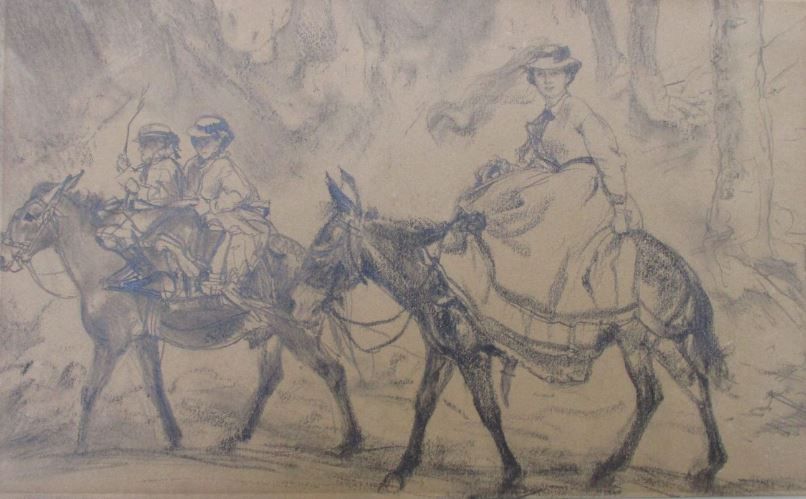
Kurpark Bad Harzburg, Menzel
© Museum Georg Schäfer, Schweinfurt
Adolph Menzel

Artist

1868

Created

Pencil on paper, smudged

14.7 x 23.5 cm

Museum Georg Schäfer, Schweinfurt

Inv. No. MGS 2103A

Hiking tip

The hiking trail network of Bad Harzburg is dense and excellently signposted. On a walk of no longer than an hour, you can visit three stamping points of the Harz Hiking Badge: the Elfenplatz, the Cross of the German East, and of course the Burgberg with the eponymous Harzburg (483 m).

About the artist

Adolph Menzel (1815–1905) was one of the most important German artists of the 19th century, even though he was only as tall as an adolescent. At just 16 years old, after his father's death, he, as the eldest son, took over his father's lithography business and the responsibility of providing for the family. So for him there was only work — no wife or children — and it was not until the age of 35 that he went on his first trips, which he loved, especially travelling by train. His paintings about the history of Frederick the Great still shape the image of this Prussian king today. The small Menzel was even ennobled and later called “Excellency”. In that sense, he felt proud to belong to high society through his art and to be able to afford Harzburg. He seasoned his 27 distinctive views of Harzburg, a selection of which he also published as wood engraving sheets, with his own humour. Above all, with his famously analytical eye for reality, he also looked into the less bright corners of Neustadt-Harzburg.

For comparison

Adolph Menzel, Under the Oaks, 1868, pencil on paper, 15 x 8.5 cm, Staatliche Museen zu Berlin, Kupferstichkabinett, sketchbook 31, fol. 30/31

 Kurpark Bad Harzburg, Menzel
©  bpk Berlin Kupferstichkabinett, SMB Dietmar Katz

The refreshment stand was, along with the water features on the Radau, the heart of the former spa park “Unter den Eichen”. Menzel shows it to us surrounded by old oaks, busy with benches and tables. This refreshment stand remained until 1938 just a few metres east of today’s donkey monument. But its location is now buried beneath the asphalt of the four-lane federal road.

A. Kunz after Adolph Menzel, Family Krigar’s pleasure ride, 1870, wood engraving, sheet size 44.2 x 37 cm, central image and five further depictions on a “Picture sheet for young and old No. 190”, “From the summer retreat”, 

Kurpark, Menzel
©  Kupferstich-Kabinett, Staatliche Kunstsammlungen Dresden, Foto: Alexander Diesend

published by Gustav Weise in Stuttgart, Staatliche Kunstsammlungen Dresden, Kupferstich-Kabinett, Inv. No. A 1915-472 

Menzel spent two weeks in Bad Harzburg in July 1868. He always carried a carpenter’s pencil and his sketchbook, and from the great number of his sketches, six motifs were selected for this picture sheet and engraved on wood by the wood engraver Kunz. In the central image of the sheet, you can see the family of his sister riding donkeys through the Harz Mountains. There’s also the donkey driver, a boy of about ten years old, probably from the Neustadt village school. Boys like him helped to support their families through their work. It could happen that they had to walk not only up to Harzburg, but twice a day up to the Brocken. The Brocken trip led from Harzburg either via Burgberg, Rabenklippe and Molkenhaus or directly via Molkenhaus, 1 thaler for the donkey, 15 silver groschen for the donkey driver on the direct route, 17½ silver groschen for the donkey driver on the longer way. Soon after the turn of the century, ponies replaced the donkeys – and by the mid-1920s, even this means of transport fell victim to the craze for speed. “Eselsborn” and “Eselsstieg” were old field names that have since disappeared from Bad Harzburg.

What Menzel observed in Harzburg

With a wink, Menzel made the choice of images for the picture sheet. One person immortalises himself in the trunk of a beech tree. You can see a lady hurrying back across the yard to the guesthouse from the secret little place (as was common practice well after the Second World War). Meanwhile, the chickens are scratching around on the dung heap, and Menzel hid no fewer than four cats in this picture. With a social eye, he also added an image of the basket women and cart pushers, who belonged to the Harz scenery just as much as the spruces and the mountainous ravines, and of course once again the nieces and nephews, delighted by the flock of geese. At the bottom left, he also shows a glimpse of the sophisticated spa life in the bathing and inn complex of Juliushall. The company has settled down, sheltered from sun or rain. Snacks were served, and the band played every Sunday. Nature was merely the backdrop for this world transplanted here from the city. By the way: the promenade hall of the brine bath in Juliushall, which can still be admired today, is not visible here; it was only built in 1898, thirty years after Adolph Menzel’s stay.

When holidays didn’t yet exist

Menzel didn’t know the word “holiday” yet; it wasn’t until around 1900 that the term was established as a legally granted permission (holiday) for rest. Three to six days. Menzel said “summer retreat” and used that as the title for his picture sheet. In fact, he was always drawing, so he was working here as well. The Stuttgart publisher Gustav Weise released six motifs from his numerous sketches as a picture sheet. Menzel’s name had become a selling point. But this also shows that Menzel didn’t despise the printmaking of his youth, even as an older painter. A picture sheet had a high print run, cost one penny, two if coloured. Such a picture could be pinned to the walls of a living room, gather dust and fade for decades, yet still awaken a longing for a summer retreat in everyone who couldn’t (yet) afford it.