© Fotoweberei & Schloß Wernigerode GmbH

Blankenburg 

1810

The motif

The location of this painter’s view is the Teufelsmauer near Blankenburg. At its eastern end stands the Großvater Rock, beside which the ground drops steeply down towards the town. This natural balcony therefore became the most popular viewpoint for the many 19th‑century depictions of Blankenburg. The Danish artist’s view is one of the earliest portrayals from here and something truly special. Eckersberg dedicates more than half of the picture to the Großvater Rock. The rock was already strongly weathered by wind and rain back then, but not yet easy to climb. Such an interesting foreground, almost hiding the actual view, is a popular painter’s trick and arouses curiosity about what is being concealed.

Castle and town appear distant. Blankenburg’s heyday as a ducal‑Brunswick secondary residence, where marriages into Spain or Russia were used to polish its image and the castle was expanded, had long since passed. The castle and gardens were preserved, and Blankenburg became a small town of civil servants and retirees. The castle, far too large for the small town, can be visited, and an association has been committed to its restoration for years.
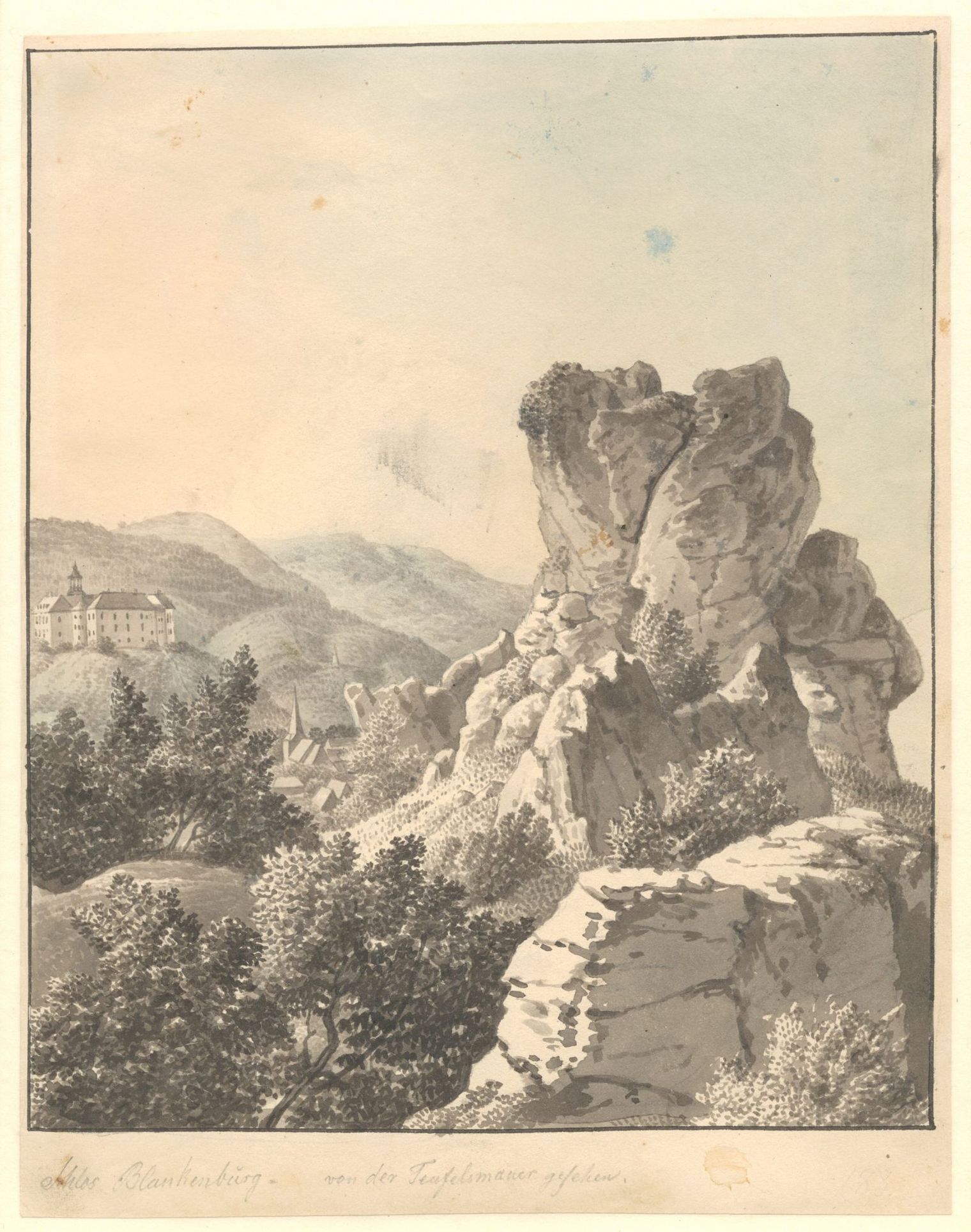
Blankenburg von Eckersberg
© States Kunst Museum Kopenhagen
Christoffer Wilhelm Eckersberg

Artist

1810

created

Pen and brush in grey and light blue over pencil on paper

24.4 x 19.2 cm

States Art Museum Copenhagen

Inv. No. KKSgb4045

Hiking tip

Anyone who makes it up to the Grandfather Rock (stamp station of the Harz Hiking Badge) shouldn’t miss walking along the Devil’s Wall on the ridge of the Heidelberg Mountain, with its sandstone boulders, windswept pines, and beautiful views stretching as far as Timmenrode. On the way, you'll pass the Grandmother Rock, which of course can also be found here. The long-distance hiking trail North Sea – Masuria is well signposted and can be used here.

About the artist

Christopher Wilhelm Eckersberg (1783–1853) is the most famous Danish painter of the 19th century. He was only 27 years old and on his way from Copenhagen to Paris when this drawing was created. The Harz mountains marked his first mountain experience, since the highest Danish mountain is just 172 metres high. But Eckersberg was in a hurry and doesn't seem to have stayed long — this is one of only two Harz drawings preserved in the Copenhagen museum. He was drawn to the famous Neoclassical painters in Paris, such as Jacques Louis David, and later to Italy, where he stayed for seven years. He had a scholarship for that, which he had worked hard to obtain for a long time. Before that, he had spent years struggling with printmaking commissions. It wasn’t until 1809, after the death of Nicolai Abildgaard, the director of the Copenhagen Academy, that he finally succeeded — ironically, with a poor painting.

Later, he succeeded in everything he set out to do — history, portrait, nude, landscape. He immersed it all in his precise rendering, nourished by accurate observation. Exaggeration and romanticism were not his thing. In 1817, he became a professor and teacher at the Copenhagen Academy of Fine Arts, and through his many students, his fame spread everywhere, marking the beginning of Denmark’s Golden Age of Painting.

For comparison

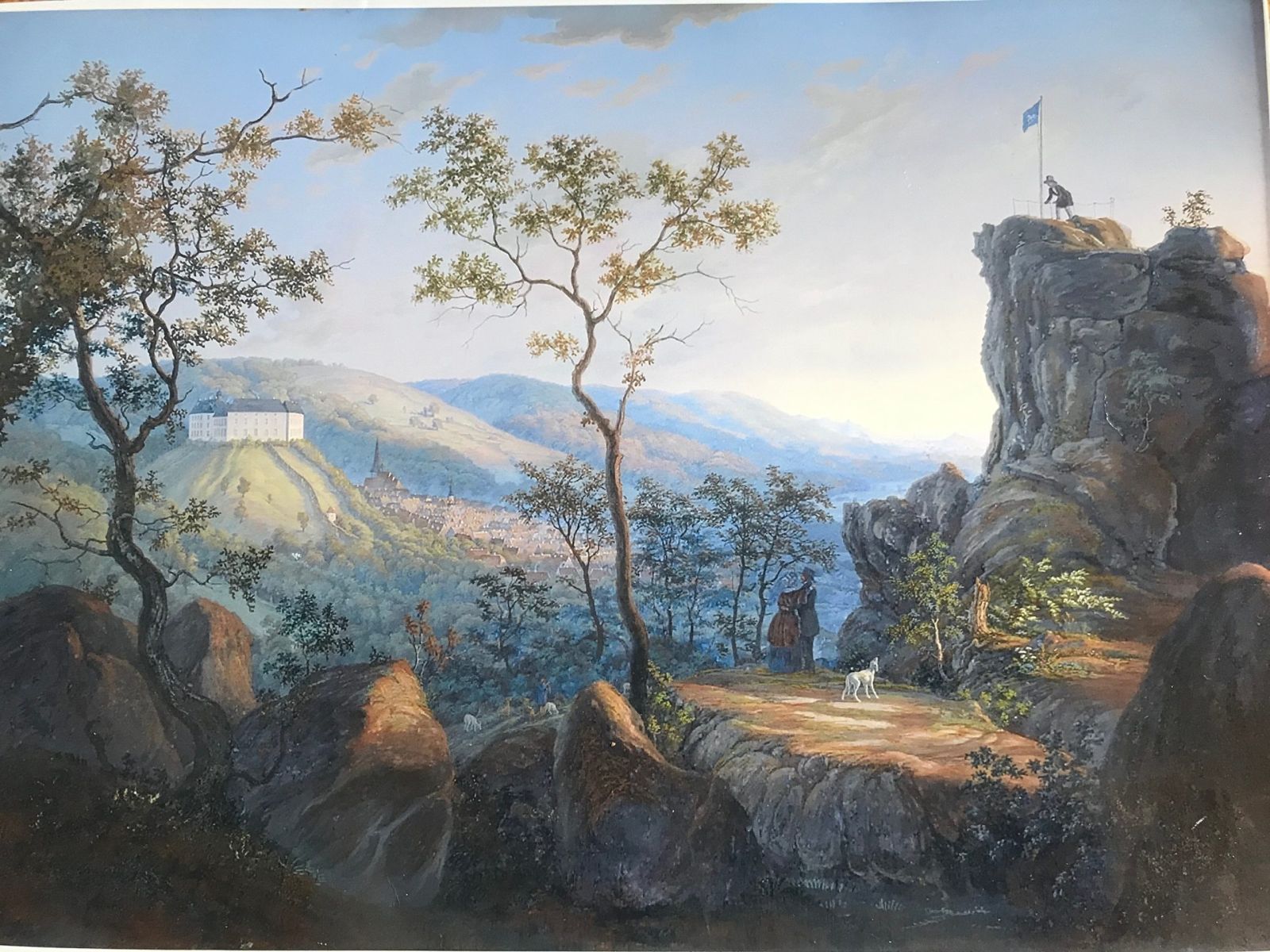
Anonymous, The Grandfather Rock and Blankenburg, around 1835, gouache on paper, 65 x 93 cm, private collection

Der Großvaterfelsen und Blankenburg, Anonym
© Privatbesitz

Our anonymous painter shows a visitor who has climbed the Grandfather Rock and is holding on to a thin railing. As a sign of Brunswick ownership, the Welf flag is hoisted, its blue corresponding with the sky and the distant hills on the northern side of the Harz Mountains. The artist frames the view of the castle and town picturesquely with two slender trees.

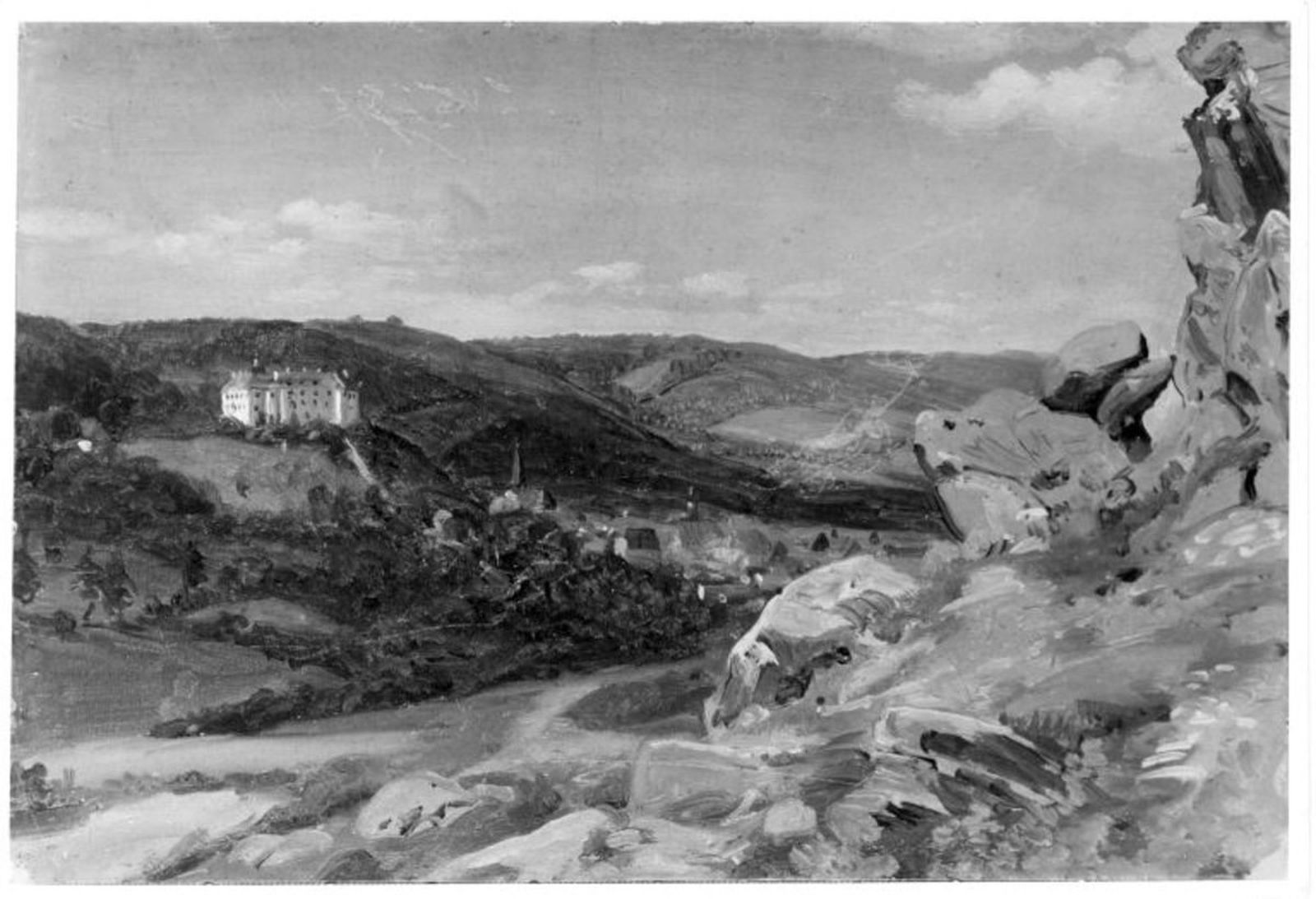
Eduard Meyerheim, View from the Foot of the Grandfather Rock towards Blankenburg, 1840, oil on cardboard, 20.4 x 30.1 cm, Neue Pinakothek Munich Inv. No. 8764, originally in colour

Aussicht vom Fuße des Großvaterfelsens auf Blankenburg von Meyerheim
© Neue Pinakothek München

Eduard Meyerheim (1808–1879) came from a well-known family of painters of his time, and he too created many paintings depicting Harz motifs. This work is probably an oil sketch painted directly from nature. It shows only a few cliffs next to the Grandfather Rock, not the rock itself. Meyerheim stepped forward to present us with a wide panoramic view of the northern Harz Mountains with Blankenburg Castle in the direction of Heimburg. By the way, he was closely connected by a deep friendship with Adolph Menzel, who was seven years his junior.