© Fotoweberei & Schloß Wernigerode GmbH

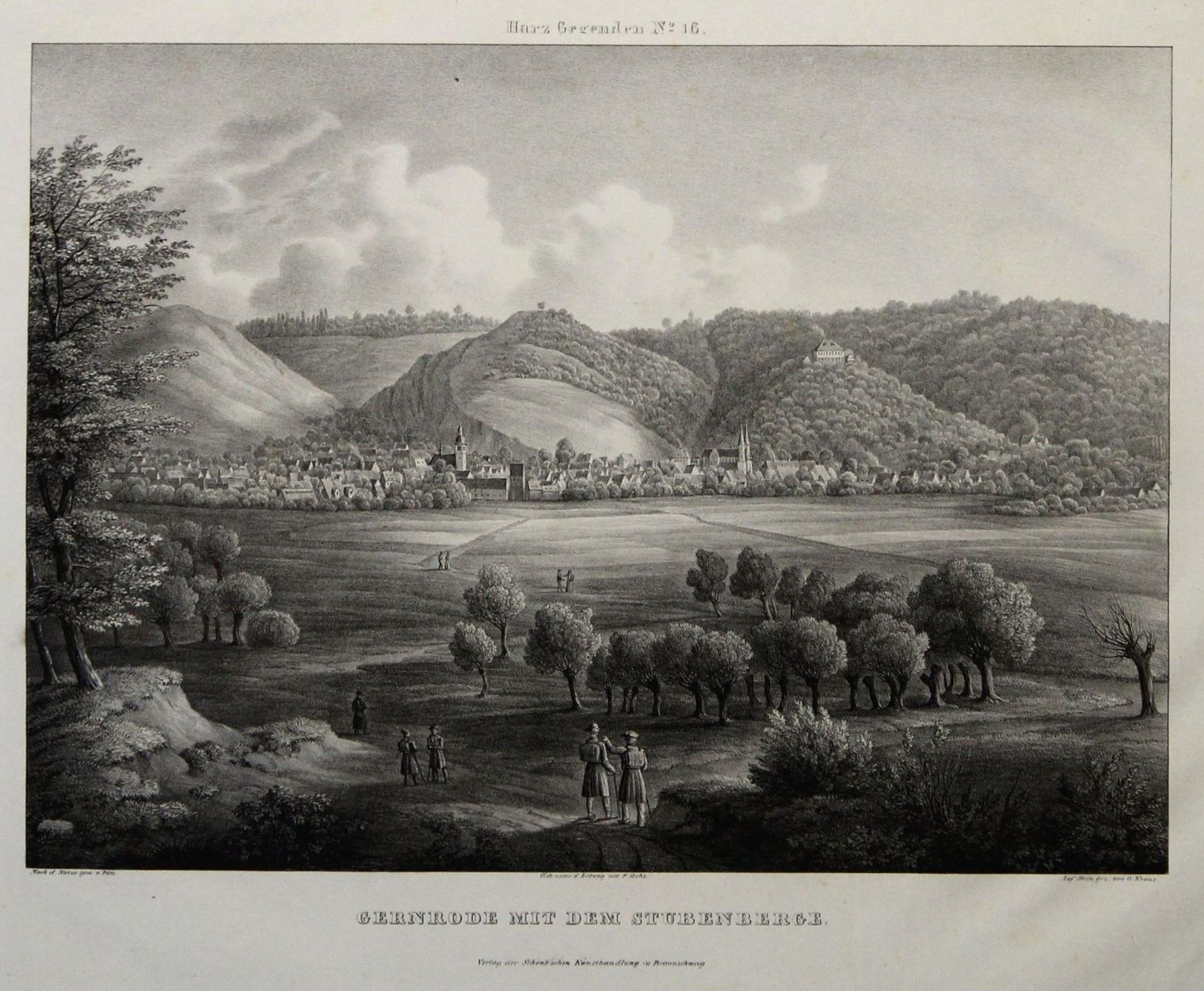
Gernrode with the Stubenberg

1828

The motif

This painter’s view from the Bückeberg has changed a lot in the foreground, but the mountains are still there, and the pavilion on the Stubenberg, which is now a hotel, remains. The Stubenberg mainly attracted people and therefore also painters. Prince Victor Friedrich of Anhalt-Bernburg had a hunting and guest house built there in 1754. From Ballenstedt, he could reach this north-western tip of his small residence on horseback in less than an hour. At this not very high point, the location delighted visitors as an eye-catcher or point de vue, attracting hikers even from the neighbouring still bare slopes, and offering a “heavenly view” either northwards as far as Magdeburg, or in other directions towards the Harz. Soon this spot was described in all Harz travel guides. Exclusive pleasures lured contemporaries to the Stubenberg.

This view was published in Brunswick in 1828 as plate 16 of a series of twenty lithographed Harz motifs. They were produced in Berlin. At that time, Brunswick did not yet have the technology: neither the thick plates made of Solnhofen limestone, nor suitable presses, nor, above all, good lithographers. That’s why the drawing and printing were commissioned in Berlin at the leading institution “Winckelmann und Söhne”.
Gernrode, Paetz
© Antiquariat Clemens Paulusch GmbH
Gustav Wilhelm Kraus after Wilhelm Paetz

Artist

1828

created

Lithography

27 x 34.5 cm from: Series of prints at the Royal Lithographic Institute Berlin

Private property

...

Hiking tip

This time the site of the painter’s viewpoint isn’t that easy to find.
Option 1: The cycling circuit route from Osterteich Gernrode via Ballenstedt and Quedlinburg, as it passes directly by the viewpoint on the slope of the Bückeberg.
Option 2: If you cycle along the road from Gernrode to Suderode below, you’ll pass the Hungerstein from 1846/47. It reminds us of how hard the times were back then; because of crop failures in 1846 and 1847, the well-known revolutionary unrest broke out in spring 1848. If you turn here into the nearby Baumschulenweg and then keep to the right along the edge of the slope, you can’t miss the painter’s spot.

About the artist

Wilhelm Paetz (1800–1856) came from Braunschweig, and in his mid-twenties he earned some money as a draftsman for the Schenksche Bookshop in his hometown, drawing views. Only later, in his mid-thirties, did he spend a few years at the Düsseldorf Academy. In 1841, he was appointed by Prince Georg Wilhelm of Schaumburg-Lippe as a drawing teacher at the Adolphinum Grammar School in Bückeburg. It is always astonishing how mobile painters were, and usually unclear how communication worked. They certainly didn’t just stick their noses into the wind in search of new motifs, interesting teachers, patrons, or even a job.

For comparison

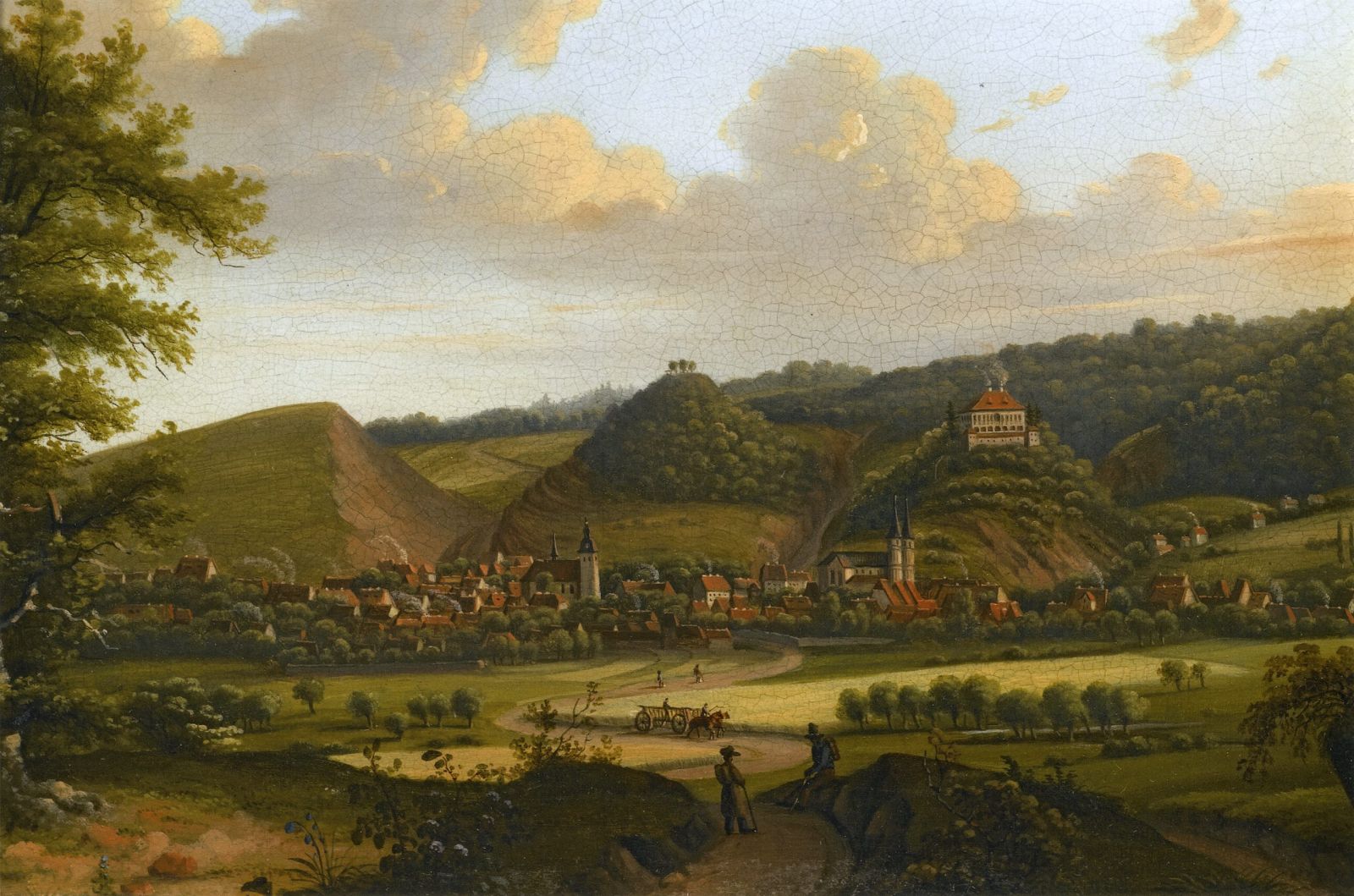
Anonymous, Gernrode from the north, around 1830, oil on metal, 14 x 20 cm, Koller Auctions

Gernrode von Norden, Anonym
©  www.kollerauktionen.ch

Not every painting was created directly from nature. Painters learned from the works of others and often used them for inspiration or as a model. Occasionally, small chains of copied paintings can be traced, and most painters varied their copies a little, especially in the staffage. It’s worth comparing this painting with the lithograph. By observation, one can determine that the painting was made after the lithograph.

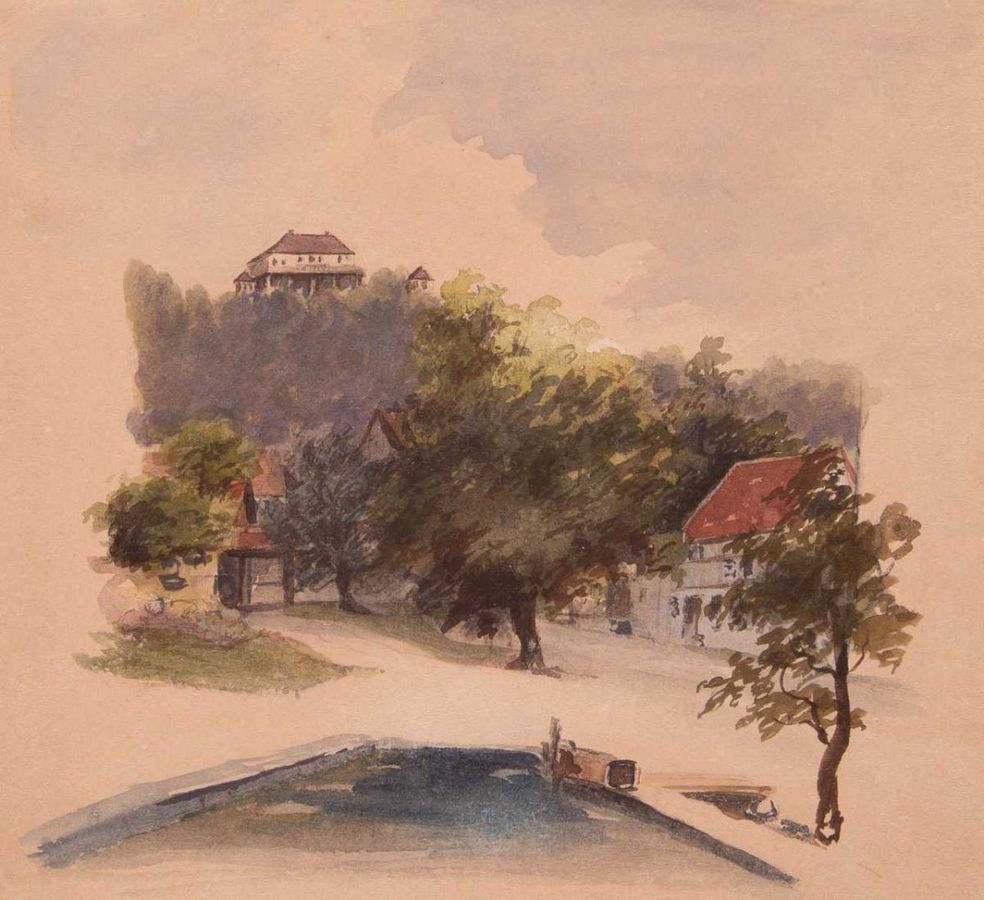
Christian Friedrich Gille, Stubenberg from the north, around 1870, watercolour on firm reddish paperboard, 20.5 x 22.5 cm, private collection, formerly Dr Peter Posse, Dessau

Christian Friedrich Gille, Stubenberg von Norden
© www.veryimportantlot.com

Christian Friedrich Gille was born in 1805 in Ballenstedt. In Dresden, he was a student mainly of Johan Clausen Dahl, the well-known Norwegian who lived in the same house as Caspar David Friedrich, at An der Elbe 33. Hundreds of Gille’s marvellous oil sketches have survived. During his lifetime, however, he was unknown, died in complete poverty, and has only been rediscovered in recent years. It’s quite likely that he often visited the Harz region, since he was from Ballenstedt. But that still calls for further investigation. The late watercolour of Stubenberg is one piece of this puzzle.