© Fotoweberei & Schloß Wernigerode GmbH

Güte des Herrn mine in Lautenthal

1853

The motif

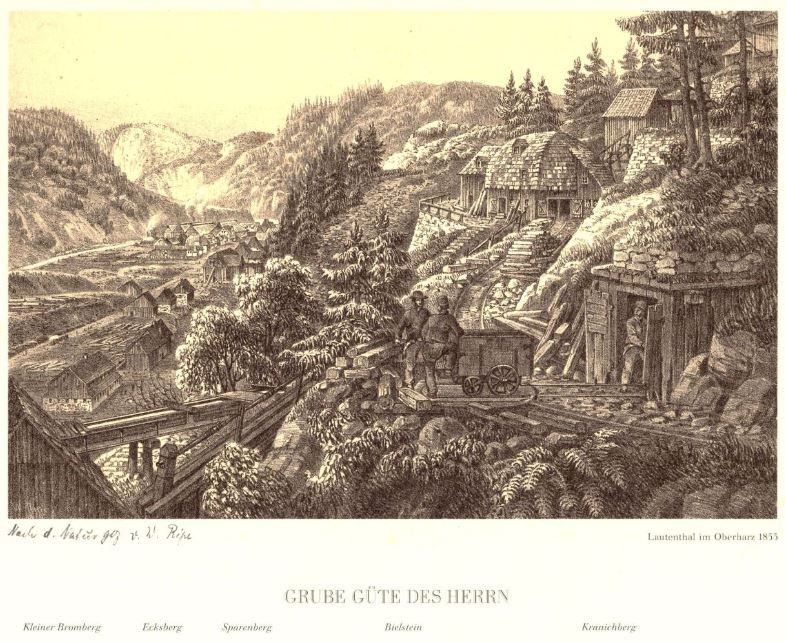
Our location is just a few steps to the left of the current entrance to the Mining Museum Lautenthal, situated on today’s Wildemanner Straße. From the pavement, you can see a brick-lined adit of the Güte des Herrn mine. Since 1691, silver, lead and copper ore have been mined here.

Wilhelm Ripe’s sketch shows a wooden adit on the right, in front of which a barrow runner is chatting with a miner. His front-tipping barrow with unevenly sized wheels can fetch the ore from the top of the shaft house and bring it down to the stamping mills in the valley, or also carry timber for reinforcement into the tunnel. On the left, water flows through a wooden trough and disappears into the gable of the wheelhouse. Inside is a large water wheel. Its power drives the wooden rod system, which vanishes into the shaft house in the painting. Today, in the outdoor area of the Mining Museum, we can see original troughs, rod systems and barrows.

Mining scenes showing people at work are a rare subject for painters. It took a special artist like Wilhelm Ripe to do it. He shows us how energy was produced for mining and how the ore came from the mines to the smelters. Their chimneys can be seen smoking in the valley of the Innerste in the background.
Lautenthal, Ripe
©  Museumsverein Goslar
Wilhelm Ripe

Artist

1853

created

Lithograph

15 x 22.5 cm

Museum Association Goslar

1989

Hiking tip

The small mining town of Lautenthal, prettily nestled among mountains and forests, is now a popular holiday destination. Tourism has replaced mining, for whose sake Lautenthal was founded in 1538. The mines closed in 1931, and the last smelting works in 1966. This change was similar for all mining towns in the Upper Harz. In the surroundings of Lautenthal, especially on the Kranichberg, you'll come across more fascinating traces of mining history than almost anywhere else in the Harz region in such a density. They are excellently explained. Whether along the Lautenthaler Kunstgraben or on Kranichberg at the Maaßener Gaipel, whose view you really shouldn’t miss (with an inn).

About the artist

Wilhelm Ripe (1818–1885) was interested in mining because he himself was the child of poor people and grew up among miners and pedlars. But he also depicted mining because it had become an attraction for visitors to the Harz. For them, Wilhelm Ripe prepared his pictures in a didactic way. He enlarged the space between the valley and the slope so that everything would fit in and so that buyers of his lithographs could recall the details: the tunnel mouth, the muzzle-loader, the washing channel, the headgear, the shaft house and the pit timber. In Ripe’s pictures, there is always someone looking directly at the viewer, drawing them into the visual story. Here, it is the barrow pusher.

Where did the strangers, the visitors to the Harz, come from? They came from the big cities, which had become noisy and dirty because of industrialisation and their many inhabitants. Those who could afford it took a second home for the summer retreat. In Ripe’s time, mining in the Harz was already in steep decline, something which also affected the charcoal burners. The growing tourism was at that time seen as a hope for the people of Lautenthal; today, it is a reality.

For comparison

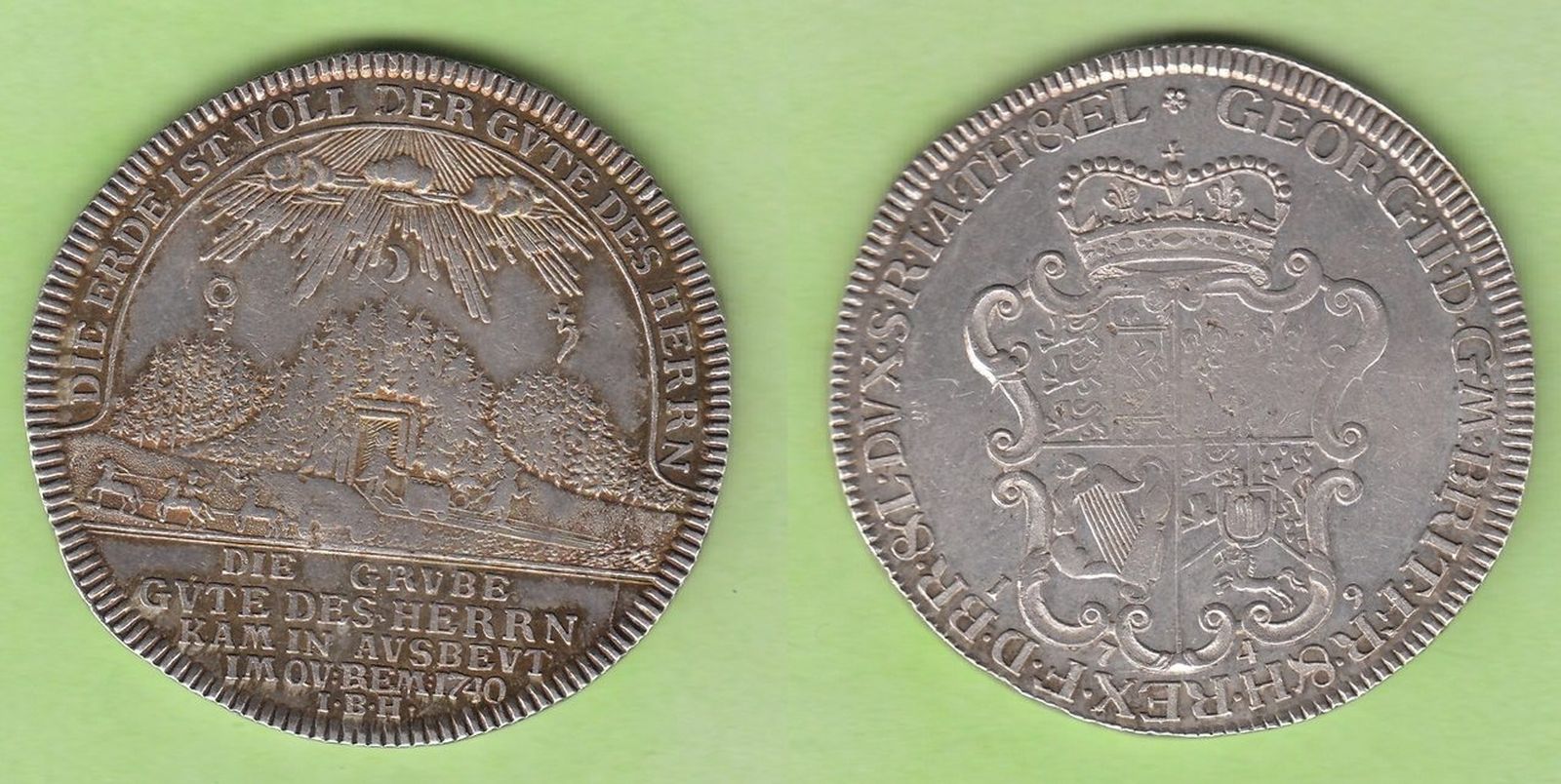
View of the Güte des Herrn mine in Lautenthal, on the obverse of a yield thaler, 1740, silver, minted in Zellerfeld under mint master Johann Benjamin Hecht, weight 23.47 g, private collection

Lautenthal Münze, Privatbesitz
© Privatbesitz

For almost 50 years, people had been developing the mine “Güte des Herrn” (Goodness of the Lord), working here and searching for a vein without making any profit. In mining terms, this period is called the “repentance time”. The Upper Harz mining administration had to plan for such long periods, which were seen as a time of sacrifice or abstinence. Finally, in 1740, this mine—one of about 30 in Lautenthal at that time—started making a profit. Proudly, a yield thaler was minted, showing on its front a tunnel entrance and two miners with a mining cart, along with the Bible verse “The earth is full of the goodness of the Lord”, which gave the mine its name. The three alchemical symbols in the sky mean: the moon in the centre stands for silver, to the left copper, and to the right lead.

Of the planned economy of the mines

To also weigh up the necessary investments and construction projects, the owners in the Upper Harz had joined together in 1788 to form the state-run Communion Harz. Mining was the source of their wealth, but also a huge challenge for long-term planning. Villefosse described this in his fundamental 1822 work as follows: “It is never the purpose to enrich speculators, but also never to deceive them (…) It is never the goal to immediately deliver considerable sums into the sovereign coffers … Its true purpose is to maintain a large number of works without subsidies, which are capable of producing annually a sum of one to one and a half million thalers.”

Matthäus Merian after Conrad Buno, Lautenthal from the west, 1654, copper engraving/etching, image size 14.2 x 38.1 cm, from: Topography of the Duchy of Brunswick-Lüneburg, Frankfurt/Main 1564, Upper Harz Mining Museum Clausthal-Zellerfeld

 Lautenthal, Buno
© Oberharzer Bergbaumuseum

In this view, 200 years before Wilhelm Ripe, we can see the silver smelters of Lautenthal on the left in the foreground. From the right, the Innerste river flows in below, and halfway up the Kranichberg there is a road, next to which the Lautenthal water channel ran, which was already built from 1570 onwards. For its construction, they only had a drop of 60 metres over a distance of eight kilometres! And that without computer simulation. What’s interesting about Merian’s engraving is that the area along what is now Wildemanner Straße is still completely undeveloped. However, the first mine adits, such as the Tiefen Sachsenstollen marked with the letter K, are already shown. The same adit opening can still be seen today on the grounds of the mining museum.