© Fotoweberei & Schloß Wernigerode GmbH

Halberstadt Wood Market

1830

The motif

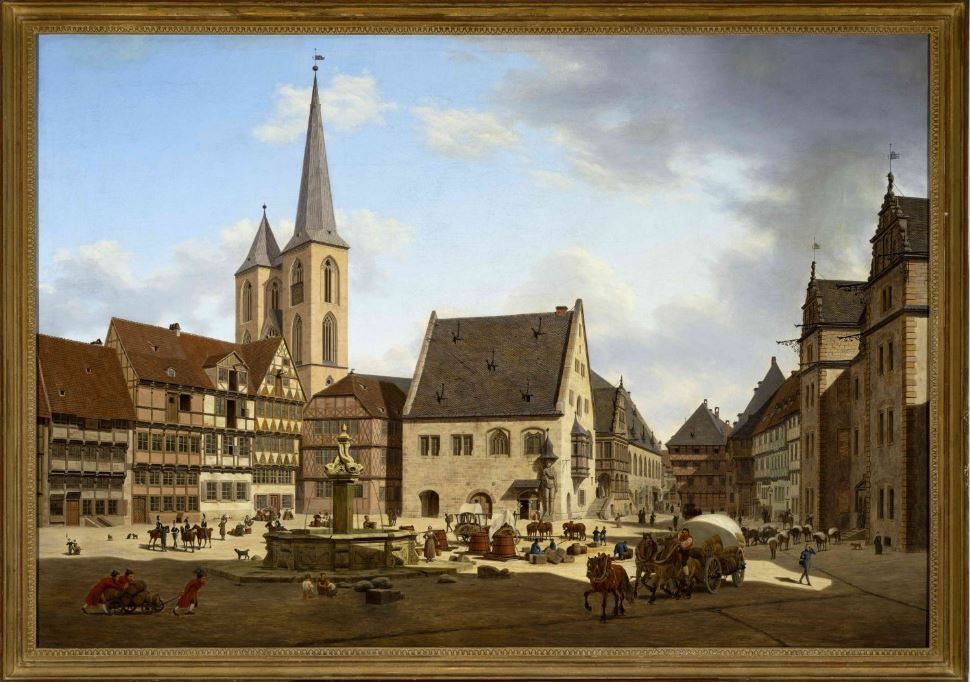
8 April 1945 is still today the great trauma of Halberstadt. Just a few days before the end of the war, the entire city centre was destroyed in an air raid. A painter’s view that has existed for centuries accompanies this event and shows its strength. We encounter it in many paintings in the Municipal Museum and can take its viewpoint in front of city models that show it in its former, destroyed, and current states. In doing so, we stand at the Holzmarkt and look either to the left towards the Martinikirche or to the right towards the Fischmarkt. It’s therefore a beautiful composition with two lines of sight. This painter’s view alone in the museum is worth wandering through the building, as the city’s history is reflected in it. As is all the pain of what Halberstadt once was.

Its creator is the painter Carl Hasenpflug. What a self-confident picture of the townspeople. Of course, the town hall is at the centre of the painting. It bears witness to the citizens’ rights that had been wrested — with many setbacks — from the episcopal sovereign since the Middle Ages. Attached to it is the council loggia from 1662, built when the town finally had rights over the entire city. At the start of the Second World War, it was walled up, so it remained protected — as did the Roland statue, by the way. The reconstruction of the town hall succeeded thanks to the great dedication of the people of Halberstadt — as a modern building in old forms. In 2004, as the final stage of the reconstruction, the council loggia could also be rededicated. The Martinikirche, which was also destroyed, had by the way already been rebuilt shortly after the war, by 1954.
 Halberstadt, Hasenpflug
©  Städtisches Museum Halberstadt, Foto: Ulrich Schrader
Carl Hasenpflug

Artist

1830

Created

Oil on canvas

Dimensions including frame 89.5 x 126 cm

On loan

On loan to the Municipal Museum Halberstadt

Hiking tip

Anyone who wants to get an idea of Halberstadt’s former great importance should visit not only the Cathedral and the Church of Our Lady, but also the Gleim House and the Municipal Museum

About the artist

Carl Hasenpflug (1802–1858) associated personal hopes with this large-format painting, as he had only just permanently moved to Halberstadt, and it was his first truly major commission. He wanted to paint the most beautiful view of Halberstadt and even included the patron in the picture. This was Werner Friedrich Julius Stephan von Spiegel (1802–1877), grandson of the famous cathedral dean and a man of the Gleim era known for his humanity. He stands to the right behind the wagon. Hasenpflug’s use of light shines on him like a spotlight. 

The painting was a success; the Prussian king ordered a copy, and the painter stayed in the city. His most frequent painting theme became the Gothic style: first the great cathedrals of Magdeburg and Halberstadt, later mainly ruins.

For comparison

Albert Schwendy, The Wood Market in Halberstadt, 1874, oil on canvas, dimensions including frame 126 x 167 cm, Municipal Museum Halberstadt, Inv. No. K1 0041, on view in the permanent exhibition

Halberstadt von Hasenpflug
© Städtisches Museum Halberstadt, Foto: Ulrich Schrader

There are a number of painters who specialised, in the second half of the 19th century, in depicting market squares with lavish displays. Albert Schwendy and Charles Hoguet are among them. They drew artistic inspiration from the Netherlands, from the baroque Golden 17th Century. And all this happened at a time when industrial goods production was just taking off. Once again, a nostalgic image of the good old days. What’s important here: for his only Halberstadt motif, Schwendy naturally chose the Holzmarkt, from the same viewpoint that Carl Hasenpflug had been the first to paint.

Walter Gemm, The Burning Martin Towers, 1945, oil on canvas, dimensions including frame 112 x 139.5 cm, Municipal Museum Halberstadt, Inv. No. K1 0157, on view in the permanent exhibition

Die brennenden Martinitürme von Gemm
©  Städtisches Museum Halberstadt, Foto: Ulrich Schrader

Walter Gemm, The Burning Martin Towers, 1945, oil on canvas, dimensions including frame 112 x 139.5 cm, Municipal Museum Halberstadt, Inv. No. K1 0157, on view in the permanent exhibition