© Fotoweberei & Schloß Wernigerode GmbH

Oderteich

1803

The motif

The Oderteich near Torfhaus was once a place for painters, also because important High Harz routes crossed here. It is the oldest dam in Germany and, when completed in 1721, it was also Germany’s largest. The Oderteich held this record well into the industrial age, until 1891. It can store the then almost unimaginable amount of 1.75 million cubic metres of water, one cubic metre being 1,000 litres. The costs were four times higher than planned, but the mining authority was satisfied and approved everything, as the benefit was beyond question. The high Oder Dam was sealed – another innovation – not with earth, but with compacted granite gravel.

Its purpose was not flood protection, but to provide a water supply for the New Rehberg Ditch, which delivered process water to the high-lying mines of St Andreasberg. Throughout the year, day and night without interruption, for example in the Samson Mine. The outflow at the Oderteich is still regulated today by the straining house on the dam.

For centuries, water provided the only source of energy for mining. Water struck the water wheels, drove the reversing wheels and the man engines, lifting the ore from the shaft and bringing all the miners to their workplaces underground and back to the surface. Even today, the water from the Rehberg Ditch drives two turbines deep down in the Samson Mine.
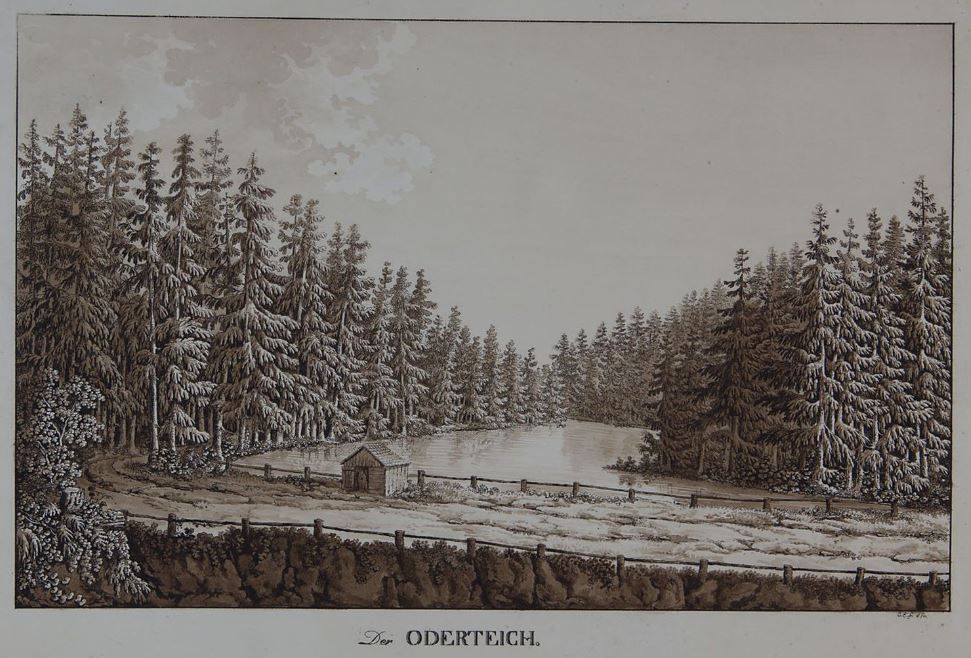
 Oderteich, Eberlein
© Sammlung Bode, Hamburg
Johann Christian Eberlein

Artist

1803

created

brown washed outline etching

Plate size 23.8 x 37.8 cm

Bode Collection

Hamburg

Hiking tip

Once at the Oderteich, it’s a good idea to start with a circular hike to get to know the Oder inflow and the Great Spillway blasted from the rock (4 kilometres, 1 hour). Of course, you should also walk down to the Rehberger Ditch and take a closer look at this most challenging Harz ditch construction. (Circular route around Rehberger Moor with a stop at the Rehberger Grabenhaus, 12 kilometres)

About the artist

Johann Christian Eberlein (1778–1814) published two series of five prints each showing views of the Harz Mountains in 1802 and 1803, when he was just 23 and 24 years old. It was quite a daring project, since he wasn’t a publisher but a freelance artist who, like his father before him, taught drawing at the University of Göttingen. Each series (five sheets) in a washed state was meant to cost five thalers. That was a lot of money, considering that the painter Ernst Helbig couldn’t even pay two silver groschen in taxes. Eberlein’s next innovation came in 1804 with his book for students entitled “Theoretical and Practical Guide to Drawing and Colouring Landscapes after Engravings, Paintings, and from Nature.” He dedicated it to the Bavarian crown prince, who rewarded him generously by granting him a scholarship to study in Italy, where he spent nine years abroad. Sadly, Eberlein died shortly after returning home to Göttingen, at only 36 years of age. Who knows what other views of the Harz we might have from him otherwise. His beautiful ten plates of the Harz, however, were acquired by the Dresden publisher Morasch, who reprinted them in an altered form.

For comparison

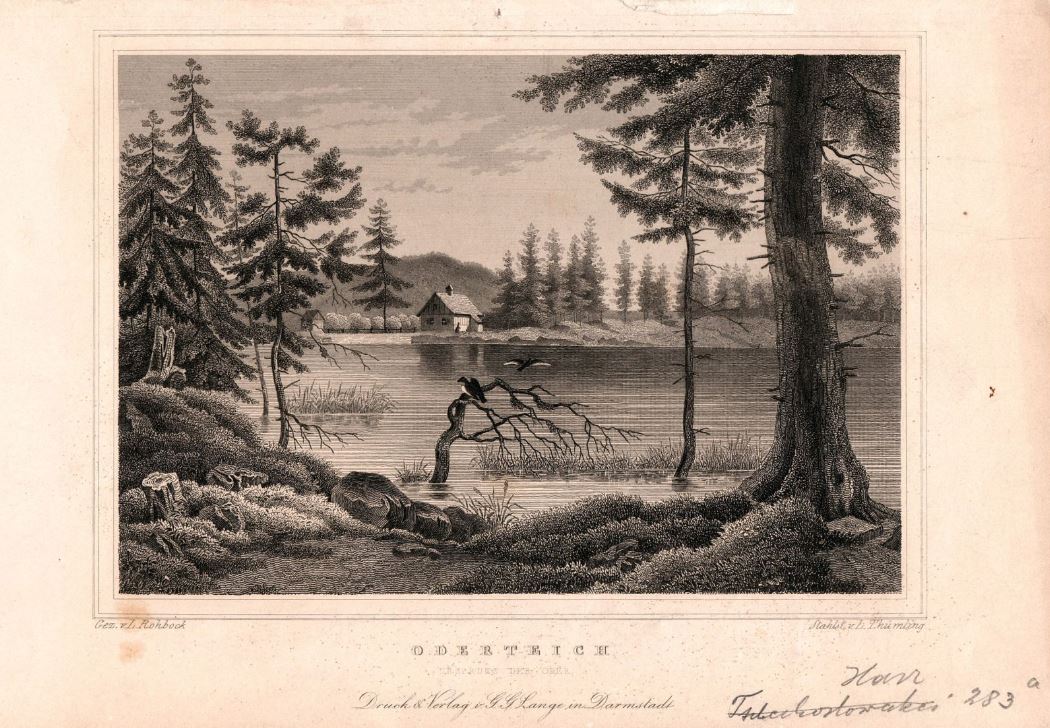
Ludwig Thümling after Ludwig Rohbock, The Oderteich, 1853, steel engraving, sheet size 15.2 x 23.2 cm, image size 11 x 16 cm, from: The Kingdom of Hanover and the Duchy of Brunswick represented in picturesque original views 

Oderteich, Rohbock
© Schloß Wernigerode GmbH

of its most interesting regions, edited by Gustav Georg Lange in Darmstadt and New York, 1853, from the collections of Schloss Wernigerode GmbH 

Anyone who knows that deep down in the Oderteich the Rehberger Ditch rises, its water flow regulated by the Striegelhaus, will look differently at the crow puffing up in the cold on the branch just below. All this was created over decades for the energy once needed in the mines of St. Andreasberg, seven kilometres away: the pond, the dam with the Striegelhaus and the New Rehberger Ditch, not to forget the many wheel chambers in St. Andreasberg that transformed the driving water into motion.

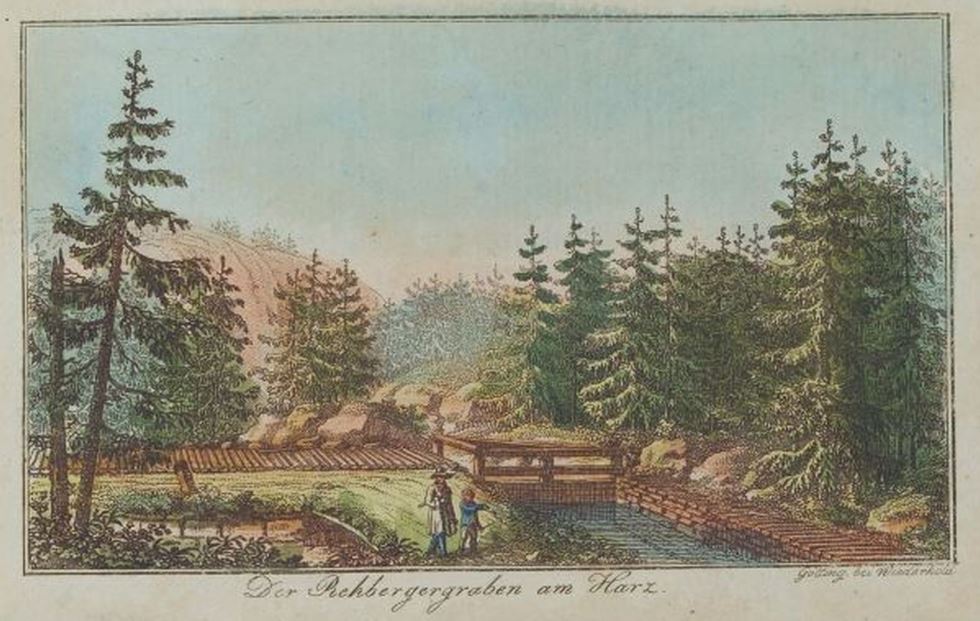
Heinrich Christoph Grape, At the Rehberger Graben, after 1802, album leaf, published in Göttingen by Johann Carl Wiederhold, coloured etching, plate size 9.8 x 14.7 cm, Herzog August Library Wolfenbüttel, 

Oderteich, Grabe
© Herzog August Bibliothek Wolfenbüttel

Top. App. 2:257 top

Students loved album leaves, which they stuck into each other's friendship albums and used to praise, in verses, the beautiful landscapes they had explored. The people of Göttingen, who often travelled in the nearby Harz Mountains, pursued this trend particularly eagerly between 1780 and 1830, and master bookbinder Wiederhold profited from it. His prints can even be found in American collections. Naturally, the famous Rehberger Graben is also one of the motifs.