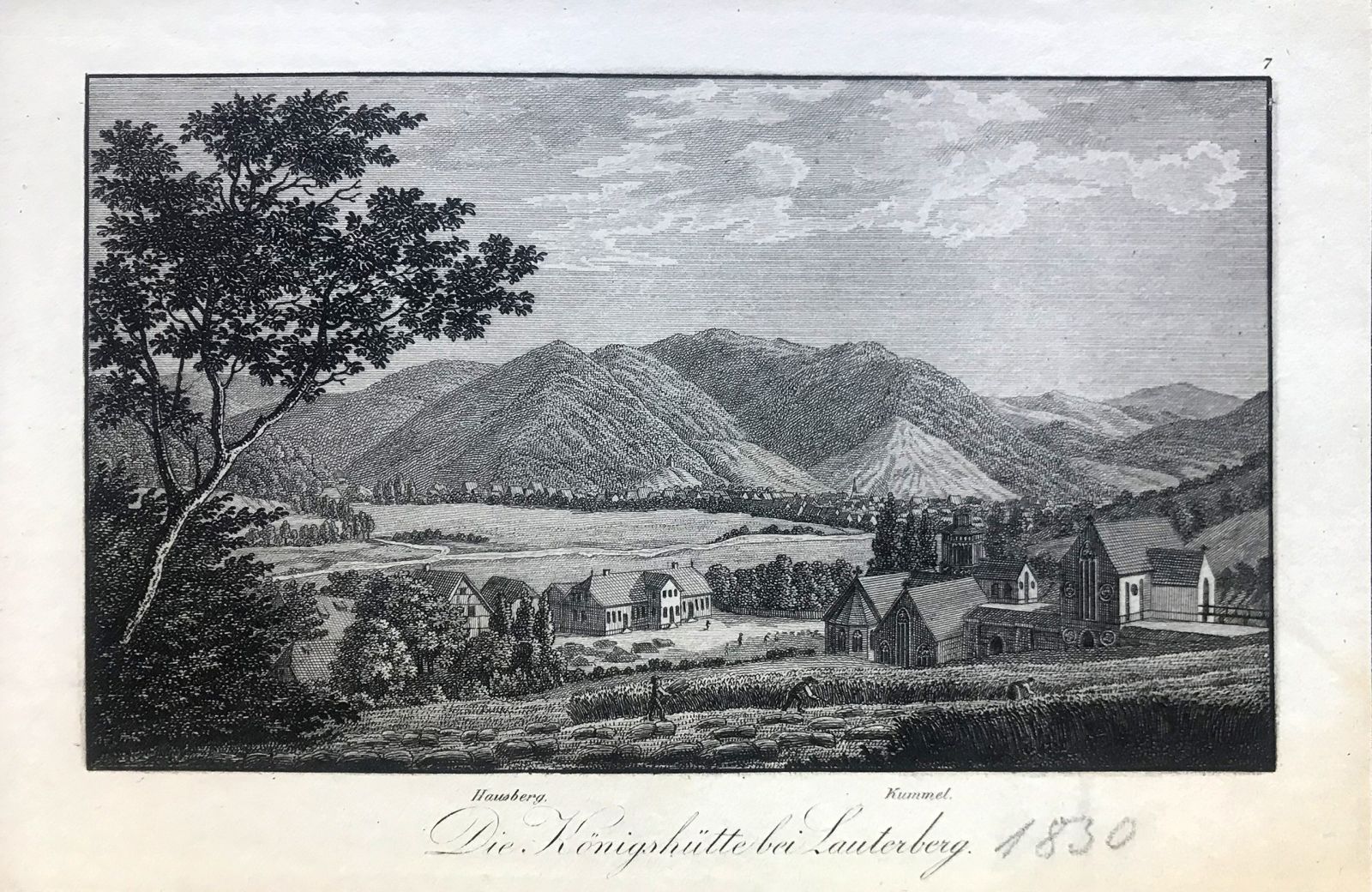
The Karst Hiking Trail from Barbis to Steina passes the grounds of the Königshütte in a distinctive curve south of Bad Lauterberg. We stand amazed before the best-preserved ironworks in the Harz, a monument of national significance. It’s easy to identify several distinctive buildings in the foreground of the painting. What catches the eye first is a building on the main square with a proper temple façade. It dates from 1816/17 and was the iron warehouse where the Königshütte’s products were stored for sale: grave crosses, stoves, iron gratings, machine parts. It is half hidden on the left by the factory building from 1736, which still exists. Black smoke rises in the centre of the picture from the blast furnace building dating from 1830. In front of it are the two rolling mill buildings.
The Königshütte was built here between 1733 and 1737 on the site of an earlier foundry. The surrounding forests supplied wood for the buildings and charcoal for the smelting process, while the nearby Oder River provided water power all year round. Iron ore, marl, and fluorspar were mined. The still-preserved hut ditch once powered up to 22 waterwheels on three gradient levels. Eleven historic buildings from before the mid-19th century still stand in Königshütte today. Well explained by information boards, a walk through the site is also an educational experience. But why the name ‘Königshütte’? Because the foundry was built on behalf of the mining authority in Clausthal. The mining director there represented the Elector of Hanover in the Hanoverian Harz region, and in 1714 he had ascended the English throne as King.
We can climb a little up the slope, called the ‘Koldung’, together with the painter, and from there we’ll find exactly the characteristic landscape panorama that forms the background of the painting: two steep conical hills, the Hausberg on the left and the Kummel on the right, both rising protectively just behind Lauterberg.