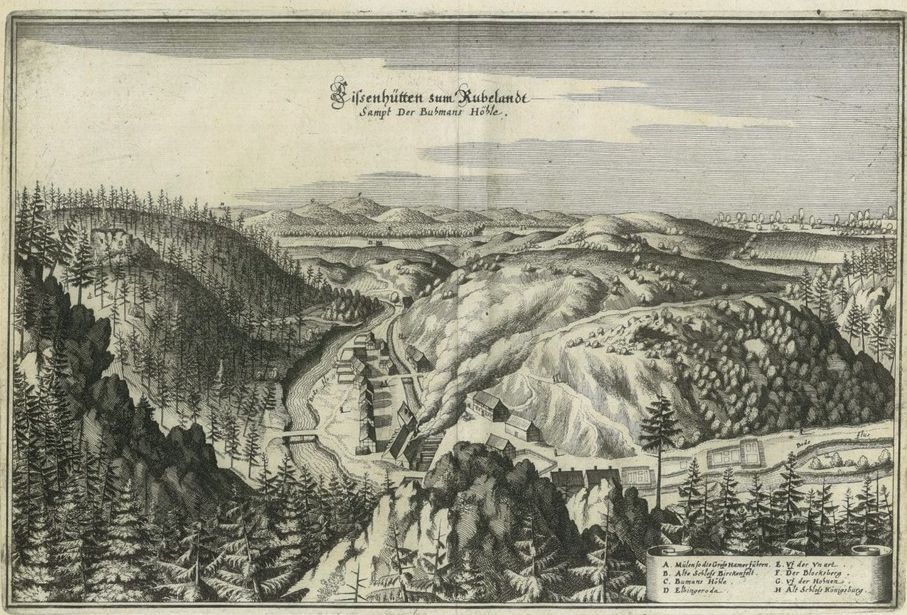
We’re looking down at Rübeland from the graceful pavilion on the Hoher Kleef. The River Bode flows below. Down there, right by the road, you can also see the low white building with the entrance to the Baumann’s Cave. Our comparative painter’s perspective from the famous publisher Matthäus Merian is more than 350 years old, and we need to orient ourselves a little first. Did you spot the old entrance to the Baumann’s Cave in the picture – a dark opening on a mostly treeless slope, about 150 metres in a straight line above today’s entrance? Nowadays, this old entrance is sealed and lies hidden under trees and hedges on the steep slope of the Chimney Sweep Hill.
The Baumann’s Cave was, alongside the Brocken, the most important sight in the Harz region. It could only be entered by crawling, and there were five chambers open to visitors. In 1788, the Bielstein Cave, now sealed, was opened, and in 1866 the Hermann’s Cave was discovered during road construction work. More beautiful stalactites were found there – those in the older cave had already been damaged or stolen. The Baumann’s Cave lost some of its appeal. Desperate, people dug further and found new cavities, keeping public interest alive and investing in stairs, railings, and electric lighting. In 1929, the 74 m long entrance tunnel was completed. From then on, Baumann’s Cave also had an entrance directly from the road. Around 200,000 people visit the Rübeland caves every year.