© Fotoweberei & Schloß Wernigerode GmbH

Marble Mill near Rübeland

1765

The motif

This location at the Marble Mill has fallen into oblivion today. But anyone who wanted to reach the Brocken from the east—and there were many—could use the paths up along the Bode from Wendefurth. Inevitably, on reaching Rübeland, they passed not only the Baumann and Bielstein caves but also, shortly before, the marble quarries and the Marble Mill. That’s why there are particularly old, numerous, and beautiful painter’s views here. In 1855, the 'Guide through the Harz' stated: “Numerous depictions prove that this area is a favourite spot for painters.”

In the mill, marble was cut, ground, and polished using hydropower, then transported away by carts—the path is wide enough for that. Either along the Bode to Rübeland or via Kreuztal to Hüttenrode and on to Blankenburg. The mill building still exists, though altered. It stands where the Kreuztal flows into the Bodetal and today’s B 242 makes a sharp bend. The previously treeless area around the mill has been reclaimed by nature; a little hidden stands the yellow sign of a Dennert pine telling the mill’s story. According to it, the mill was in operation from 1719 to 1889. The marble processed there was of outstanding quality and even used in palaces.
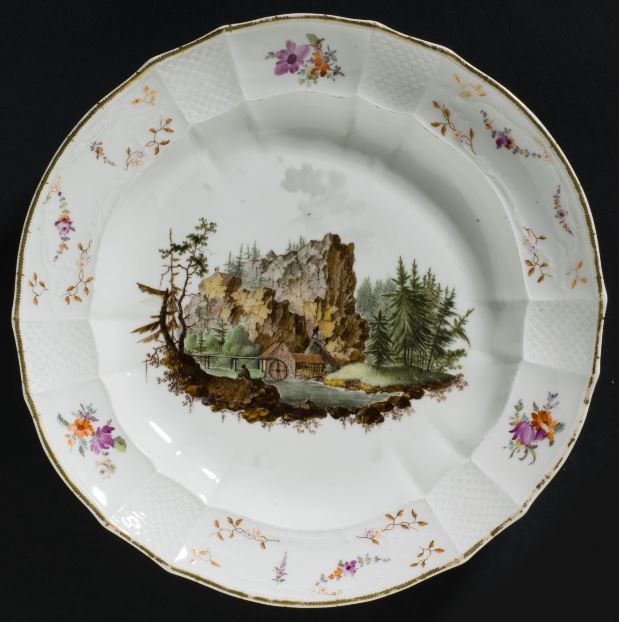
Marmormuehle, Weitsch
© Historisches Museum Hannover
Pascha Johann Friedrich Weitsch

Artist

1765

created

on a plate from the Fürstenberg porcelain manufactory

Diameter 24.3 cm, height of the view 4.2 cm

Historical Museum Hannover

Inv. no. VM 028668

Hiking tip

The Marble Mill is only a few metres away from the Harzer-Hexen-Stieg; just cross the Bode towards the B 245. You could climb the Krockstein or go on a circular hike to Rübeland via the Blue Lake and enjoy the view from the Schornsteinfegerberg. (8 kilometres)

From a travel guide of 1855

The 1855 travel guide also says: “The path from Rübeland to Blankenburg at first follows the course of the Bode and is one of the most delightful that can be found. (…) Thus we reach the bridge that leads across the Bode at the Marble Mill to Kreuzthal and to the small Brunswick smelting village of Neuwerk. One should not fail to pause for a moment before this bridge to take in the picturesque view offered by the magnificent marble wall behind it, further enhanced by the Düval Cottage — a pavilion built by a court agent named Düval on one of the rocky peaks — by the Marble Mill at the foot of the cliffs, and by the charming little houses of Kreuzthal peeping out from the trees on the opposite bank.”

About the artist

The deserted landscape is a more recent romantic invention, and even there, painters arrange it for us. In the works of painters from earlier centuries, even supposed wilderness is characterised by human activity as an inhabited place; mills are popular motifs. The landscape painter from Brunswick, Pascha Johann Friedrich Weitsch (1723–1803), also followed this tradition. His uncommon first name is a short form of ‘Paschalis’, still known today as Pascal, meaning ‘born at Easter.’

Since 1756, Weitsch had been employed in Fürstenberg as a porcelain painter and worked there for twelve years as both a trainer and quality inspector. From 1763 onwards, he repeatedly travelled through the Harz mountains, drawing with great enthusiasm — more than 50 of his drawings have survived. His modest porcelain painting from 1765 was a sensation. Usually, the highly specialised porcelain painters created flowers, animals, decorations, or even composed landscapes only based on templates. For the first time in Germany, a prince had his own local landscapes depicted on his dinner service. What was unusual: the initiative had come from the painter himself. The service was produced at the Fürstenberg porcelain manufactory in the Duchy of Brunswick-Lüneburg — naturally also because the Harz belonged to the duchy and thus displayed its territory on the porcelain. Finally, in 1768, Weitsch was able to make a living from his painting and leave his position at the porcelain manufactory. He was 45 years old at the time.

About Rübeland marble from a travel guide of 1824

Niemann’s travel guide from 1824 reports more about the marble processed here:
“Marble mill, over half an hour from Rübeland, in a romantic area where the iron ore fades into the marble of the Krockstein and also appears in nests within the marble itself. In the marble, especially the brown‑coloured kind, you can find many fossils of shells and sea creatures, as well as curious natural formations. On a red marble slab you can see the figure of a woman holding a mirror in her hand; on a black‑grey slab, a running dog and a sitting bird; and on a multicoloured one, the figure of a spinner. A water wheel sets the saws in motion, which cut the marble into slabs of various sizes, and on the upper floor the hollowing and carving with chisels take place.”

For comparison

Pascha Johann Friedrich Weitsch, View of the Marble Mill, around 1760, graphite on laid paper, 30 x 43.4 cm, Herzog Anton Ulrich Museum Braunschweig, Z WB XII 61

Marmormuehle, Weitsch
© Herzog Anton Ulrich-Museum Braunschweig

This is a quick sketch on rather large-format paper, for which suitable folders had to be carried along when hiking. Weitsch was one of the first artists to explore the Harz systematically through drawing, thus passing on valuable details to us, such as the simple wooden bridge over the Bode, which already existed at that time. Today there is a stone bridge at this spot.

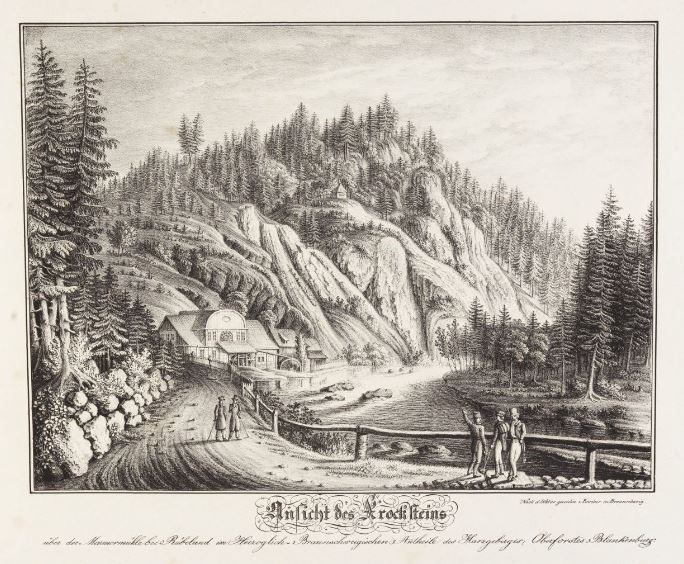
Karl Dietrich Pirscher, Marble Mill at Krockstein, around 1828, lithograph, image size 27.4 x 36.5 cm, Herzog August Library Wolfenbüttel, Top 18a:25

Marmormuehle, Pirscher
© Herzog August Bibliothek Wolfenbüttel

At the same spot where Johann Friedrich Weitsch once stood, more than half a century later another draftsman from Brunswick captures and passes down a scene that has changed only slightly. Karl Dietrich Pirscher (1791–1857) worked as a clerk, doing copying tasks. Drawing and painting were side pursuits for him. In 1820, he introduced the first lithographic press in Braunschweig for printing forms, which he later used for artistic works such as his fascinating views of the Harz region. The Schenk bookshop had previously needed to have its works produced in Berlin, since there had been no lithographic press and no skilled lithographers in Braunschweig. With Pirscher, that changed.