© Fotoweberei & Schloß Wernigerode GmbH

Marble Quarry at Krockstein

1812

The motif

The location of the Painter’s View can be found on the Krockstein, not far from the Krockstein viewpoint, which offers a wide view towards the Brocken. Right there, where the distinctive yellow sign of the Dennert fir tree tells the history of the Krockstein quarries. There has been much speculation about the exact spot where Caspar David Friedrich drew in June 1811. But it must have been here, because from Rübeland to the Brocken along the Bode runs a historic painter’s trail, and there are even print representations of this quarry.

Caspar David Friedrich is certainly the most important German landscape painter of the Romantic period. He came from Greifswald but spent most of his life in Dresden. Two carefully made drawings of the marble quarry have survived, which he created on two consecutive days. They show how fascinated he was by the dark, cool cave-like hollow of a quarry. But he didn’t immerse himself in the subject for tourism or to sell it as a view. The motif inspired him to convey messages that speak directly to us and our lives. That is what makes him so great – and many people still feel that today.

By the way, the marble from the quarries near Rübeland was highly valued. It wasn’t pure white, but ranged in shades of red and brown. There were three quarries on the Krockstein, which were operated from 1715 to 1889. It was further processed in the nearby marble mill.
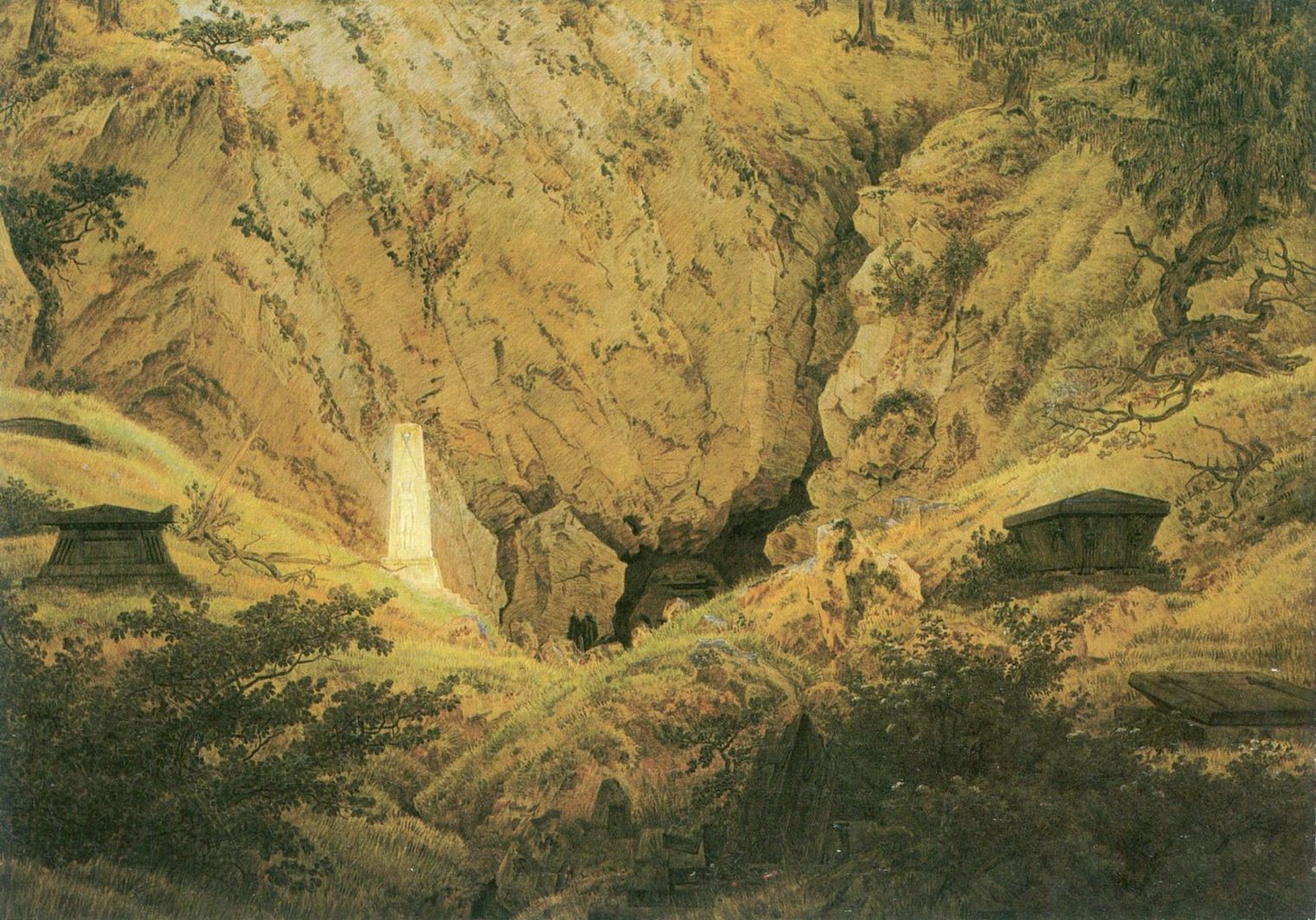
Marmorbruch von Friedrich
© wikimedia
Caspar David Friedrich

Artist

1812

created

Oil on canvas

49.5 x 70.5 cm

Hamburg Kunsthalle

on display in the permanent exhibition

Hiking tip

This painter’s view is best reached from Rübeland after about an hour’s walk. First, follow the Harzer-Hexen-Stieg to Neuwerk, then cross the Bode in the village and continue uphill on the marked hiking trail to the Krockstein.

About the artist

Caspar David Friedrich (1774–1840) painted the famous work “Tombs of Ancient Heroes” just one year after his Harz hike with the marble quarry motif. It was the time of the French occupation, which Friedrich despised, and the marble quarry provided the right setting for a call to resistance: the rocks – filling the entire picture, without the sky that is usually so fascinating in Friedrich’s works – block the two French soldiers from moving forward; a cool breeze blows towards them from the dark cave opening. Next to it stands a white grave monument of the Germanic hero Arminius. He defeated the Romans in 9 AD, which, as is well known, happened in the Teutoburg Forest and not in the Harz mountains. But that wasn’t Friedrich’s concern; he didn’t want to paint a landscape view but rather express his thoughts in pictures. That is also why other old and new memorials remind us that sacrifices must be made for the continued existence of the German community.

Nine years later, Friedrich painted a completely different message, as it was by then the period of restoration. The cave becomes a place of refuge for two wanderers. Finally, he repeated the motif once again two years before his death.

For comparison

Caspar David Friedrich, Marble Quarry near Rübeland, 27 June 1811, pencil, watercolour, pencil grid, the intersections partly pierced with a needle, 19.2 x 24.5 cm, Albertina Vienna, Inv. No. 28628

Marmorbruch, Friedrich
© Albertina Wien

Caspar David Friedrich created very meticulous nature studies in the Harz Mountains, but he never painted a recognisable view, a so-called veduta. His demand of painters applies above all to himself: “The painter should not only paint what he sees before him, but also what he sees within him. But if he sees nothing within him, then he should also refrain from painting what he sees before him.” In this way, throughout his life, he was able to retrieve his nature studies like a collection of inner experiences and connect them with new messages.

Caspar David Friedrich, Harz Cave (Marble Quarry in the Harz), around 1837, brush in brown over pencil on laid paper, 34.2 x 43.8 cm, Royal Library Copenhagen, Sign. I, 3a-3 

Marmorbruch, Friedrich

Towards the end of his life, around 1837, Caspar David Friedrich painted the quarry once more on a large scale using brush and brown ink. It was a commission from the Danish Prince Christian Friedrich, later King Christian VIII. The section is taken smaller, the cave very close up, without people, rendered with almost painful precision in the details and in the contrast between the brightest light and the darkest brown. The darkness of the cave exerts a dangerous pull, while the sunlit landscape outside promises life. The depiction allows for an interpretation as an allegory of the two poles: life and death.