© Fotoweberei & Schloß Wernigerode GmbH

Scharzfeld Unicorn Cave

1780

The motif

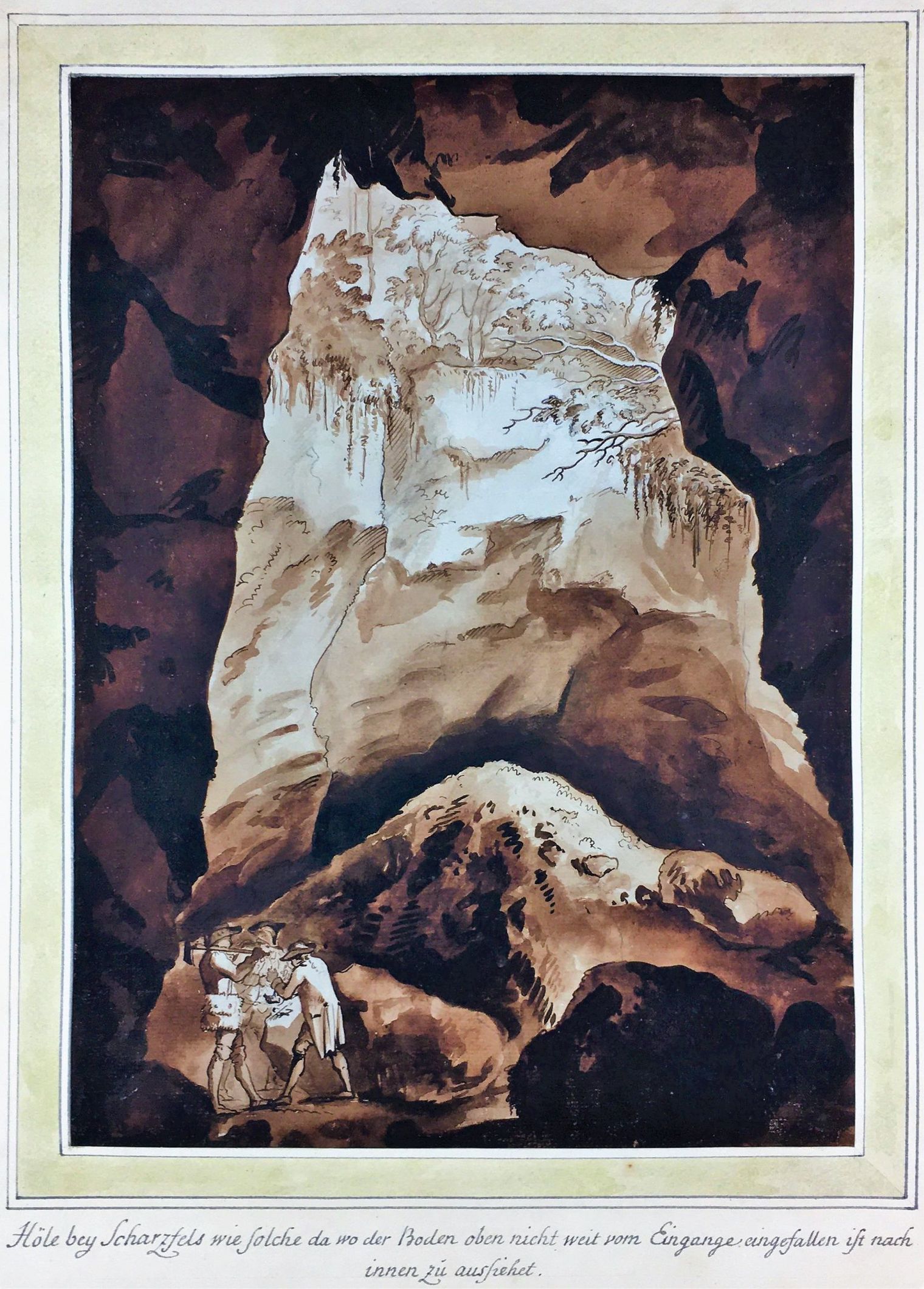
Our location is the historic, no longer used entrance to the Einhornhöhle. During a cave tour, you can stand below and look up in wonder. The charm of this cave lies precisely in its above-ground entrance. It is situated right next to the main path coming from Scharzfeld, which was even paved in 1840 for a royal visit. Today, this old entrance is protected by a tall fence and a video camera. Then as now, it is surrounded by beautiful beech mixed forest. A quick pen-and-ink drawing from 1780 shows it from the outside at about half height – the artist thus has the present iron gate behind him – trees above, then a pile of rock and cliff, one person still on the steps, two others already on the ground searching for bones. For palaeontology, the science of fossilised bones and fossils, the cave was and still is an inexhaustible subject.

People believed that the fabled bones of the never-proven unicorn had been found here. Ground up and mixed with water and red wine, they produced the miraculously healing unicorn milk or unicorn blood. This gave the “Dwarves’ Cave” or “Scharzfeld Cave”, as it was previously called, its name and kept drawing people here again and again. Einhorn Cave and Baumann’s Cave are the two oldest known caves in the Harz Mountains.
Einhornhöhle, Ramberg
© Niedersächsisches Landesmuseum, Foto: Dr. Karl Sanders
Johann Heinrich Ramberg

Artist

1780

Created

Brush, brown wash on vellum

27.1 x 36.9 cm

Lower Saxony State Museum

On loan from the Museum August Kestner, Hanover, Inv. No. P. Hz. 203

Hiking tip

Today's access to the cave is located directly on the Karst Hiking Trail (a white K on a red square) and can be reached through a tunnel built about 100 years ago. A visit to the cave can easily be combined with a hike to the Rock Church and to Scharzfeld Castle, which are both located along the Karst Hiking Trail. Also very interesting is a half-hour circular walk around the cave, passing the fire pits and another, now collapsed entrance used by Neanderthals, who are known to have lived here since the Old Stone Age.

About the artist

Johann Heinrich Ramberg (1763–1840) from Hanover, only seventeen years old at the time, made more than twenty drawings during his journey through the Harz Mountains in 1780, which he took together with the older and more experienced painter Johann Friedrich Weitsch. Boldly, he put the sheets into a folder and had them presented to the English king through the Hanoverian envoy. Well, his father was a commercial councillor and had good connections. The plan worked. The king was so impressed that he allowed the talented young man to study at the Royal Academy in London. Ramberg stayed there for nine years, and after his return he became a successful draughtsman and illustrator – and something new for Germany at the time: a caricaturist. He captured the tastes of an entire generation and became one of the great artists of his era.

For comparison

Johann Friedrich Ramberg, Unicorn Cave from the inside, 1780, brush in brown, washed on vellum, 26.6 x 28.8 cm, Lower Saxony State Museum, on loan from the Museum August Kestner, Hanover, Inv. no. P. Hz. 204

Einhornhöhle, Ramberg
©  Niedersächsisches Landesmuseum, Foto: Dr. Karl Sanders

This drawing shows the view from inside the cave, looking back towards the old entrance. You can have this view at the end of a modern cave tour; the hall is called the Blue Grotto. In 1780, however, this was the porch. The pointed rock in the foreground, shining in the sunlight, is called Schweinsrücken. The incidence of daylight still makes this space so enchanting today, because the meeting of the cave’s cold air with the outside always creates mist. Johann Wolfgang Goethe already noted about it: “Limestone cave lit from above; picturesque effect”.

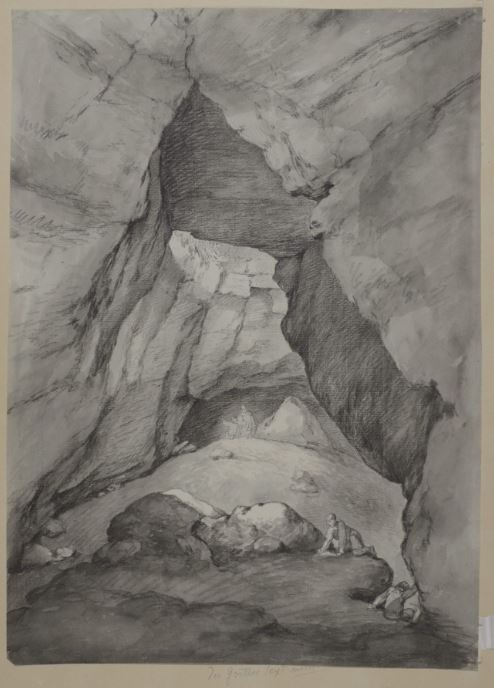
Georg Melchior Kraus, Unicorn Cave from the inside, 10 August 1784, drawing in black chalk, partly smudged, 20 x 32.8 cm, Klassik Stiftung Weimar/Museums, Goethe’s property, Inv. no. KHz/AK 2420 

Einhornhöhle, Kraus
© Einhornhöhle, Kraus

The sheet was created on the occasion of Goethe’s third trip to the Harz, which he undertook with Duke Carl August, Georg Melchior Kraus and Baron von Stein. Kraus also included these four people in his picture. Otherwise, he focused on the geological aspects, the dolomite rock of the Harz, the clay on the ground, washed out many millions of years ago. The cave had long lost its stalactites, as they had already been broken off — they were thought to come from unicorns.