© Fotoweberei & Schloß Wernigerode GmbH

Sangerhausen from the east (Rosarium)

1838

The motif

This painter’s view lies in front of today’s city entrance to the Rosarium. It takes you back to a time when the Rosarium didn’t exist yet. But this was Sangerhausen’s area for walks, and therefore also for painters, with its ponds. Citizens of the town who were passionate about roses founded the city park more than 100 years ago, from which the city’s main attraction today, the Rosarium, developed. The town and the Rosarium therefore belong together.

Adrian Ludwig Richter was here in the summer of 1836. The Riestädt Gate, demolished from 1821 onwards, had left a gap, and today’s Bergstraße was bare and undeveloped. The painting shows, from left to right: the tower of the Old Castle, then the Jakobi Church, and in front of it the old Romanesque Ulrich Church. In the background are the Kyffhäuser heights, crowned by the towers of Rothenburg and Kyffhäuser Castle – the well-known monument was built much later.

The painting is an invitation to take a walk through the town. Old and young rose bushes can also be admired in the city. One tip is the path through the Husaren Gate, up to the southern city wall with a lovely view of the old town. Crossing the small river Gonna, you go north out of the city centre and up into the Spengler Park, shaded by tall trees, with the Spengler Museum, which, by the way, can secretly be compared with the famous Natural History Museum in Berlin! Here, you can also see the originals of our two views.
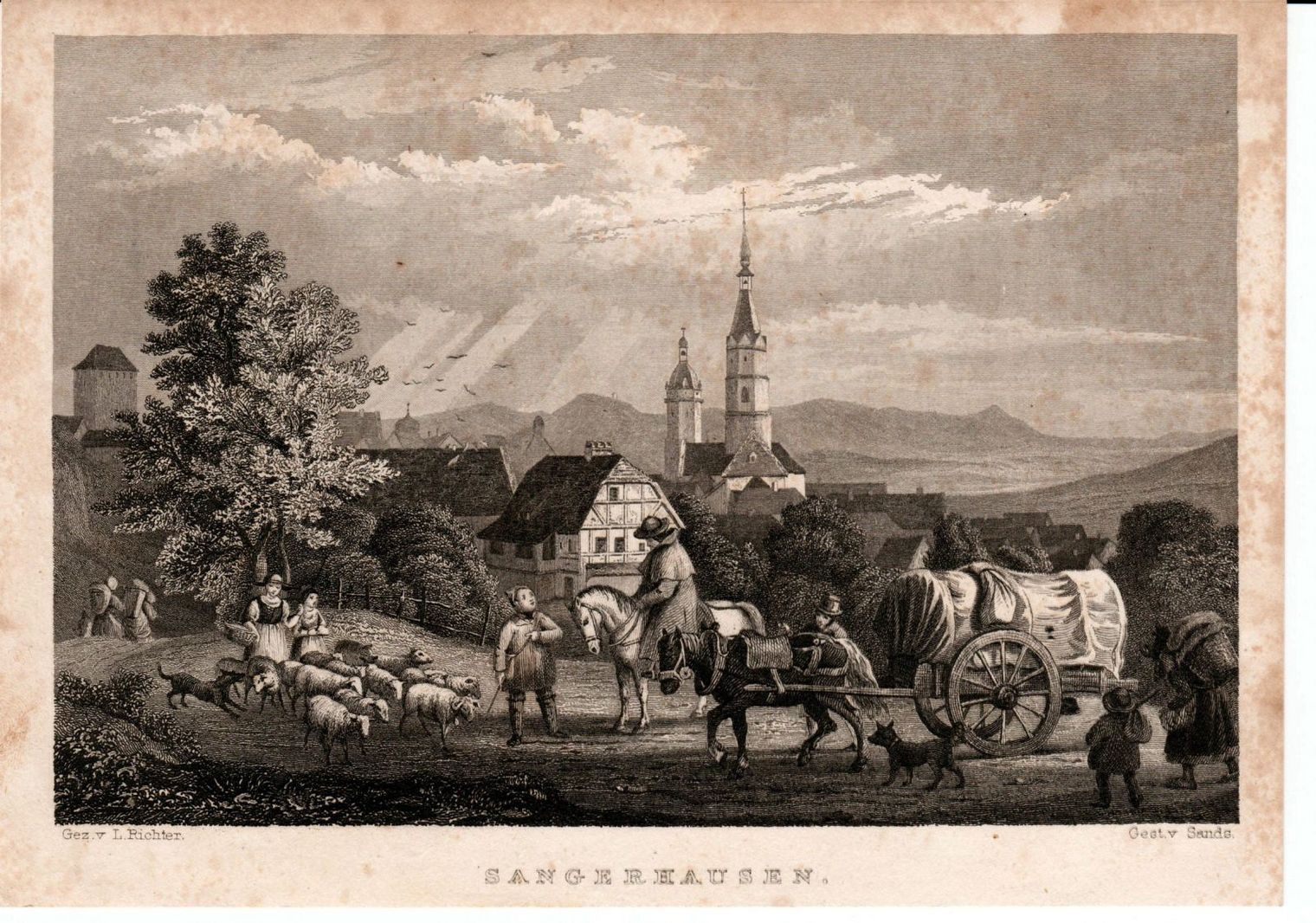
Sangerhausen, Richter
© Schloß Wernigerode GmbH
Robert Sands after Adrian Ludwig Richter

Artist

1838

created

Steel engraving

Print size 12.0 x 16.8 cm

from:

Wilhelm Blumenhagen, The Harz, in: Picturesque and Romantic Germany, published in Leipzig by Georg Wigand, 1838, from the collections of Schloß Wernigerode GmbH, Bürger Collection

Hiking tip

The surroundings of Sangerhausen are more picturesque than you might think. You can choose between five circular hiking routes. Everywhere you look, the cone of the Hohe Linde north of Sangerhausen catches your eye. The mountain has grown since 1955 as a spoil heap from the now closed copper mining operations, bearing witness to a long industrial history. It will take decades before vegetation grows on its slopes, but it has the potential to become the city’s most famous viewpoint one day! If you arrive by train, you’ll be welcomed by the bright, modern, and beautifully restored station building from 1963, the heyday of copper mining.

About the artist

Adrian Ludwig Richter (1803–1884) didn’t want to simply copy, etch and colour mechanically like his father and teacher of copper engraving. He wanted to express feelings. That’s why he started landscape painting at the Academy in Dresden, then went to Italy with a scholarship from the publisher Arnold from Dresden, and even achieved some success. But for eight years he had been stuck in Meißen as a teacher at the porcelain manufactory; there was little time for painting and it didn’t earn any money. He had three children, his beloved wife was ill, and the money wasn’t enough. That was when the turning point came. He received a commission that also took him to the Harz Mountains in the summer of 1836. In his memoirs, he described how this came about.

From then on, Richter mainly drew designs for prints, which made him famous. Because he observed poor people and painted comfort into his pictures. Late Romantic idylls that struck a nerve. One such scene is also told in the foreground of the Sangerhausen sheet: the rich man beside the carriage comes out of Christian charity to take the poor widow from Sangerhausen and her daughter to better circumstances in Osterode. It’s understandable that the artist handles the topography with some artistic freedom for the sake of a harmonious composition.

From the memoirs of Adrian Ludwig Richter

“One day Arnold [my publisher] came to me with an unusually sullen expression and confronted me, saying that I must have given a Leipzig publisher, Georg Wigand, my permission to copy some of the brochures of Saxon Switzerland from his publishing house. I was neither acquainted with the said publisher nor with the work in question, but I could well understand how Papa Arnold, who had already often and badly suffered from reprints, must have become embittered through infringements of his rights. It was easy for me to make him see that I had no involvement in this matter, and we parted on our usual friendly terms. As he then threatened Wigand with a lawsuit, Wigand came to Dresden, and the two men settled their dispute. On this occasion Wigand visited me; he, still quite unfamiliar at the time with art and artists, had first learnt of my existence in Dresden through Arnold. He told me that the dispute with him had been about using a few plates of ‘Views of Saxon Switzerland’ for his copperplate series ‘Picturesque Romantic Germany’, which was then in preparation; he had sent the plates etched by me to London, to have them translated into a more effective manner for steel engraving, and had had to pay dearly for it. Finally, he asked me whether I would like to draw and execute from nature some of the still missing views for the ‘Saxon Switzerland’ section. Now, back in Rome I had already been thinking about one day creating a work, ‘The Three German Rivers – Rhine, Danube, Elbe’, in which not only picturesque but also historically remarkable regions, towns, castles, monasteries, and so on, in connection with folk costumes, festivals, and customs, were to be worked into a poetic whole. As our conversation went on, I explained this long-cherished favourite idea to Wigand, and with enthusiasm he exclaimed that this was precisely what he had been vaguely envisioning, and he asked me to take on a few parts of the work. We agreed on the sections: ‘Harz’, ‘Franconia’, and the ‘Giant Mountains’, and in this way I came into business contact with Georg Wigand for the first time, and the drawings made for ‘Picturesque and Romantic Germany’ became the bridge to my later compositions for wood engraving. The journeys through those picturesque regions of Germany were mostly carried out on foot and provided my sketchbook and memory with a rich collection of images and experiences of German folk life, which proved highly beneficial to my later work.”

For comparison

A. Deinert after Christoph Agthe, At the Sheep Bridge over the ponds near Sangerhausen, around 1830

Lithograph, sheet size 33 x 47 cm, printed by Robrahn & Co. in Magdeburg, Spengler Museum Sangerhausen, on display in the permanent exhibition

Sangerhausen, Agthe
© Spengler-Museum Sangerhausen

With just a few lines and colours, seemingly effortless yet full of energy, Carl Blechen sketched the Falkenstein. Truly brilliant. He probably had ink colours with such a monochrome palette with him, as he painted a similar sketch in the Selke Valley on 22 September. He must have been travelling for many hours, as we have from him sketches dated 22 September 1833 from the Selke Valley, from Gernrode and from the Bode Valley.

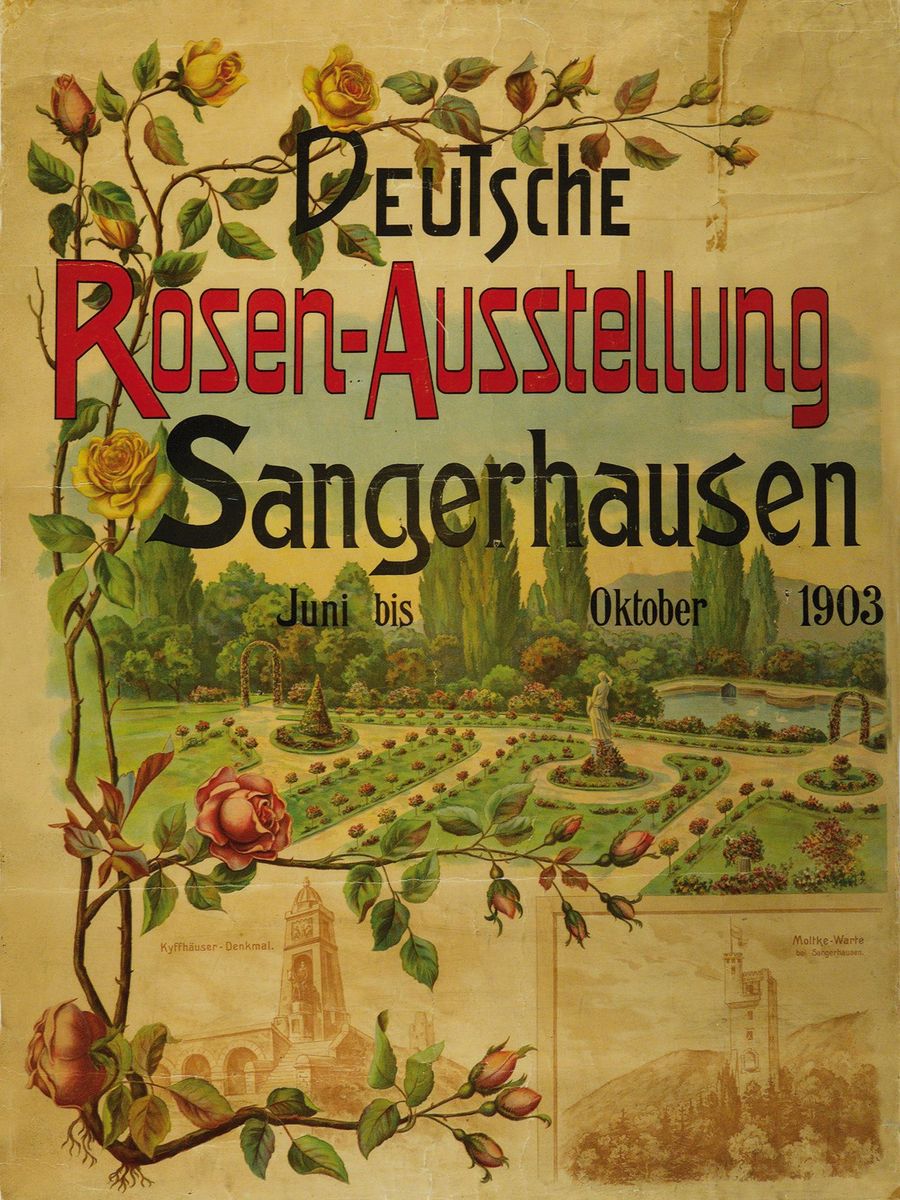
Poster of the Rose Exhibition, 1903, lithograph, approx. 80 x 60 cm, Europa-Rosarium, displayed as a reproduction in the ticket office at the city entrance

Sangerhausen Plakat
© Europa-Rosarium Sangerhausen

This oldest known artistic depiction of the Rosarium was not photographed like our modern posters, because painting allowed the special features to be shown more clearly and, above all, in colour: the rose beds and one of the ponds. In 1896, 76 citizens of Sangerhausen founded a beautification society and wanted to create a city park by the three ponds at the Röhrgraben, which had always been a popular place for walks. With their botanical knowledge and rose cultivation, they gave it its character. In the meantime, the grounds have more than quadrupled in size, becoming the world's largest rose collection. The scent and beauty of the blossoms attract 100,000 visitors every year. The pavilion with the number 1898 on the weather vane marks the boundary of this lower-lying oldest part.